
AAC Home Carryover Activities Families Can Use Daily
Discover AAC home carryover activities that help families model core vocabulary at home. Try Little Speech Corner
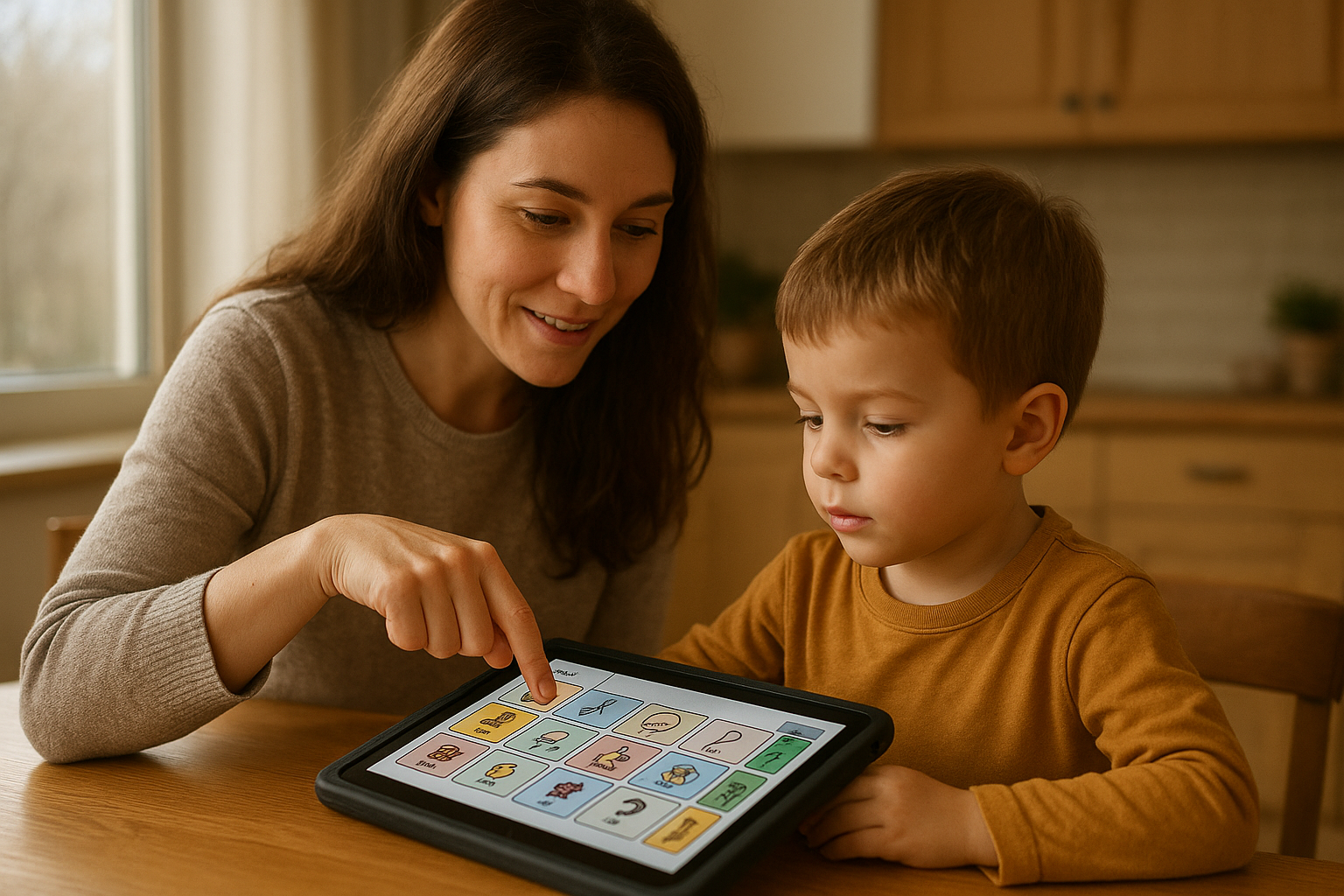
AAC home carryover activities give families simple, repeatable ways to use a child's communication system outside of therapy sessions, turning daily routines into real practice opportunities. For many children who rely on augmentative and alternative communication, or AAC, the biggest gains happen not in a therapy room but at snack time, bath time, and bedtime, when a caregiver models a core word on the device instead of speaking for the child. This guide from Little Speech Corner walks through what AAC home carryover activities are, why they matter, and how the Read, Model, Play approach makes carryover realistic for busy households.
Quick Answer: AAC home carryover activities are everyday moments, like meals, bath time, and play, where a caregiver models core words on a child's AAC system. Consistent short practice at home helps a child generalize communication skills beyond the therapy room.
What Are AAC Home Carryover Activities?
AAC home carryover activities are the small, repeated moments when a family member models language on a child's AAC system during normal daily life. Unlike formal therapy, these moments require no special equipment beyond the device or board the child already uses.
Augmentative and alternative communication, according to the American Speech-Language-Hearing Association's description of AAC, covers any tool or strategy that supports or replaces spoken language, from picture boards to speech-generating devices. Carryover simply means practicing those tools in places other than the therapy setting, such as the kitchen table or the living room floor.
Because children spend far more hours at home than in therapy, this everyday modeling often determines how quickly a core word becomes a word the child actually uses on their own.
AAC home carryover activities often happen in ordinary moments, like modeling a core word during breakfast.
Why AAC Carryover Matters at Home
Therapy time is limited, usually just one or two sessions a week. In contrast, home routines happen every single day, which makes them a powerful setting for language growth.
Research summarized by the CDC's early childhood developmental milestones resource notes that consistent, responsive interaction across settings supports stronger communication development overall. Similarly, AAC carryover at home gives a child many more repetitions of a core word than a single weekly session ever could.
In addition, children often generalize new skills faster when they see the same word modeled by different people in different places. For example, a child who sees "more" modeled by a parent at snack time, a teacher at lunch, and a grandparent during play is more likely to start using that word independently.
Therefore, AAC carryover is not an optional extra. It is often the piece that turns a therapy goal into a real, usable skill.
The Read, Model, Play Approach for Home AAC Practice
Little Speech Corner's Read, Model, Play approach was designed with exactly this kind of home AAC practice in mind. A short Core Story, often about five minutes long, offers shared reading and core-vocabulary modeling before moving into interaction and child-led play.
This structure matters because it gives families a clear, low-pressure starting point. Instead of guessing what to model, a caregiver reads a brief story that already highlights one core word in context, then follows up with play that naturally repeats that same word.
As a result, AAC modeling at home feels less like a task and more like a shared activity. The story provides structure; the play that follows provides flexible, child-led repetition.
For a closer look at how stories specifically support core-word learning for AAC users, see this guide on using stories to teach core words to AAC users.
7 AAC Home Carryover Activities to Try This Week
The following numbered sequence offers a practical starting point. Specifically, it walks through how to pick a routine, choose words, and build consistent modeling over time.
- Choose one routine. Pick a daily routine that already happens without fail, such as breakfast, bath time, or a car ride, and plan to model AAC during that specific moment.
- Pick one or two core words. Select a small number of words that fit the routine naturally, like more, done, or help, instead of targeting many words at once.
- Model before expecting output. Point to the words on the child's AAC system yourself first, showing them how it works without demanding an immediate response.
- Pause and wait. After modeling a word, pause a few seconds to give the child time to imitate, select a symbol, or respond in their own way.
- Add a short shared story. Read a brief, illustrated story that highlights the same core word, reinforcing the vocabulary through repeated exposure in a new context.
- Move into child-led play. Follow the child's interests and keep modeling the same words as opportunities arise, letting the child lead while language support continues.
- Track and repeat weekly. Use a simple planning calendar to note which words were modeled each week, then repeat them for several days before adding new vocabulary.
Notably, these steps work for any family, regardless of which AAC system a child uses. They also pair well with classroom strategies described in this roundup of AAC activities for preschool speech therapy sessions, since consistency between school and home tends to accelerate progress.
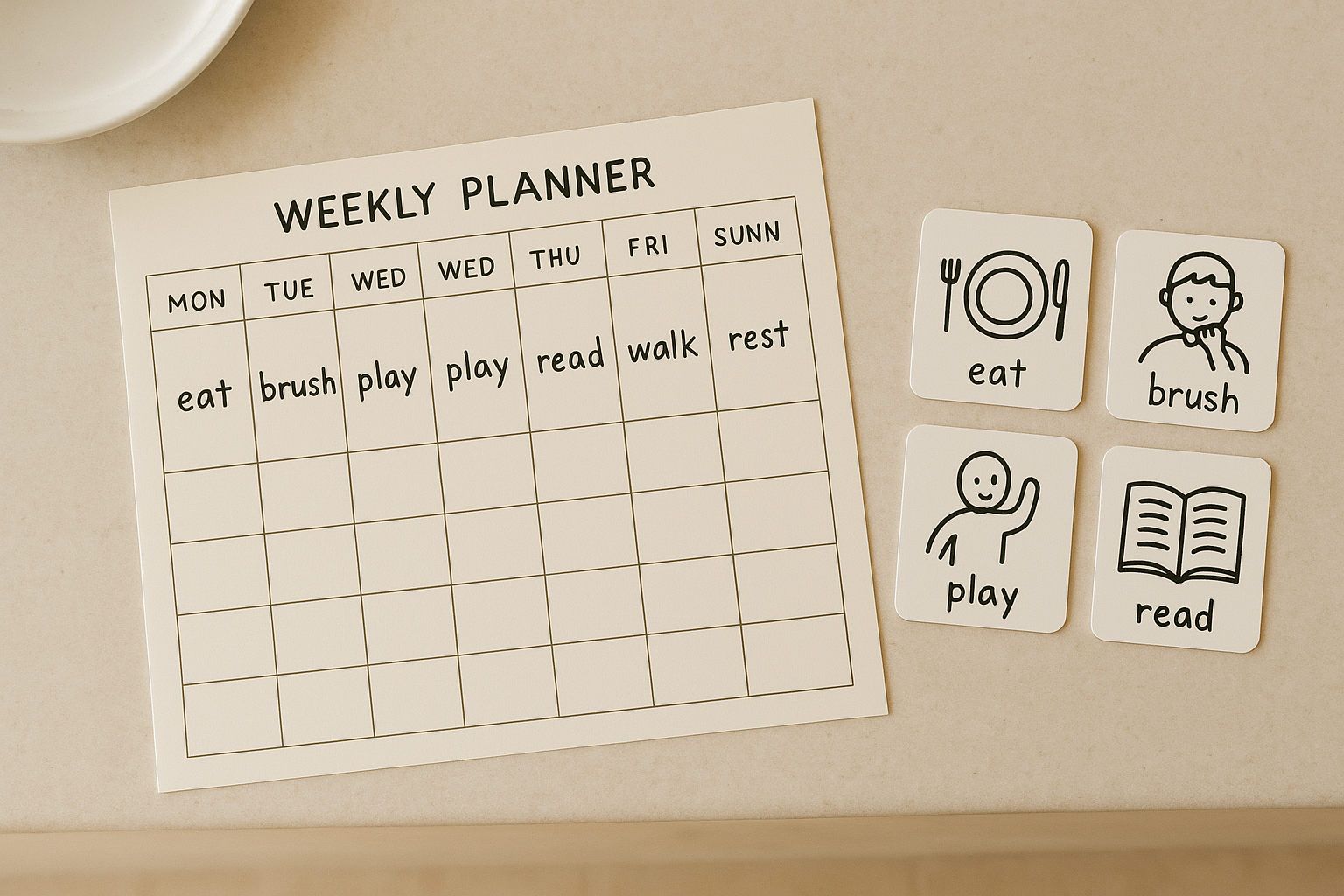
A simple weekly calendar helps families keep AAC home carryover activities consistent.
Using Core Stories to Model AAC Vocabulary at Home
Little Speech Corner's Core Stories were built specifically to support this kind of home modeling. Each short, illustrated story centers on one core word, giving families and clinicians a ready-made script for Read, Model, Play.
For example, the free sample story Apples for Anna models the word THERE, offering an easy entry point for families who are new to AAC home carryover activities. Because the story is brief, it fits naturally into a busy evening without feeling like extra homework.
For broader coverage across a full year, the Core Stories Foundational 53-Pack connects 53 stories to a suggested Core Word of the Week sequence. Families and teams who want to confirm current included files and licensing details should check the listing directly on Little Speech Corner before purchasing through the Teachers Pay Teachers store.
In addition, the Team Supports collection offers core-word tip sheets designed to help parents, teachers, and therapists stay aligned on which words to model each week, reducing confusion between home and school.
Common Mistakes That Limit AAC Carryover
Even well-meaning families sometimes stumble into habits that slow progress. However, most of these mistakes are easy to adjust once they are recognized.
One frequent mistake is waiting for the child to initiate communication before modeling the device. In contrast, research-informed AAC practice encourages adults to model frequently, whether or not the child responds right away.
Another common issue is trying to target too many core words at once. Consequently, both the adult and the child can feel overwhelmed, which often leads to inconsistent practice.
Finally, some families treat the AAC device as something only used in therapy. Above all, carryover works best when the system travels with the child into play, mealtime, and everyday conversation.
Building a Simple Home AAC Routine
A sustainable home AAC routine does not need to be elaborate. In fact, simplicity is usually what makes it last.
Start by anchoring practice to one or two existing routines, then layer in a short story and a few minutes of play, similar to the structure described in this collection of play-based language activities for speech therapy. Over time, families can expand to additional routines as modeling starts to feel natural.
For ongoing ideas specific to AAC, the Little Speech Corner AAC blog category offers additional strategies and product-based tips tailored to home and classroom carryover.
Ultimately, the goal is not perfection. Rather, it is steady, repeated exposure that gives a child many chances to see core words used in meaningful ways.

Child-led play gives natural chances to repeat core words after a short Core Story.
Frequently Asked Questions
What are AAC home carryover activities?
AAC home carryover activities are everyday routines where a family member models core words on a child's AAC system outside of therapy. They turn ordinary moments like snack time or bath time into real communication practice.
How do I start AAC carryover activities at home?
Start small by choosing one or two core words to model during a routine you already do every day, such as mealtime or playtime. Keep the AAC system nearby and model the word yourself before expecting the child to use it.
Why is home carryover important for AAC users?
Therapy sessions happen for a short time each week, but communication needs occur all day long. Consistent modeling at home helps children generalize core words across people and places, which speeds up real-world progress.
What is the difference between AAC carryover and AAC therapy?
AAC therapy is structured practice guided by a speech-language pathologist, often targeting specific goals. AAC carryover is the informal, repeated modeling families do at home to reinforce those same skills in natural settings.
Do AAC home carryover activities cost money?
Many carryover activities are free and simply use daily routines like bath time, meals, or play. Some families also use affordable printed resources, such as story-based materials, to add structure to home modeling.
How much time should families spend on AAC carryover each day?
There is no required amount of time; even a few short moments of modeling during an existing routine can help. Many families find that about five minutes of focused modeling, repeated across the day, works better than one long session.
What mistakes do families make with AAC carryover?
A common mistake is waiting for the child to communicate first instead of modeling the device regularly. Another is targeting too many words at once, which can overwhelm both the child and the adult.
What are best practices for modeling AAC at home?
Best practices include modeling without always requiring a response, using core words across many activities, and following the child's interests during play. Pairing modeling with a short shared story can also make practice feel natural.
Who should be involved in AAC home carryover?
Anyone who regularly interacts with the child can help, including parents, siblings, grandparents, and babysitters. The speech-language pathologist usually guides which words and strategies to focus on first.
At what age should AAC home carryover activities begin?
Carryover can begin as soon as a child is introduced to an AAC system, which may happen as early as toddlerhood. Little Speech Corner's resources are designed primarily for young communicators ages 2 to 7.
What tools help with AAC home carryover activities?
Helpful tools include the child's own AAC device or board, a visual core-word chart, and short illustrated stories that model vocabulary in context. A simple weekly planning calendar can also keep modeling consistent across settings.
What if my child resists using AAC at home?
Resistance often fades when adults model the system themselves instead of pressuring the child to use it immediately. Keeping sessions short, playful, and low-pressure usually helps children stay engaged over time.
Which core words should I model first at home?
High-frequency words such as more, go, stop, help, and in are useful starting points because they apply across many situations. A speech-language pathologist can help confirm which words fit a child's current goals.
Where can I find ready-made AAC home carryover activities?
Little Speech Corner offers Core Stories and a free sample story called Apples for Anna that model core vocabulary through short, illustrated narratives. These materials are available for preview and download through the Little Speech Corner Teachers Pay Teachers store, accessible from littlespeechcorner.com.
In conclusion, AAC home carryover activities work best when they fit naturally into routines a family already follows. By modeling one or two core words during meals, bath time, or play, and pairing that modeling with a short shared story, caregivers can give a child far more practice than therapy time alone provides. Starting small, staying consistent, and leaning on ready-made tools like Core Stories can make AAC home carryover activities a sustainable part of everyday life rather than one more task on a long list.