
Core Vocabulary Activities for Special Education Classrooms
Explore core vocabulary activities for special education that boost communication through play, Core Stories, and AAC-friendly routines today.
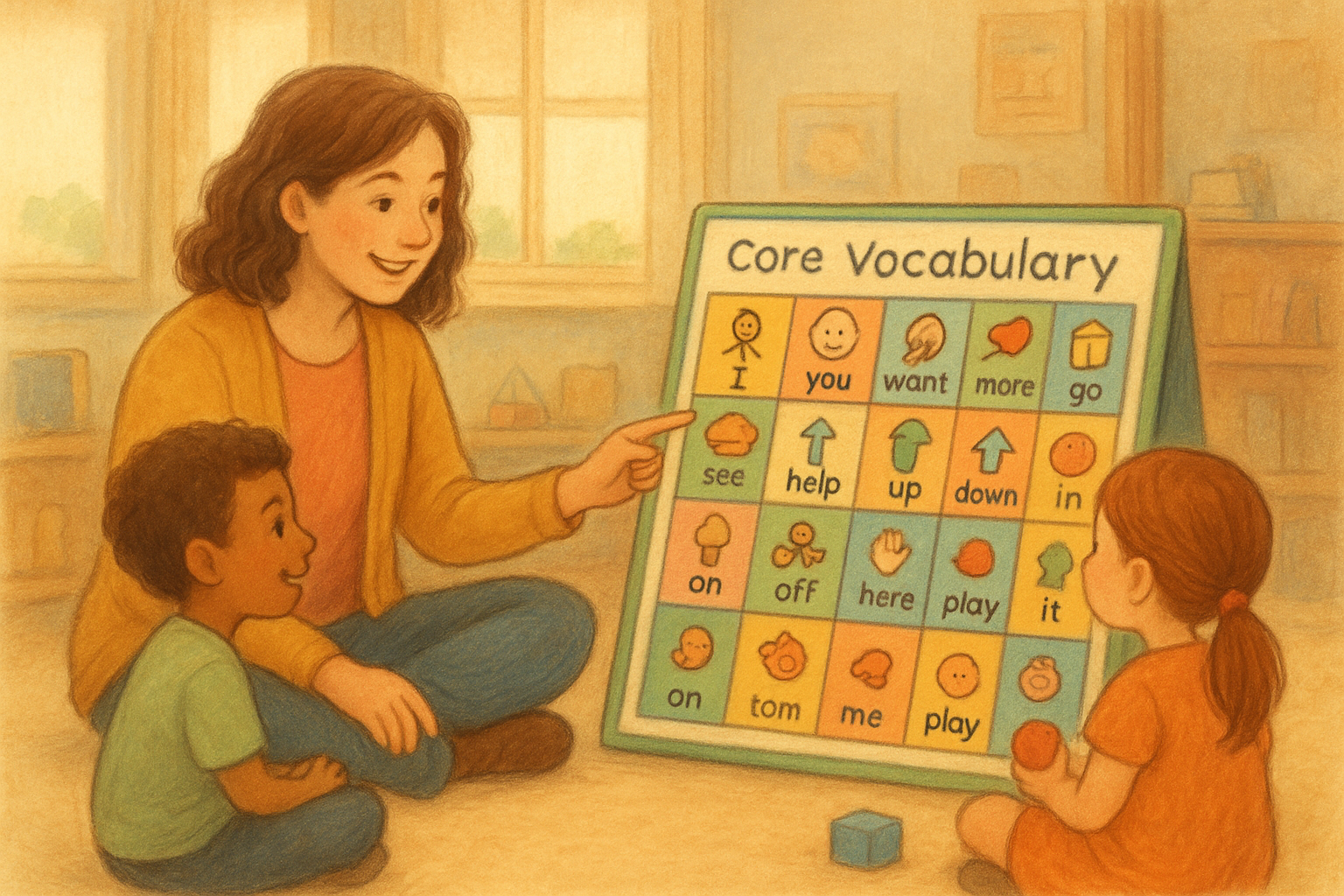
Core vocabulary activities for special education give teachers and speech-language pathologists a simple way to build functional communication using a small set of high-power words like "go," "more," "stop," and "want." Because these words show up across nearly every routine, story, and play scheme, students get far more practice than they would with topic-specific vocabulary alone. In addition, this approach fits naturally into classrooms, therapy rooms, and homes serving children ages 2 to 7 who use spoken words, gestures, or AAC devices.
Quick answer: Core vocabulary activities for special education work best when a small group of flexible words is modeled repeatedly through play, story reading, and daily routines, rather than drilled through flashcards or one-time worksheets.
Modeling core words during play is one of the most effective core vocabulary activities for special education classrooms.
What Are Core Vocabulary Activities for Special Education?
Core vocabulary activities for special education are structured tasks and play routines built around a short list of high-frequency words. Specifically, these words include verbs, pronouns, and descriptors that work across countless contexts, unlike "fringe" vocabulary, which covers narrow, topic-specific nouns like "dinosaur" or "pumpkin."
According to the American Speech-Language-Hearing Association (ASHA), a core set of just 200 to 400 words accounts for the vast majority of everyday spoken language. Therefore, teaching these words first gives students with complex communication needs the most functional return on instructional time.
In special education settings, this often looks like a teacher or SLP modeling a target word during a game, a story, or a transition, rather than asking a student to name or point to it on demand. For example, saying "go!" while rolling a ball teaches the word through natural use, not testing.
Why Core Words Matter for Students With Complex Needs
Core words matter because they generalize. A student who learns "more" can use it for snacks, toys, songs, and swinging, while a student who only learns "cracker" can only use that word for crackers. As a result, core vocabulary instruction gives students a flexible communication toolkit rather than a list of isolated labels.
This matters even more for students who use augmentative and alternative communication, often shortened to AAC, a term describing tools and strategies that support or replace spoken language. Because core words sit at the center of most AAC devices, familiarity with them speeds up navigation and message building.
Similarly, many students receiving special education services also have co-occurring diagnoses, such as autism spectrum disorder, that affect language development. Readers can learn more about that overlap in this guide to autism spectrum disorders and speech.
Choosing the Right Core Vocabulary Words to Target
Not every core word needs to be taught at once. Instead, most teams start with a small, high-utility set: go, stop, more, want, help, all done, and look. These words appear in nearly every classroom routine, from snack time to recess.
Above all, choose words that connect to what already motivates each student. A child who loves bubbles will practice "more" and "pop" far more eagerly than a child asked to label unfamiliar pictures. For a deeper breakdown of word selection and board setup, this core words guide walks through practical examples.
Once a small set feels comfortable, teams can rotate in new words gradually. In particular, adding one or two words per month keeps instruction sustainable for both students and busy classroom staff.
7 Core Vocabulary Activities for Special Education Classrooms
The following activities give teams practical, low-prep ways to model core words throughout the school day.
- Bubble play: Model "more," "go," and "pop" every time bubbles appear.
- Core-word story reading: Pause on repeated core words in a story to model and point to a symbol board, similar to the approach used in Core Stories.
- Obstacle course: Use "go," "stop," "up," and "down" as students move through simple stations.
- Snack time modeling: Model "want," "more," and "all done" during a natural, motivating routine.
- Sensory bin exploration: Model "in," "out," and "find" while students search for hidden objects.
- Music and movement: Pair "go" and "stop" with start-and-freeze songs for repeated, playful practice.
- Core word scavenger hunt: Hide symbols around the room and model "find" and "look" as students search.
Notably, none of these activities require expensive materials. Consequently, they fit easily into busy special education schedules without adding extra prep time.
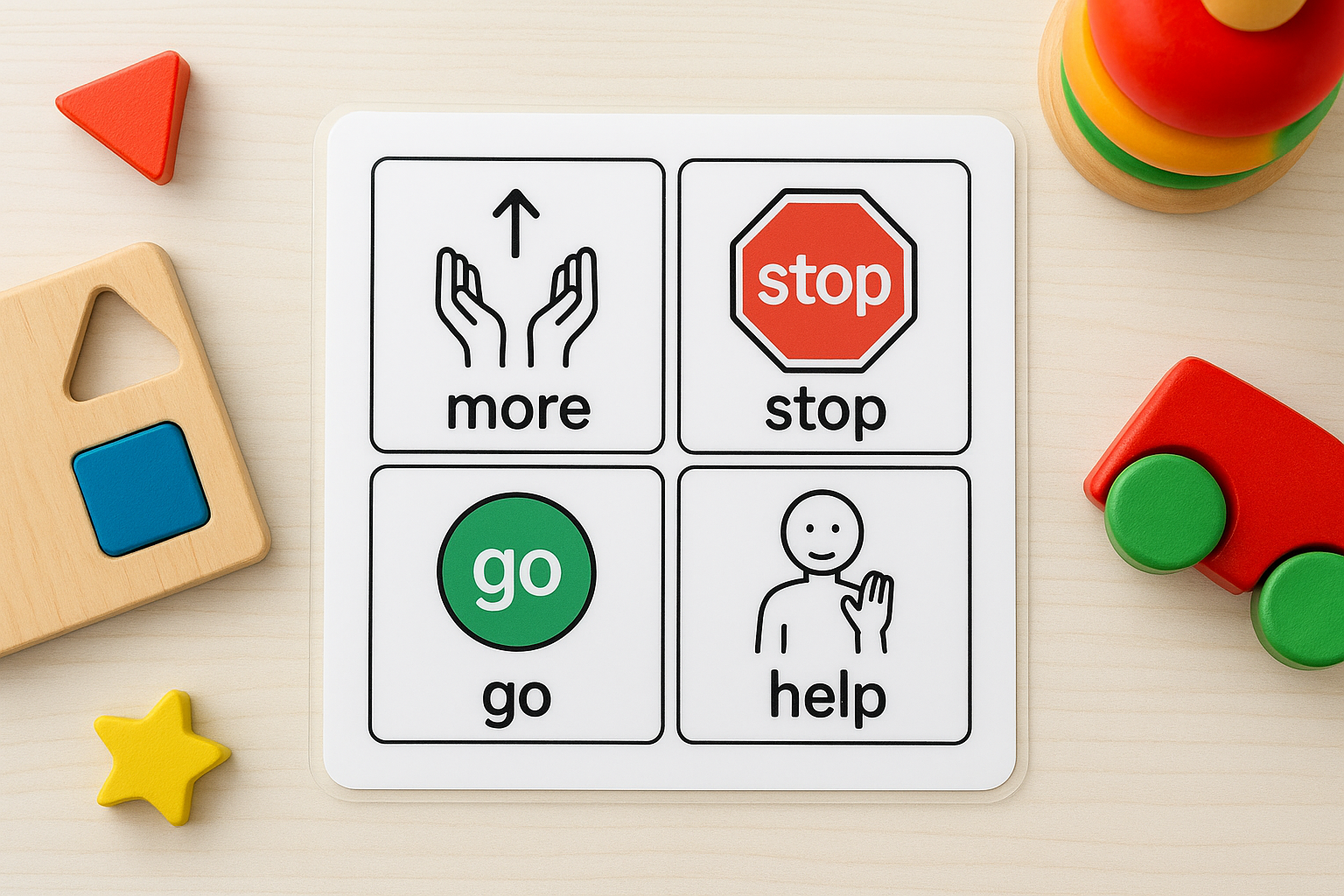
A core word board is a common tool for modeling core vocabulary during hands-on activities.
Using Story-Based Routines for Carryover
Story-based routines give core word practice a predictable structure. In particular, the "Read, Model, Play" approach used in Core Stories pairs a short story with a matching hands-on activity, so students hear a core word, see it modeled, and then practice it immediately through play.
This repetition matters because most students need many exposures to a word before using it independently. For guidance on building this kind of environment at school and home, see this resource on how to create a language-rich environment.
Furthermore, pairing core vocabulary stories with targeted articulation practice, such as the Sound Stories approach, allows one lesson to address both language and speech sound goals at once.
Supporting AAC Learners With Core Vocabulary
Students who use AAC devices benefit enormously from consistent core word modeling. Specifically, when adults point to the same core word buttons during every activity, students learn the device layout faster and build phrases with less frustration.
In contrast, only bringing out the AAC device during "communication time" limits practice opportunities and slows progress. Therefore, core words should be modeled on the device throughout the day, not just during scheduled sessions. This companion guide on AAC covers device modeling strategies in more depth.
According to the U.S. Centers for Disease Control and Prevention (CDC), roughly one in six children in the United States has a developmental disability that may affect communication, underscoring why accessible, repeatable core vocabulary practice matters at scale.
Common Mistakes When Teaching Core Vocabulary
One common mistake is testing students on words instead of modeling them. Asking "what is this?" repeatedly can feel like an interrogation, while simply saying and pointing to the word during play feels natural and low-pressure.
Another mistake is introducing too many words at once. Consequently, students may disengage or stop attending to any of the targets. Above all, keeping the word set small and consistent leads to stronger, faster progress.
Finally, limiting core vocabulary practice to therapy sessions alone restricts growth. In addition, involving classroom teams and caregivers in modeling ensures the words show up across every setting, not just one room.
How to Plan a Core-Vocabulary Calendar for Special Education
A shared calendar keeps an entire team aligned on which words to model each month. Follow these steps to build one:
- Review each student's IEP communication goals and note which core words already appear so the calendar reinforces existing targets.
- Choose four to six core words per month, such as go, stop, more, and want, to keep the workload manageable for staff and students alike.
- Match the chosen words to seasonal stories, classroom themes, or holiday routines so the vocabulary feels relevant across the month.
- Share the finished calendar with co-teachers, related service providers, and caregivers so everyone models the same words consistently.
- Track which words each student begins using independently, then adjust the following month's list to retire mastered words and add new ones.
Teams looking for ready-made planning tools and story-based lessons can explore the free introductory materials available at Little Speech Corner to get started quickly.
Frequently Asked Questions About Core Vocabulary Activities for Special Education
What are core vocabulary activities for special education?
Core vocabulary activities for special education are structured tasks and play routines that teach a small set of high-frequency, flexible words like go, more, stop, and want. These activities help students with communication delays practice the same words across many contexts so the language transfers to daily life.
Why is core vocabulary important for students with disabilities?
Core vocabulary is important because a small set of words does most of the communicative work in everyday speech. As a result, teaching these words gives students with disabilities maximum communicative power with a manageable learning load.
What core words should I teach first?
Start with a handful of versatile words such as go, stop, more, want, help, and all done. These words work across routines, toys, and settings, so students get frequent, natural practice.
How do core vocabulary activities support AAC users?
Core vocabulary activities support AAC users by modeling the same buttons or symbols repeatedly during play, stories, and routines. Consistent modeling helps students learn where core words live on their device and how to combine them into short phrases.
What is the difference between core and fringe vocabulary?
Core vocabulary includes a small set of high-frequency words usable across many situations, while fringe vocabulary includes specific nouns tied to one topic, like dinosaur or birthday. Core words are taught first because they generalize; fringe words are added once core communication is established.
How many core words should a lesson target?
Most special education teams target two to four core words per lesson or activity. Focusing on a few words allows for repeated, meaningful practice instead of overwhelming students with too much new vocabulary at once.
What is a good example of a core vocabulary activity?
A simple bubble-popping game that models go and more each time bubbles appear is a strong example. It pairs a motivating action with repeated exposure to two functional core words in a low-pressure, playful setting.
How much do core vocabulary resources typically cost?
Digital core vocabulary bundles sold on platforms like Teachers Pay Teachers commonly range from about 5 to 40 dollars depending on the number of stories, boards, and planning materials included. Many creators also offer free sample stories so teams can try the approach before buying a full bundle.
How long does it take to see progress with core vocabulary instruction?
Some students show new attempts at core words within a few weeks of consistent modeling, while others need a full semester of daily practice. Progress depends on exposure frequency, motivation, and the communication method the student uses.
What mistakes should I avoid when teaching core vocabulary?
Common mistakes include testing students on core words instead of modeling them, teaching too many words at once, and only practicing during isolated therapy time. Instead, model core words naturally throughout the day and keep the word set small until it is mastered.
Can core vocabulary activities work in general education classrooms too?
Yes, core vocabulary activities work well in general education classrooms because every student benefits from rich, functional language models. Many teachers use core word boards during circle time, centers, and transitions for the whole class, not just students with IEPs.
How do I plan a core-vocabulary calendar for my classroom?
Plan a core-vocabulary calendar by reviewing IEP goals, choosing four to six target words per month, and matching them to seasonal stories and classroom themes. Sharing the calendar with the whole team keeps modeling consistent across school and home.
Bringing It All Together
In summary, core vocabulary activities for special education work best when they are woven into everyday routines rather than treated as a separate lesson. Bubble play, story reading, snack time, and simple movement games all give students repeated, meaningful exposure to the same functional words.
Ultimately, the goal is consistency across the whole team. Teachers, SLPs, and caregivers who model the same small set of core words will help students build communication skills that carry far beyond the classroom.