
Core Vocabulary Books: A Guide for SLPs and Teachers
Core vocabulary books teach core words through repeated, predictable stories. Learn how they build language and AAC skills—explore free samples today.

Core vocabulary books are predictable, story-based speech and language tools built around a small set of high-frequency words — words like go, more, want, help, and stop — that children can practice again and again inside one engaging plot. For speech-language pathologists (SLPs), classroom teachers, and parents supporting a child who uses AAC (augmentative and alternative communication, a system that replaces or supports spoken language with symbols, devices, or signs), these books turn an abstract vocabulary goal into something a child actually asks to read again. In addition, they give adults a ready-made script for modeling the exact words a child needs most, which is why core vocabulary books have become a staple of modern language intervention. This guide covers what the research says about why core vocabulary books work, how to choose the right titles for your caseload or classroom, and a session-by-session plan for getting the most out of every single page.
Quick answer: Core vocabulary books are predictable, repetitive stories built around core words — the small bank of words used most often in everyday talk — so children get dozens of meaningful repetitions in a single sitting. As a result, they are a go-to resource for AAC modeling, classroom language instruction, and home carryover, and they work for verbal and non-verbal communicators alike.
What Are Core Vocabulary Books?
Core vocabulary books are stories built entirely around core words rather than topic-specific nouns. Specifically, core words are the small pool of words — verbs, pronouns, and descriptors like go, help, and more — that make up most of everyday spoken language. Because the same word appears on nearly every page, children hear it dozens of times in a single sitting instead of once or twice, the way it might show up in a typical picture book.
According to research popularized in the AAC field, a surprisingly small set of roughly 200 to 400 core words accounts for around 80 percent of everyday spoken language. Therefore, teaching these words well has an outsized impact on a child's overall communication, far more than memorizing dozens of topic-specific nouns that only apply in narrow situations. The American Speech-Language-Hearing Association similarly emphasizes core vocabulary as a foundation for both spoken language and AAC intervention, which is exactly why core vocabulary books have become a cornerstone resource in speech rooms and inclusive classrooms alike.
Why Core Vocabulary Books Matter for Language Development
Repetition is the engine behind early vocabulary growth. Young children typically need many exposures to a word before they use it independently, and core vocabulary books provide that repetition in a natural, engaging way. Unlike flashcards or drills, a story gives the word context, emotion, and a reason to matter, so the learning feels like play rather than practice.
The 80/20 Rule Behind Core Word Repetition
Because a handful of core words does so much of the communicative work, repeating them inside a story is far more efficient than teaching one new noun per page. Furthermore, predictable text supports early literacy skills alongside language goals. Children begin to anticipate the repeated word, which builds confidence and encourages them to join in during shared reading — sometimes finishing the sentence before the adult even turns the page. For a deeper look at building this kind of language exposure throughout the day, see this guide on how to create a language-rich environment at home or in the classroom.
Core vocabulary books work best when they are easy to reach and reread often.
How Core Vocabulary Storybooks Support AAC Users
For children who use augmentative and alternative communication, core vocabulary storybooks give adults a natural script for modeling. Because most AAC systems organize core words on a home page, a story built around those same words lets caregivers point to the matching button every time it appears in the text. Consequently, the child sees the connection between the printed word, the spoken word, and the AAC symbol repeated over and over, which is exactly the kind of consistent mapping that accelerates symbol learning.
This modeling approach, sometimes called aided language stimulation, is far more effective when paired with a predictable story rather than isolated drills. For a closer look at pairing books with AAC systems, this guide to supporting AAC users in everyday routines offers practical strategies, and this collection of core vocabulary teaching materials for AAC language goes further with ready-to-use supports. Little Speech Corner's own Core Stories were built with this modeling approach in mind, using a "Read, Model, Play" structure that gives adults a clear script to follow. You can review the full approach at Little Speech Corner.
The Best Core Vocabulary Books by Target Word
Rather than picking books at random, it helps to shop by target word. In particular, matching a story's repeated word to a child's current AAC targets or IEP goals makes every session count. Below are the word families most SLPs start with, along with what to look for in a strong core vocabulary book for each one.
Go / Stop
Look for simple vehicle, animal, or chase stories where a character is constantly moving and pausing — titles in the style of Go, Dog. Go! work well because "go" and "stop" appear on nearly every spread. Similarly, interactive push-button books that prompt the reader to make something start and stop are excellent for this word pair.
More / All Done
Snack, feeding, and counting stories naturally repeat "more" and "all done," since a character is almost always asking for another bite or finishing a task. Caterpillar- and hunger-themed classics work especially well, because eating is a built-in, repeatable action on every page.
In / Out
Lift-the-flap and hide-and-seek stories are ideal here, since a character or object repeatedly goes "in" a box, barn, or den and then comes back "out." Above all, choose titles with a clear, repeated flap or peek-a-boo action so the words map to a visible, predictable event.
Help / Like / Want
Problem-solving stories, where a character needs assistance or expresses a clear preference, repeat these words naturally across the plot. In contrast to single-noun picture books, look for a storyline with an obstacle and a resolution, since that structure forces the target word to reappear at each turning point.
Choosing the Best Core Vocabulary Curriculum for Your Caseload
Not every core vocabulary curriculum fits every caseload. First, consider the age range; stories written for toddlers should use shorter sentences and bolder pictures than those written for kindergartners. Next, check whether the target words align with the child's IEP goals or the words already programmed on their AAC device, since a mismatch here undercuts the whole point of modeling.
In addition, format matters. Digital, printable resources are easy to reuse across therapy rooms, send home, and reprint when pages wear out. For example, the Core Words guide walks through selecting appropriate target words before choosing a book set, while a bundled option like the Core Stories Foundational 53-Pack gives teams a full year of material without constantly sourcing new titles. Teams that also need articulation practice alongside vocabulary work often pair core stories with Sound Stories for targeted speech sound practice. To see the full range of options for schools and private practices, visit the services page.
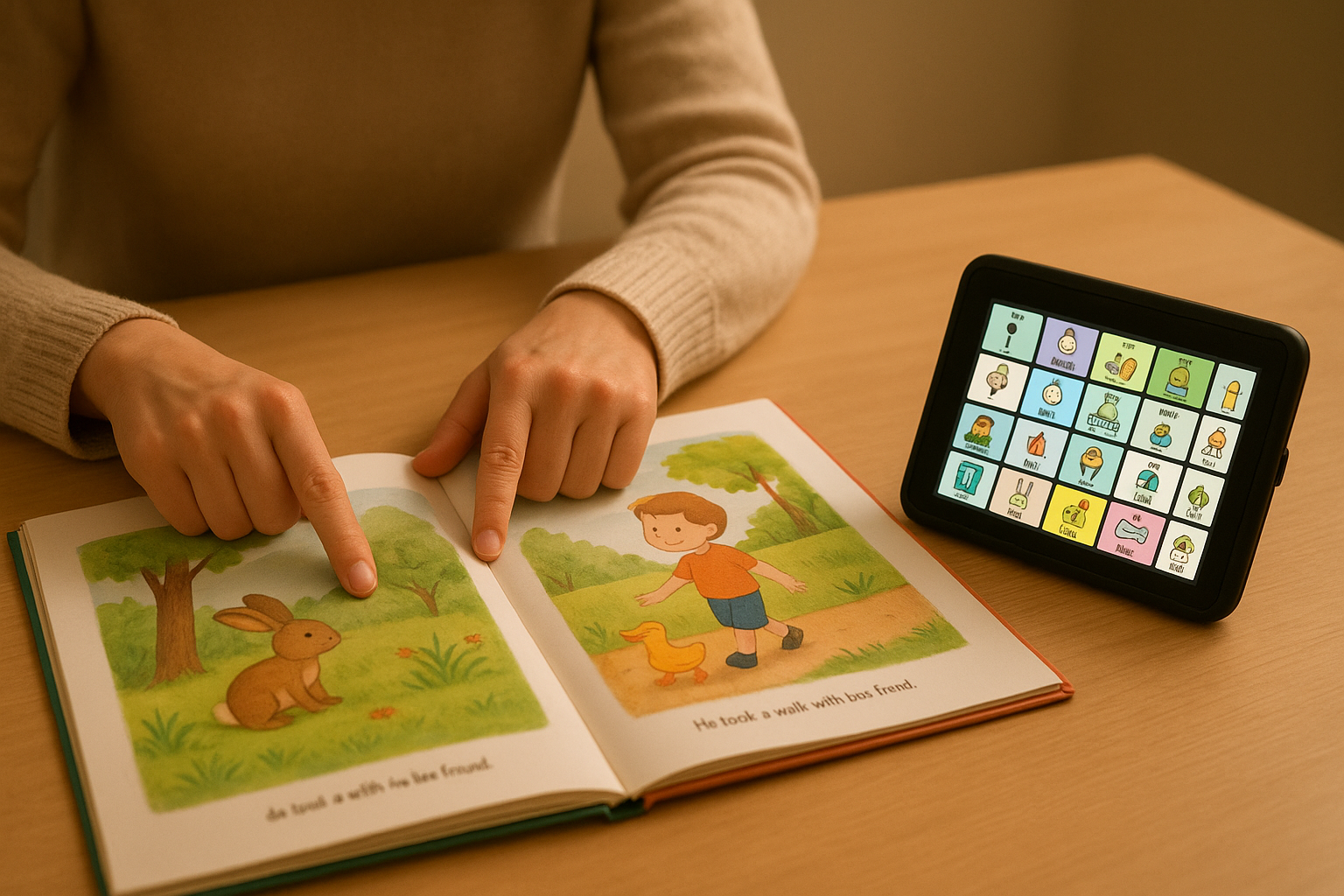
Pairing an AAC device with core vocabulary books helps children map symbols to spoken words.
Printable vs. Physical Core Vocabulary Books: Which Format Wins?
Printable, downloadable core vocabulary books tend to cost less than physical hardcovers, and a single digital file can be reprinted for an entire caseload or classroom without buying multiple copies. Consequently, many SLPs and teachers build a rotating printable library instead of a shelf of single-use hardbacks, since worn pages can simply be reprinted rather than replaced.
Physical board books, on the other hand, hold up better to chewing, drooling, and daily handling from very young or motor-impaired readers. Therefore, the best approach for most teams is a hybrid one: printable titles for structured sessions and send-home carryover, paired with a few durable board books for independent exploration during free play.
Core Vocabulary Books vs. Traditional Storybooks (and Fringe Vocabulary)
Traditional storybooks are written primarily for entertainment and often introduce many new, topic-specific words on every page. In contrast, core vocabulary books are intentionally repetitive, using the same small set of functional words throughout the entire story. Neither format is better on its own; rather, they serve different purposes.
Core vocabulary books: Repeat a small set of functional words; ideal for AAC modeling and language intervention goals.
Traditional storybooks: Introduce varied, topic-based vocabulary; better suited for expanding fringe vocabulary and general literacy exposure.
Fringe vocabulary books: Focus on specific nouns tied to one topic, such as dinosaur or birthday cake; useful for themed units but not reusable across settings.
Many SLPs use all three formats side by side, leaning on core vocabulary books during structured therapy targets, traditional storybooks for broader classroom read-alouds, and fringe titles for seasonal or themed units.
How to Use Core Word Storybooks: A Step-by-Step Approach
Using a core word storybook well takes more than a single read-through. The following steps outline a simple, repeatable process that works in therapy rooms, classrooms, and at home.
- Identify target core words. Choose the core words most functional for each child, such as go, more, want, and stop, so the story matches real communication needs before you open the book.
- Read for enjoyment first. Read the story once through without heavy teaching, letting the child enjoy the pictures and plot so the words feel natural rather than forced.
- Model on the reread. Reread the same story while modeling each target word using speech, sign, gesture, or an AAC device, so the child sees the word used repeatedly in context.
- Extend into play. Follow the story with a short, related play activity that reuses the same core words, since hands-on practice helps children generalize vocabulary beyond the page.
- Send the words home. Share a brief tip sheet with caregivers so the same core vocabulary gets modeled during meals, bath time, and everyday play routines.

A repeated read, model, and play routine helps core vocabulary books stick.
Core Vocabulary Books at Home, in the Classroom, and in Therapy
At home, a short, predictable core vocabulary book fits naturally into a bedtime or bath-time routine, since repetition is already built into the day. In the classroom, teachers can use the same title during circle time so every child hears the word modeled in a group setting, which supports both language and early literacy goals at once.
In therapy, SLPs often pair a core vocabulary book with a short, matching activity to reinforce generalization. For more structured session ideas organized by age, this collection of story-based speech therapy activities for ages 2 to 7 offers ready-to-use plans that slot directly alongside core vocabulary book sessions.
Common Mistakes to Avoid With Core Vocabulary Materials
One common mistake is reading a book only once and moving on before the child has had enough repeated exposure. Similarly, some teams forget to pair the book with the child's AAC device, which limits how much the modeling transfers to daily communication.
Another pitfall is choosing books with too many words per page for a child's current language level. Above all, the goal is functional repetition, not entertainment alone, so it helps to check that the story's core words genuinely match each child's therapy targets. According to the National Institute on Deafness and Other Communication Disorders, consistent, meaningful language exposure during early childhood plays a key role in long-term communication outcomes, which underscores why matching materials to a child's level matters so much.
Frequently Asked Questions About Core Vocabulary Books
What are core vocabulary books?
Core vocabulary books are story-based resources that repeat a small set of high-frequency words, called core words, across predictable, engaging plots. They give children multiple chances to hear and use the same functional vocabulary in different contexts.
How do core vocabulary books support AAC users?
Core vocabulary books mirror the core words already programmed on most AAC systems, so adults can model the same buttons the story uses. This consistent pairing helps AAC learners connect symbols to meaning more quickly.
Why are core vocabulary books effective for early language development?
They rely on repetition and predictability, two factors strongly linked to vocabulary acquisition in young children. Because the same words appear across many pages, children get the repeated exposure research shows is necessary for new words to stick.
What is the difference between core vocabulary books and fringe vocabulary books?
Core vocabulary books emphasize a small, reusable set of words like go, more, and stop, while fringe vocabulary books focus on specific, topic-based nouns such as dinosaur or birthday cake. Core words transfer across settings, whereas fringe words stay limited to particular topics.
How much do core vocabulary books typically cost?
Digital, downloadable core vocabulary books often range from a few dollars for a single title to $20 to $40 for a bundled set with dozens of stories. Printable formats are usually more affordable than physical hardcover books.
How long does it take to see progress using core vocabulary books?
Many teams notice increased spontaneous use of target core words within four to eight weeks of consistent modeling. Progress depends on session frequency, carryover at home, and the child's starting communication level.
What ages benefit most from core vocabulary books?
Children ages two through seven benefit most, since this is when functional core vocabulary and early sentence structures typically develop. However, older students who use AAC or have language delays can also benefit from core-word repetition.
What common mistakes do teams make when using core vocabulary books?
A frequent mistake is moving through a book only once instead of repeating it across several sessions. Another is failing to pair the book with an AAC device or visual supports when the child uses one.
Can core vocabulary books be used without an AAC device?
Yes, core vocabulary books work well for verbal children who need extra practice with functional, high-frequency words. They also support gesture, sign, and picture-based communicators alongside spoken language.
What is the best way to introduce a new core vocabulary book?
Read the book once through for enjoyment, then reread it while modeling each core word using speech, sign, or an AAC device. Follow with a related play activity so the child can practice the words outside the story.
Are core vocabulary books only for children with speech delays?
No, core vocabulary books also benefit typically developing toddlers, multilingual learners, and classroom groups working on early literacy. Their repetitive structure supports any child building foundational language skills.
How many times should a core vocabulary book be repeated before moving on?
Most SLPs repeat a core vocabulary book across three to five sessions before introducing a new title. Repetition can continue longer if the child is not yet using the target words independently.
What is the difference between core vocabulary books and board books?
Board book simply describes the sturdy, chewable format of a title, while core vocabulary describes the words repeated inside it. In other words, a book can be both a board book and a core vocabulary book at the same time if its pages repeat high-frequency words.
Can I make my own core vocabulary book?
Yes, many SLPs create simple, homemade core vocabulary books using photos of a child's own routines paired with one repeated target word per page. This personalized approach can work alongside published titles, especially for highly motivating, individualized targets.
Bringing It All Together
Core vocabulary books turn one of the most researched principles in early language intervention — repeated, functional practice — into something children genuinely enjoy. Whether you are an SLP building a therapy caseload, a classroom teacher supporting early literacy, or a caregiver looking for carryover activities, choosing core vocabulary books built around the right target words gives every reading session a clear purpose. As a result, teams that consistently use core vocabulary books alongside AAC modeling, play-based extensions, and home carryover tend to see steadier, more functional language growth over time. Ultimately, the right core vocabulary books are the ones matched closely to each child's target words, current level, and daily routines — and with a clear selection process and a repeatable read-model-play routine, any team can put them to work right away.