
Core Vocabulary Lesson Plans: A Complete SLP Guide
Discover core vocabulary lesson plans that build AAC and language skills in preschoolers. Explore free samples and story-based activities today.
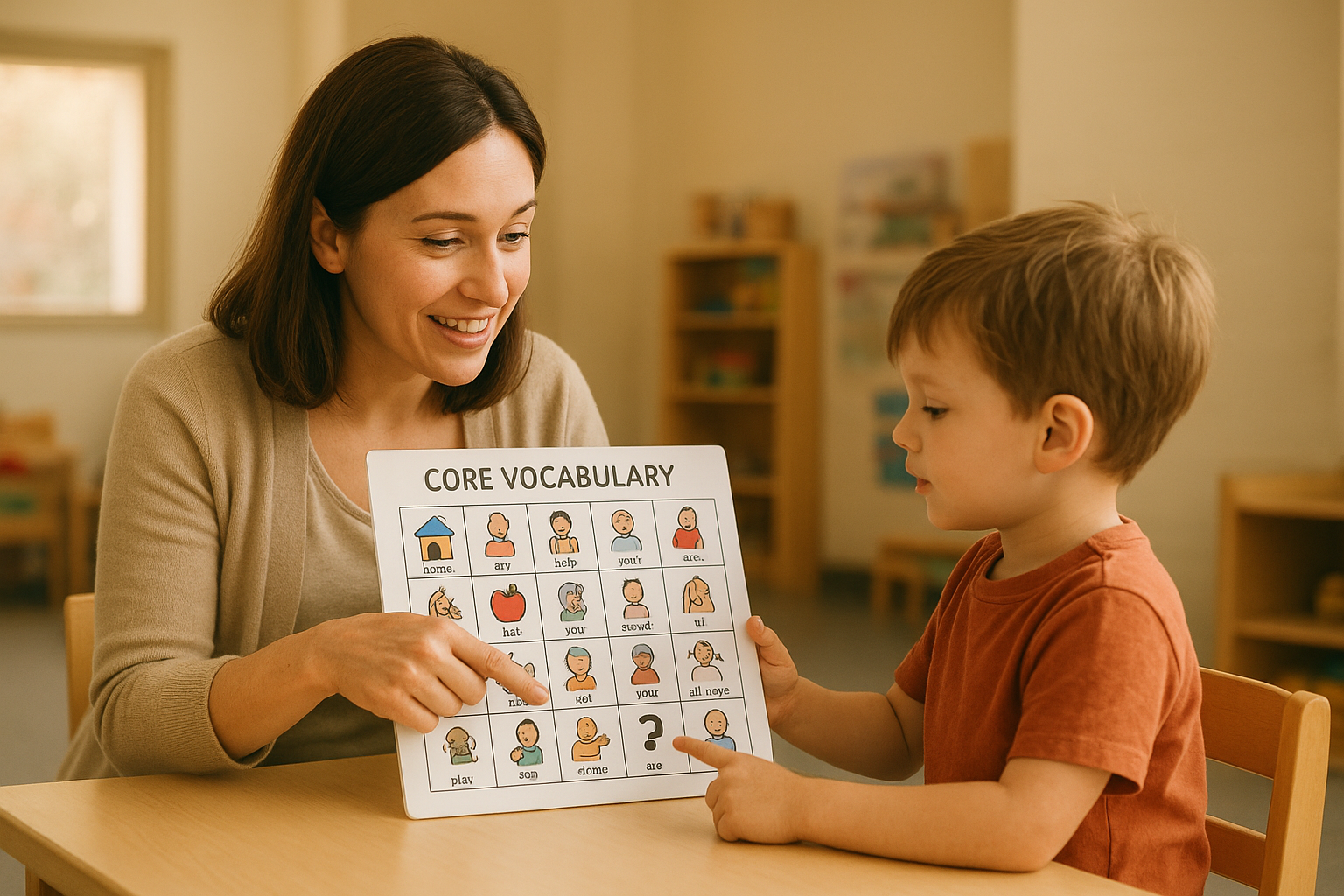
Core vocabulary lesson plans are structured teaching sequences that use a small set of high-frequency words to build functional communication skills in young children. For speech-language pathologists and early childhood educators, these plans turn everyday words like "go," "more," and "stop" into the foundation for language growth. In addition, this guide breaks down what these lesson plans include, how to build them step by step, and how ready-made tools like Core Stories can save valuable planning time.
Consistent modeling is at the heart of effective core vocabulary lesson plans.
What Are Core Vocabulary Lesson Plans?
Direct answer: Core vocabulary lesson plans are structured teaching sequences built around a small, reusable set of high-frequency words that children use across many activities and settings. Rather than teaching themed vocabulary like fruits or animals, these plans center on words such as "want," "help," and "go" that apply almost everywhere.
Specifically, core vocabulary refers to a set of 50 to 400 words that make up most of everyday spoken and written language. According to research summarized by the American Speech-Language-Hearing Association, targeting these words gives children with limited expressive language the biggest communicative return for the smallest teaching effort. As a result, core vocabulary lesson plans are widely used with both verbal children and those who rely on augmentative and alternative communication (AAC) systems.
Furthermore, a well-built lesson plan does more than list vocabulary. It maps out how the words will be modeled, when they will be practiced, and how progress will be measured across a session or week.
Why Core Word Teaching Plans Matter for Communication Growth
Core word teaching plans matter because a small vocabulary set can unlock a surprisingly large amount of communication. In fact, industry sources such as AssistiveWare estimate that roughly 80% of everyday spoken language comes from just 200 to 400 core words, while the remaining 20% is made up of specific, less frequent vocabulary. Consequently, teaching a handful of flexible words often has more functional impact than teaching many isolated nouns.
For children learning AAC, this efficiency is especially important. Similarly, the CDC's early language development milestones highlight that repeated, meaningful exposure to functional words supports stronger long-term communication outcomes. Because core words repeat across routines like mealtime, play, and transitions, children get far more practice opportunities than they would with topic-specific vocabulary alone.
In contrast, themed vocabulary units risk teaching words a child may only use once or twice a year. Therefore, many SLPs blend both approaches, using core words as the backbone and themed words as seasonal add-ons.
How to Build Core Vocabulary Lesson Plans in 5 Steps
Building effective core vocabulary lesson plans does not require reinventing the wheel each week. Instead, following a repeatable process helps save time while keeping instruction consistent. Below is a simple five-step framework many school-based SLPs use.
- Choose a small set of target words. Select two to four core words that are motivating and useful across many activities, such as go, more, help, or stop, rather than category-specific vocabulary.
- Pick an anchor activity or story. Choose a book, story, or hands-on activity that naturally creates repeated opportunities to use each target word in a meaningful context throughout the session.
- Plan aided language modeling moments. Identify specific points in the activity where you will point to, say, or press each core word on an AAC system before the child is expected to respond.
- Build in repeated practice through play. Design at least three to five natural opportunities for the child to use the target words during play, snack, or movement so the words are practiced in varied contexts.
- Track progress and plan for carryover. Record whether each word was modeled, prompted, or used spontaneously, then use that data to decide when to introduce new words or send home carryover activities.
Once this cycle feels familiar, planning a new set of core vocabulary lesson plans each week becomes noticeably faster.
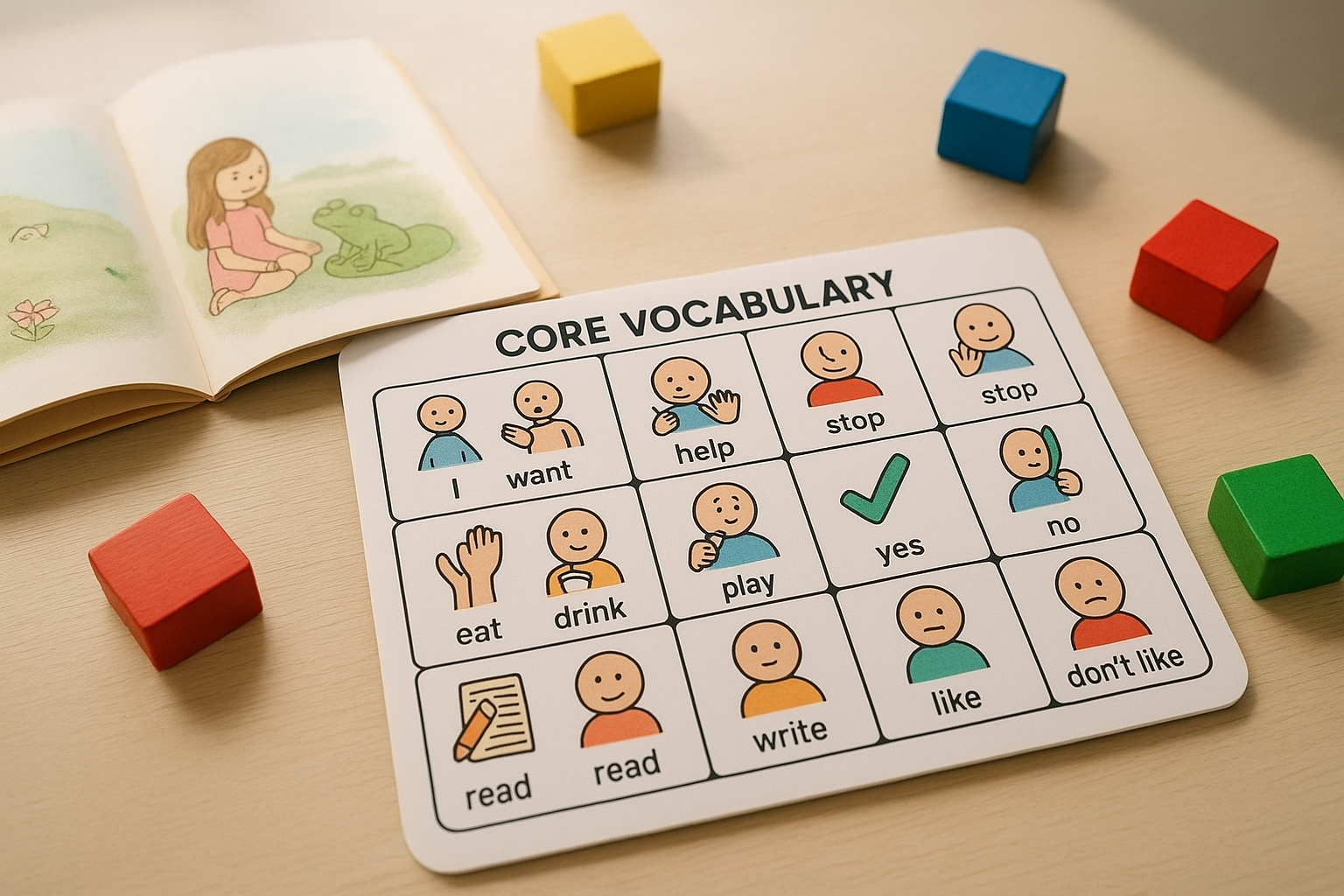
Pairing a communication board with a story helps children practice core words in context.
Core Vocabulary Curriculum: Classroom vs. Therapy Room
A core vocabulary curriculum can look slightly different depending on where it is delivered. In the therapy room, sessions are often one-on-one or in small groups, which allows for tightly controlled modeling and data collection. In the classroom, on the other hand, the same core words are woven into circle time, transitions, and centers so every child benefits from repeated exposure.
Regardless of setting, consistency is the key factor that drives generalization. For example, if a therapist targets the word "help" during a session, that same word should appear on classroom visuals and home materials. Teams that coordinate this way tend to see faster growth than those working in isolation, since the child hears and sees the same vocabulary in multiple environments each day.
Building this kind of shared environment also connects to broader classroom practices. A language-rich classroom environment naturally supports core vocabulary instruction by surrounding children with meaningful language throughout the day, not just during scheduled lessons.
Using Core Stories to Simplify AAC Lesson Planning
Writing core vocabulary lesson plans from scratch every week can be time-consuming, especially for school-based SLPs juggling large caseloads. This is where story-based resources can help. Little Speech Corner, founded by Gwen Swire, M.A., CCC-SLP, a practicing school-based speech-language pathologist with more than 20 years of experience, created Core Stories specifically to simplify this process.
Each Core Stories resource follows a "Read, Model, Play" approach, guiding adults through reading a simple story, modeling target core words, and then reinforcing those words through hands-on play. The Core Stories Foundational 53-Pack bundle organizes this structure across dozens of ready-made lessons, which removes much of the guesswork from weekly planning. For SLPs who also target articulation goals in the same sessions, Sound Stories offer a similar story-based framework for speech sound practice.
Educators new to this approach can also start with a core words guide before committing to a full bundle, and free introductory samples are available directly at Little Speech Corner for teams who want to try the format first.
Common Mistakes in Core Vocabulary Lesson Plans
Even experienced educators run into a few predictable pitfalls when writing core vocabulary lesson plans. Recognizing these early can save weeks of frustration.
- Introducing too many new words at once instead of allowing time for repetition.
- Modeling core words only during direct instruction rather than throughout natural play.
- Skipping data collection, which makes it hard to know when a child is ready for new vocabulary.
- Failing to coordinate target words between the classroom, therapy room, and home.
Avoiding these mistakes generally comes down to slowing the pace and keeping communication consistent across everyone working with the child.
Supporting Carryover at Home
Core vocabulary instruction rarely sticks if it only happens at school. Therefore, sending home simple, low-pressure activities helps caregivers reinforce the same words during daily routines. For instance, parents can model "more" during snack time or "help" while getting dressed, without needing any special materials.
Families looking for practical ideas can start with everyday activities that enhance toddlers' speech, which pair naturally with core vocabulary goals. In addition, many caregivers ask how screen time fits into this picture; guidance on balancing screen time with speech development can help teams set realistic expectations for home carryover.

Home carryover activities help extend the impact of core vocabulary lesson plans beyond the classroom.
Frequently Asked Questions About Core Vocabulary Lesson Plans
What are core vocabulary lesson plans?
Core vocabulary lesson plans are structured teaching sequences built around a small set of high-frequency words that children use across many settings and activities. They are designed to build functional communication skills for both verbal speakers and AAC users.
How do core vocabulary lesson plans differ from themed vocabulary units?
Themed units teach category-specific words like animals or colors, while core vocabulary lesson plans focus on reusable words such as go, more, and stop. These core words transfer across every activity, making them more functional for daily communication.
How many core words should a lesson plan include each week?
Most SLPs and educators target two to four core words per week to allow for repeated modeling and practice. This slower pace helps children internalize each word before new vocabulary is introduced.
Why is core vocabulary important for AAC users?
Core words make up a large portion of everyday communication, so mastering them gives AAC users the flexibility to express many messages with few symbols. This efficiency reduces the number of button presses needed to communicate.
How long does it take to plan a core vocabulary lesson?
A single core vocabulary lesson plan can take 20 to 40 minutes to prepare from scratch, depending on the activities involved. Ready-made resources, such as story-based Core Stories, can reduce this planning time significantly.
What age group benefits most from core vocabulary lesson plans?
Children ages two to seven benefit most, since this is a critical window for building foundational language and early AAC skills. However, core vocabulary instruction can also support older students with complex communication needs.
Can core vocabulary lesson plans be used in both therapy and classroom settings?
Yes, core vocabulary lesson plans work well in individual therapy sessions, small groups, and whole-classroom instruction. Consistency across settings helps children generalize core words more quickly.
What common mistakes do educators make when planning core vocabulary lessons?
A common mistake is introducing too many words at once without enough repetition. Another is failing to model core words during play, which limits the child's exposure to natural language input.
Are core vocabulary lesson plans effective for children who are not yet using AAC?
Yes, core vocabulary lesson plans support spoken language development as well as AAC use. The same high-frequency words form the foundation of early verbal communication in typically developing children.
How much do ready-made core vocabulary lesson plans typically cost?
Digital core vocabulary resources often range from free sample sets to bundled packs priced between fifteen and forty dollars, depending on the number of stories and activities included.
What is the best way to track progress with core vocabulary lesson plans?
Simple data sheets that record spontaneous versus modeled use of each core word work well for tracking progress. Reviewing this data weekly helps determine when to introduce new vocabulary.
How can parents reinforce core vocabulary lesson plans at home?
Parents can reinforce core vocabulary by modeling the same target words during daily routines like mealtime, bath time, and play. Consistent, low-pressure repetition across home and school settings speeds up generalization.
What materials are needed to implement core vocabulary lesson plans?
Basic materials include a core word board or AAC device, a few motivating toys or books, and a simple data tracking sheet. Story-based resources can also provide ready-made scripts and activity ideas.
Conclusion
Ultimately, well-designed core vocabulary lesson plans give SLPs, educators, and families a shared, practical framework for building functional communication in young children. By focusing on a small set of high-frequency words, planning intentional modeling moments, and coordinating carryover across home and school, teams can help children generalize language skills faster and with less frustration. Whether built from scratch or drawn from ready-made resources like Core Stories, strong core vocabulary lesson plans remain one of the most efficient tools for supporting both verbal and AAC communication in early childhood.