
Core Vocabulary Resources for SLPs: A Practical Guide
Core vocabulary resources for SLPs simplify AAC and language therapy planning. Explore practical tools and free samples for your caseload today.

Core vocabulary resources for SLPs make it easier to plan sessions that build flexible, reusable language instead of a fresh vocabulary list every week. For school-based and private-practice speech-language pathologists working with children ages 2 to 7, these tools connect story time, AAC modeling, and everyday play around the same small set of powerful words. In this guide, we will walk through what core vocabulary resources include, why they matter for AAC and language growth, and how to choose the right tools for your caseload.
Story-based sessions give children repeated, natural exposure to core vocabulary resources for SLPs in action.
What Are Core Vocabulary Resources for SLPs?
Core vocabulary resources for SLPs are the tools, story sets, visual supports, and planning materials built around the small group of high-frequency words people rely on most in daily conversation. Rather than teaching isolated nouns tied to one topic, these resources focus on flexible words like go, more, want, and stop that show up across nearly every activity and setting.
Consequently, therapists can reuse the same word bank in a lunchroom conversation, a classroom center, and a home routine. In addition, many resource sets pair each target word with a short story, a matching activity, and a visual board so the vocabulary feels natural rather than drilled. This structure is central to programs like Little Speech Corner's Core Stories, which build sessions around repeated exposure to the same core words through reading, modeling, and play.
Why Core Vocabulary Matters for AAC and Language Development
Core vocabulary matters because a surprisingly small set of words does most of the communicative heavy lifting. According to research often cited in augmentative and alternative communication (AAC) literature, roughly 80% of what people say in everyday conversation comes from a core set of just a few hundred words. As a result, teaching these words gives learners maximum communicative payoff for the time invested.
For AAC users specifically, a consistent core vocabulary layout on a device or board reduces the cognitive load of finding words. Similarly, verbal children benefit because these same words appear across sentence structures, helping them combine ideas rather than naming single objects. In particular, early communicators who master a handful of core words can often generate dozens of different two- and three-word phrases, which supports both expressive language and grammar development over time.
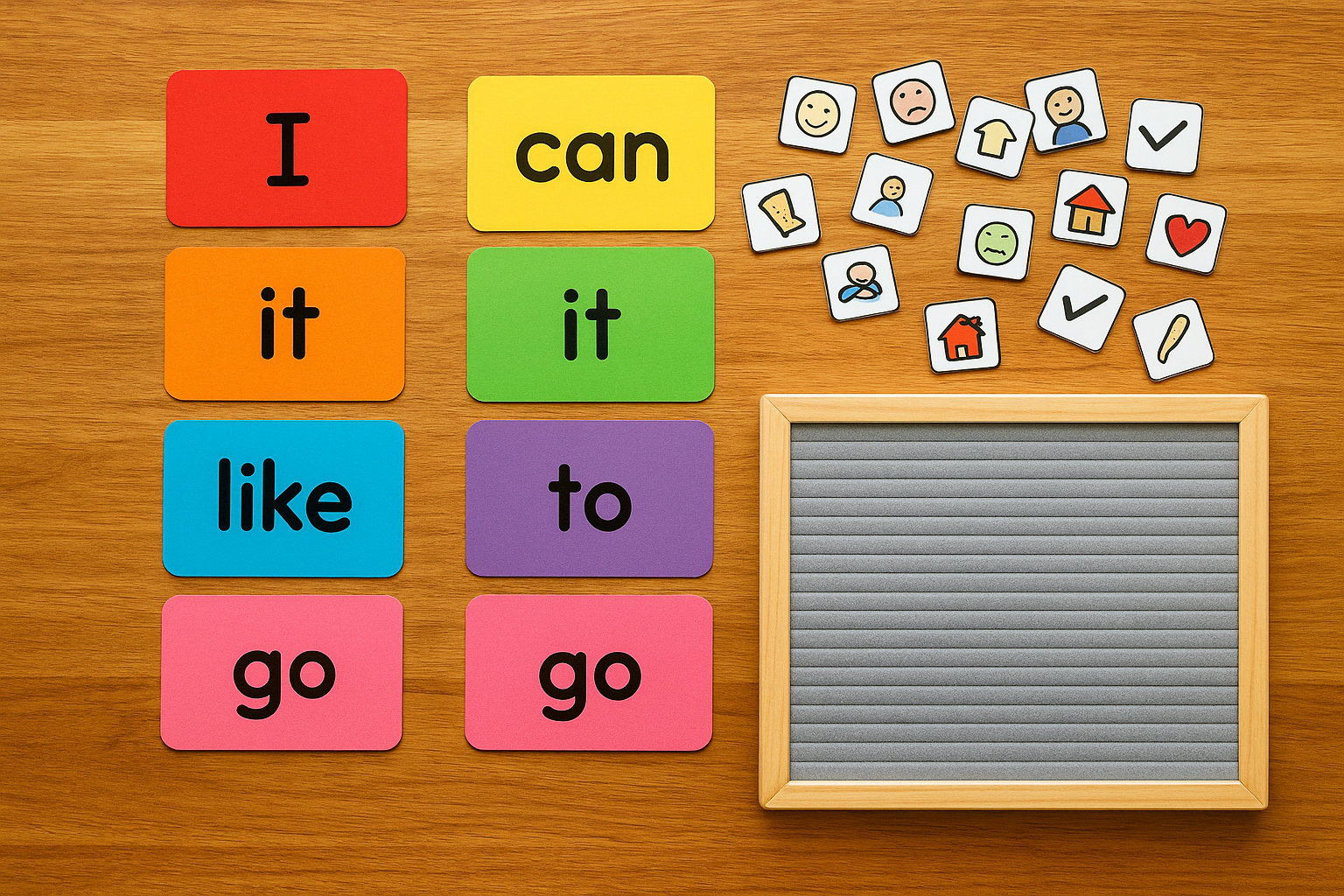
Simple, reusable materials keep core vocabulary teaching consistent across settings.
Types of Core Word Resources for Speech Therapy
Core word resources for speech therapy come in several formats, and most SLPs end up using a mix depending on the goal of the session. Story-based sets pair a short, repetitive narrative with a handful of target words modeled throughout the text. Visual boards and displays give AAC users a stable, predictable layout for locating words quickly during real conversations.
Printable activity sheets and play-based extensions, meanwhile, let therapists reinforce the same vocabulary through games, crafts, or sensory bins. Tip sheets and planning calendars round out the toolkit by helping teams schedule which words to target each month. For instance, a core words guide can help clarify which words to prioritize first for beginning communicators before layering in more complex vocabulary.
Sound-focused materials also deserve a mention here, since articulation and core vocabulary goals often overlap in mixed caseloads. Targeted articulation resources, sometimes called Sound Stories, let therapists address speech sound goals within the same story-based structure used for core vocabulary, which keeps sessions efficient for children with combined goals.
How to Choose the Right Core Vocabulary Tools for Your Caseload
Choosing the right core vocabulary tools does not have to be complicated, but it does help to follow a consistent process. Below is a simple five-step approach many school-based and private-practice SLPs use when building or refreshing their core vocabulary toolkit.
- Assess current communication levels. Review each student's expressive and receptive vocabulary, communication mode, and IEP goals to identify which core words will be most functional right now.
- Select a starter core word set. Choose a small, high-utility list of roughly 12 to 20 words rather than an overwhelming master list that is hard to reinforce consistently.
- Pick a resource format that fits your setting. Decide whether story-based sets, visual boards, or printable activities match your session length, caseload size, and prep time.
- Plan for repetition across contexts. Schedule the same words across therapy, classroom time, and home activities so children hear and use each target in several situations.
- Track progress and rotate word sets. Monitor spontaneous use over several weeks, then introduce new targets once a child shows consistent, functional use of the current set.
Core Stories: A Read, Model, Play Approach
The Read, Model, Play approach used in Little Speech Corner's Core Stories illustrates how core vocabulary resources for SLPs can move from theory into a workable weekly routine. First, the SLP reads a short, repetitive story that naturally highlights a handful of target core words. Next, the clinician models those same words during guided play, giving the child multiple chances to hear the vocabulary used in context rather than tested in isolation.
Finally, the child gets space to play and communicate using the modeled words, which builds confidence without pressure. This sequence works well because it mirrors how children naturally acquire language: through repeated, meaningful exposure rather than rote drills. The Foundational 53-Pack bundle extends this same structure across dozens of core words, giving therapists a full year of ready-made sessions built around the method.
Founder Gwen Swire, M.A., CCC-SLP, developed this framework after more than 20 years as a practicing school-based SLP, which means the materials reflect real classroom and caseload constraints rather than purely theoretical design. Teams looking for a broader overview of available options can review the full range of speech and language service resources to see how story-based tools fit alongside other supports.
Bringing Core Vocabulary Home: Tips for Caregivers and Classroom Teams
Therapy progress accelerates when the same core words show up outside the therapy room. Consequently, many SLPs pair their sessions with simple tip sheets caregivers can use during mealtime, bath time, or play. In addition, classroom teams benefit from a shared word list so paraprofessionals and teachers can model the same vocabulary during transitions and centers.
For families wanting to build language opportunities into daily routines, resources on how to create a language-rich environment at home pair naturally with core vocabulary goals. Likewise, families balancing device use can find practical guidance on balancing screen time and speech development, since screen habits often influence how much natural language modeling happens at home.
Above all, consistency matters more than intensity. A few minutes of core word modeling repeated daily tends to outperform a single long session once a week, because children need many varied exposures before a word becomes part of their spontaneous vocabulary.
Common Mistakes When Implementing Core Vocabulary Programs
Even experienced SLPs run into a few predictable pitfalls when rolling out core vocabulary programs. One common mistake is testing words with flashcard-style drills instead of modeling them naturally during play, stories, and routines. This approach can make vocabulary feel like a quiz rather than a communication tool, which tends to reduce spontaneous use.
Another frequent issue is introducing too many words at once. Therefore, it helps to start small and expand the word set only after children show consistent use of current targets. Teams also sometimes overlook children with other developmental profiles; for example, students on the autism spectrum often benefit from core vocabulary approaches, and reviewing resources on autism spectrum disorders and speech development can help clinicians tailor pacing and supports appropriately.
Finally, inconsistent carryover between settings can slow progress considerably. When therapy, classroom, and home routines use different word sets, children have fewer chances to practice any single target enough to make it automatic.
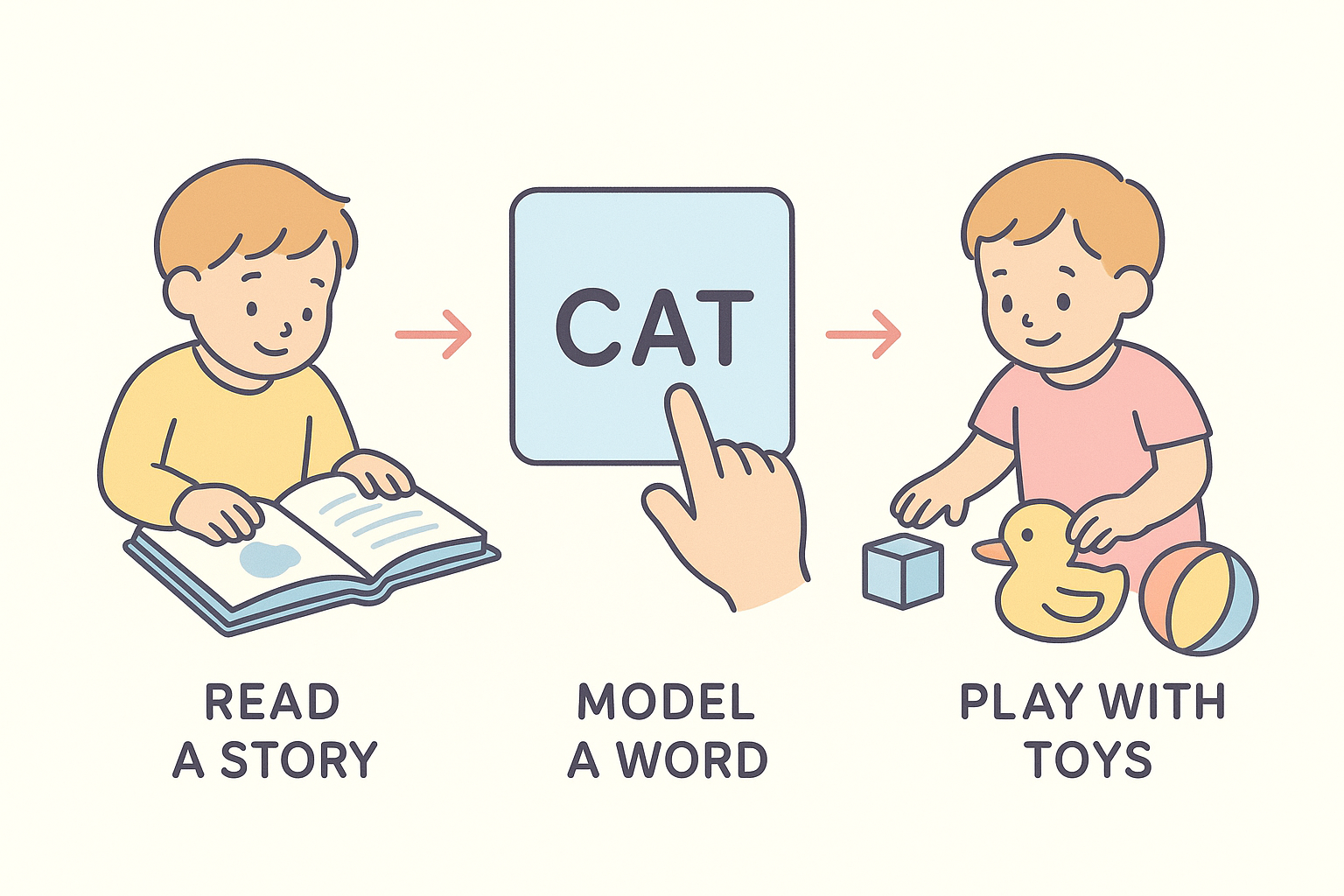
The read, model, play sequence turns core vocabulary resources for SLPs into a repeatable weekly routine.
Frequently Asked Questions About Core Vocabulary Resources for SLPs
What are core vocabulary resources for SLPs?
Core vocabulary resources for SLPs are materials, such as story sets, word lists, and visual supports, built around the small group of high-frequency words people use most often in daily communication. They help therapists teach flexible, reusable language rather than isolated topic words.
How is core vocabulary different from fringe vocabulary?
Core vocabulary includes small, flexible words like go, more, want, and stop that apply across many settings. Fringe vocabulary, in contrast, includes specific nouns like dinosaur or birthday, which are useful but limited to particular topics.
Why is core vocabulary important for AAC users?
Core vocabulary gives AAC users a consistent set of words that work across activities, locations, and communication partners. As a result, learners build automaticity and can generate new sentences without needing a new word for every situation.
How many words are considered core vocabulary?
Most core vocabulary lists contain roughly 200 to 400 words, though therapy programs often start with a smaller functional set of 20 to 50 words for beginning communicators. Research suggests a small set of core words accounts for a large share of everyday spoken language.
What age groups benefit most from core vocabulary instruction?
Core vocabulary instruction is especially effective for children ages 2 to 7, including toddlers, preschoolers, and early elementary students. However, it also supports older students and adults who use AAC or are building foundational language skills.
How much do core vocabulary resources typically cost?
Prices vary widely, from free introductory samples to bundled packs ranging from around $10 to $40 on platforms like Teachers Pay Teachers. Many creators, including Little Speech Corner, offer free sample stories so SLPs can try the approach before purchasing a full set.
How long does it take to see progress with core vocabulary programs?
Progress timelines depend on the child, but many SLPs notice increased spontaneous word use within 8 to 12 weeks of consistent modeling. Consistent exposure across therapy, classroom, and home settings tends to speed up growth.
What are common mistakes when teaching core vocabulary?
A common mistake is testing core words instead of modeling them naturally during play and stories. Another frequent error is introducing too many words at once, which can overwhelm early communicators instead of building steady momentum.
Can core vocabulary resources be used with children who don't use AAC?
Yes, core vocabulary resources benefit verbal children too, since the same high-frequency words support sentence building, vocabulary growth, and language complexity. Many classroom teams use core-word activities with the whole group, not only AAC users.
What is the Read, Model, Play approach?
Read, Model, Play is a structured method that pairs a simple story with repeated modeling of target core words, followed by hands-on play to reinforce the vocabulary in a natural context. This sequence gives children multiple, varied opportunities to hear and use the same words.
How do core vocabulary resources support carryover at home?
Tip sheets, visual boards, and simple activity ideas allow caregivers to model the same core words used in therapy sessions. This shared vocabulary approach helps children generalize language skills beyond the therapy room.
What's the best way to organize core vocabulary materials for therapy sessions?
Grouping materials by theme, word set, or monthly calendar makes it easier to plan sessions without recreating materials weekly. Many SLPs keep a rotating binder or digital folder organized by core word targets and matching stories.
Are core vocabulary resources for SLPs suitable for classroom teams?
Yes, core vocabulary resources for SLPs are frequently designed to be shared with classroom teachers and paraprofessionals for consistent use throughout the school day. This team-based approach increases the number of daily opportunities a child has to practice target words.
Final Thoughts on Building a Core Vocabulary Toolkit
Choosing effective core vocabulary resources for SLPs comes down to consistency, repetition, and a format that fits your setting. Story-based sets, visual boards, and simple planning tools all serve the same goal: giving children many natural chances to hear and use a small, powerful group of words. As you build or refresh your toolkit, prioritize materials that support carryover across therapy, classroom, and home settings, since that consistency is often what turns modeled vocabulary into spontaneous communication. Organizations like the American Speech-Language-Hearing Association offer additional guidance on evidence-based AAC practices worth reviewing alongside any resource set you choose. Whether you are starting from scratch or refining an existing plan, thoughtfully selected core vocabulary resources for SLPs can make weekly session planning faster and more effective for the children on your caseload.