
Downloadable Speech Therapy Resources for Preschoolers
Explore downloadable speech therapy resources for preschoolers, including Core Stories and Sound Stories. Preview free samples and shop on TPT today.

Downloadable speech therapy resources for preschoolers give speech-language pathologists, teachers, and families a fast, flexible way to bring core vocabulary and speech-sound practice into everyday sessions. Instead of building every activity from scratch, clinicians can open a ready-made story, model a target word, and move straight into play. This guide from Little Speech Corner, created by veteran SLP Gwen Swire, M.A., CCC-SLP, known to many families as Mrs. Gwen, explains what these resources look like, how the signature Read, Model, Play approach works, and which formats fit different therapy goals.
What Are Downloadable Speech Therapy Resources for Preschoolers?
Downloadable speech therapy resources for preschoolers are digital files—stories, visuals, planning calendars, or tip sheets—that an adult purchases or downloads once and reuses across sessions. Because the files live on a device or in print, they travel easily between the therapy room, the classroom, and home.
In particular, these materials tend to fall into two broad categories: core vocabulary resources built around a single high-frequency word, and articulation-focused resources built around a specific speech sound. Little Speech Corner's Core Stories and Sound Stories, available through the Little Speech Corner catalog, represent each category. Both are designed by a clinician with more than 20 years of experience across early intervention, preschool, and elementary settings.
Shared reading is the starting point for many downloadable speech therapy resources for preschoolers.
Why Story-Based Speech Therapy Resources Work for Young Communicators
Young children learn language largely through repeated, meaningful exposure rather than isolated drills. As a result, story-based speech therapy resources let a single short narrative carry the same target word or sound across several pages, giving a child multiple natural chances to hear it.
Furthermore, augmentative and alternative communication (AAC) research widely referenced by the American Speech-Language-Hearing Association suggests that a relatively small set of core words can account for up to 80% of what young children say every day. That statistic is one reason core vocabulary, rather than only topic-specific fringe words, anchors so many early language programs.
Consequently, a story that repeats one core word in varied, meaningful contexts gives a child far more functional practice than a flashcard drill. For a closer look at how story structure supports comprehension, see this collection of story-based speech therapy resources for young children.
The Read, Model, Play Approach Explained
Read, Model, Play is the signature framework behind Little Speech Corner's Core Stories. Specifically, it breaks a session into three short, connected stages instead of treating reading and play as separate activities.
- Share the Core Story. Read the short story aloud for about five minutes, pointing to the target core word and any AAC supports each time it appears so the child hears and sees it repeatedly.
- Model the core word. Demonstrate the word using the child's own communication method—spoken language, sign, or an AAC device—without demanding an immediate response.
- Move into child-led play. Continue modeling the same word across toys and routines so the learning extends beyond the story page.
Notably, the five-minute figure describes a planning estimate for the reading portion, not a promised therapy outcome. Because every child engages differently, the play stage can run as long as the session allows. To see this framework applied with communication devices, review these AAC activities for preschool speech therapy sessions.
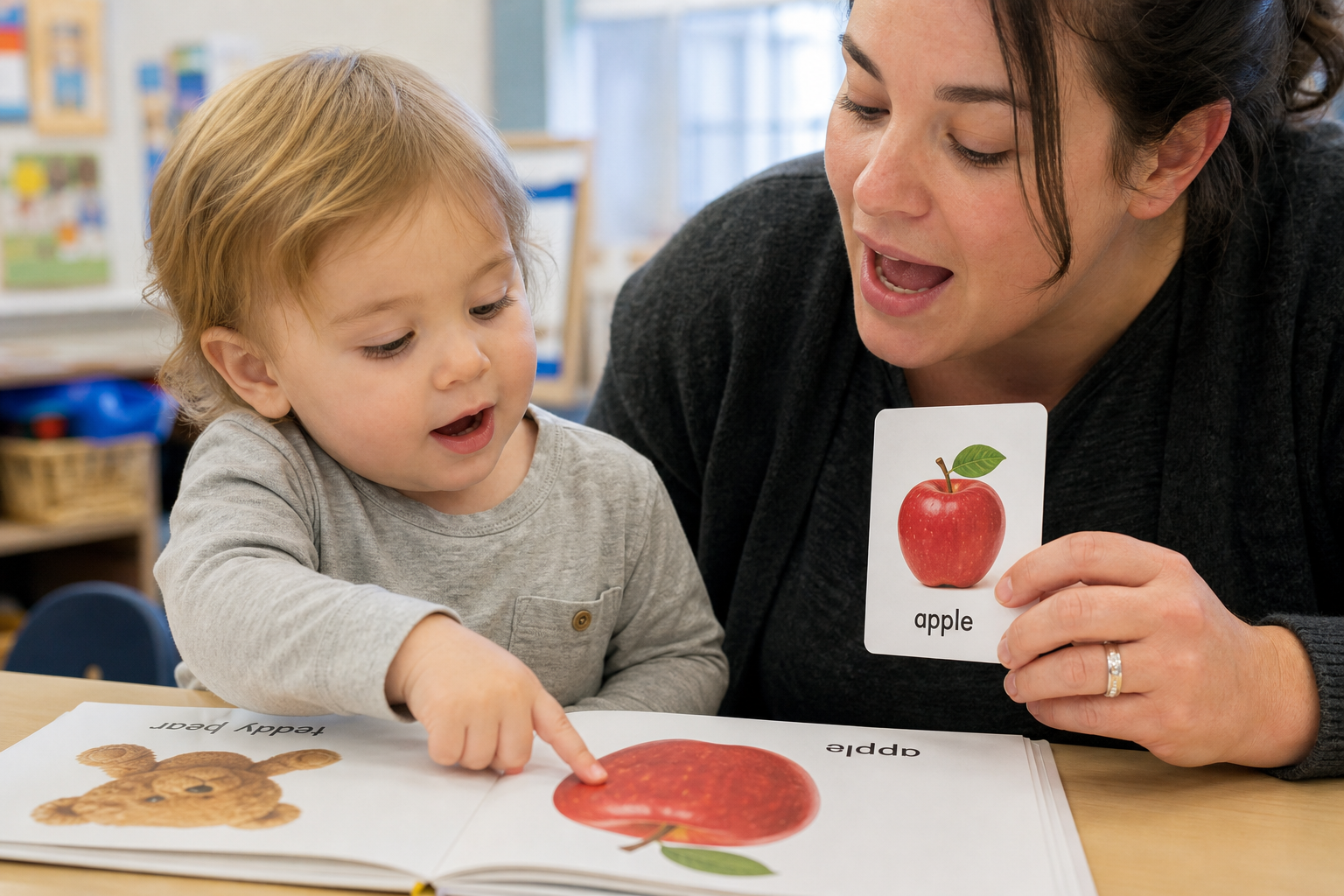
Modeling a single core word repeatedly helps a child absorb its meaning before being asked to say it.
Types of Printable and Digital Speech Therapy Materials for Preschoolers
Not every resource serves the same purpose. Therefore, it helps to understand the main formats before browsing a catalog.
- Individual Core Stories — short illustrated stories built around one core word, with related activity ideas for carryover.
- Core Stories Foundational 53-Pack — a ready-made bundle of 53 stories paired with a suggested weekly vocabulary sequence.
- Sound Stories — illustrated, sound-loaded narratives for clinician-selected articulation practice.
- Team Supports — core-word tip sheets and a planning calendar that help classrooms and families model the same vocabulary consistently.
In addition, many SLPs pair these digital files with other printable tools during sessions. A broader roundup of options appears in this guide to printable speech and language resources for preschool SLPs.
Core Stories vs. Sound Stories: Choosing the Right Resource
Core Stories and Sound Stories solve different problems, so it is worth matching the resource to the actual goal rather than the age alone.
Specifically, Core Stories support language modeling and AAC use through a single repeated core word, making them a fit for children working on early expressive or receptive vocabulary. Sound Stories, on the other hand, embed a clinician-selected speech sound throughout the narrative, giving children with articulation goals repeated exposure to that sound in connected, meaningful language rather than isolated word lists. For background on how typical speech sound development unfolds, the CDC's developmental milestones resource offers a useful reference point.
Consequently, many clinicians use both types across a caseload: Core Stories during language-focused sessions and Sound Stories when a child's plan calls for targeted articulation practice.
How to Use AAC-Friendly Speech Resources at Home and School
Carryover between settings often determines whether a new word sticks. For that reason, Core Stories are built to support flexible language modeling, including children who use AAC systems such as speech-generating devices or core-word boards.
At home, a caregiver can follow the same Read, Model, Play sequence used in session, simply swapping the toy or routine during the play stage. At school, a teacher can use the accompanying tip sheet to model the same word during snack time, circle time, or transitions, so the child encounters it far more often than once a week in therapy alone. Augmentative and alternative communication, often abbreviated AAC, refers to any tool or system that supports or replaces spoken communication, and consistent modeling across settings is widely considered a best practice for AAC learners.
For literacy-focused carryover ideas that pair well with core vocabulary modeling, see these literacy-based speech therapy activities for preschoolers.
Free Speech Therapy Resource Samples to Try First
Before committing to a purchase, previewing a free sample is a practical first step. Little Speech Corner offers several at no cost through its TPT store.
- Apples for Anna — a free Core Story targeting the word THERE.
- Core-vocabulary calendar — a planning tool that includes one sample Core Story.
- SW and CH Sound Story samples — free previews of the articulation-focused format.
Trying a free sample first helps confirm whether the story length, illustration style, and vocabulary focus fit a specific caseload before buying the Foundational 53-Pack or additional individual titles.
Direct answer: Downloadable speech therapy resources for preschoolers are ready-made digital stories and planning tools—such as Core Stories and Sound Stories—that clinicians, teachers, and families download once and reuse to model core vocabulary or practice specific speech sounds during therapy, classroom routines, and home carryover.
Who Creates These Resources?
Behind every Core Story and Sound Story is Gwen Swire, M.A., CCC-SLP, known to many as Mrs. Gwen. She holds ASHA CCC-SLP certification, California SLP licensure, and a Clinical or Rehabilitative Services Credential, along with M.A. and B.A. degrees in Communication Disorders from California State University Fullerton.
Over more than 20 years across early intervention, preschool, elementary, and family settings, Gwen shaped the Read, Model, Play approach around what actually works in a busy session. That hands-on background is, above all, why the resources read like practical session plans rather than generic worksheets. Visitors can review her full background and browse the catalog at Little Speech Corner.
Frequently Asked Questions About Downloadable Speech Therapy Resources for Preschoolers
What are downloadable speech therapy resources for preschoolers?
Downloadable speech therapy resources for preschoolers are digital files—stories, visuals, and planning sheets—that an adult downloads once and reuses across sessions, classrooms, and home routines. They typically target core vocabulary, articulation sounds, or both.
How do Core Stories support core vocabulary and AAC modeling?
Each Core Story centers on one high-frequency word shown repeatedly in context, giving adults a script for modeling it aloud, in sign, or on an AAC device. This repetition helps children see functional use before they are expected to produce the word themselves.
What is the Read, Model, Play approach?
Read, Model, Play is a three-part routine: share a short Core Story for about five minutes, model the target word using the child's communication method, then move into child-led play while continuing to model that word.
Are Sound Stories different from Core Stories?
Yes. Core Stories focus on one core vocabulary word for language modeling, while Sound Stories are illustrated narratives loaded with a clinician-selected speech sound for articulation practice.
How much does the Core Stories Foundational 53-Pack include?
The Foundational 53-Pack is a bundle of 53 Core Stories sold on TPT, paired with a suggested Core Word of the Week sequence. Buyers should confirm exact file counts and licensing on the current TPT listing before purchasing.
Can classroom teachers use these resources, or are they only for SLPs?
Both groups can use them. SLPs often select targets for one-on-one or small-group therapy, while teachers and paraprofessionals use the same stories and tip sheets to model shared vocabulary throughout the classroom day.
What free samples are available before purchasing?
Free samples include the Apples for Anna Core Story targeting the word THERE, a core-vocabulary planning calendar with a sample story, and SW and CH Sound Story samples.
How long does a Core Story session typically take?
The shared reading portion is designed to take roughly five minutes, though this is a planning estimate rather than a guaranteed outcome. The follow-up play stage can run as long as the session allows.
Where can I purchase or download these resources?
All purchases and free downloads are completed through the Little Speech Corner store on Teachers Pay Teachers, linked from the Little Speech Corner website.
What age range benefits most from these materials?
Materials are designed primarily for children ages 2 to 7, covering early core vocabulary development through emerging articulation and early story understanding.
What's the difference between printable and digital speech therapy resources?
Printable resources are formatted for paper use, while digital resources can also display on a screen or tablet during teletherapy or AAC modeling. Many downloadable files are built to support both formats.
What common mistakes should adults avoid when modeling core vocabulary?
A common mistake is demanding an immediate verbal response instead of modeling the word naturally first. Another is modeling a word only once during the story rather than repeating it throughout both the story and the follow-up play.
How do I choose between individual Core Stories and the full bundle?
Individual stories work well for targeting one specific word quickly, while the Foundational 53-Pack suits clinicians who want a ready-made yearlong sequence. Reviewing a few free samples first can help clarify which option fits current goals.
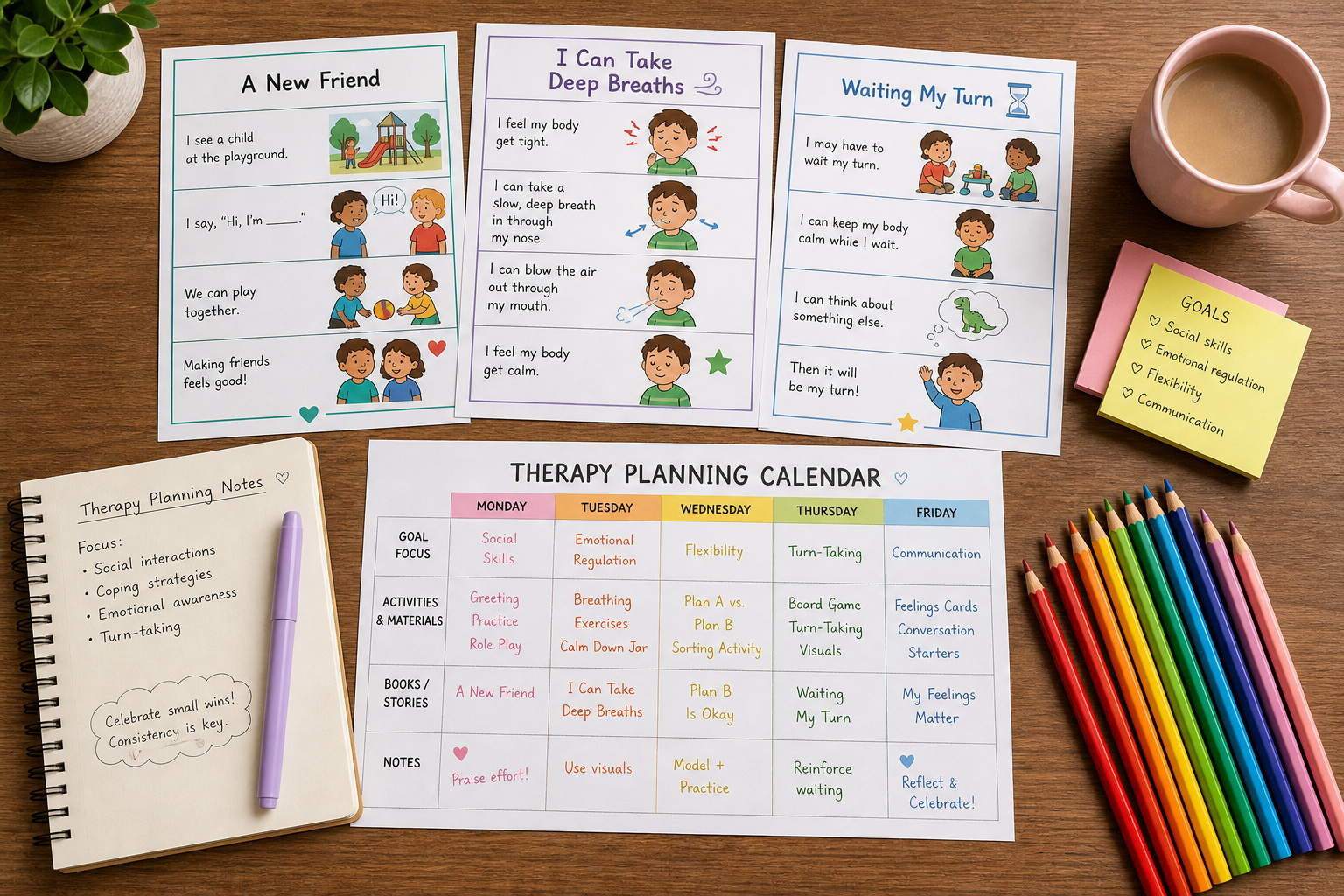
A simple planning calendar helps teams coordinate which core word to model each week.
Bringing It All Together
In summary, downloadable speech therapy resources for preschoolers work best when they combine a clear vocabulary or sound target with a repeatable routine like Read, Model, Play. Whether the goal is building core vocabulary, supporting AAC use, or practicing a specific speech sound, starting with a free sample and pairing it with team supports can help a Core Story or Sound Story earn a lasting place in weekly planning. Ultimately, choosing resources built by a practicing SLP with decades of classroom and therapy-room experience, and previewing them through free samples or the full catalog at Little Speech Corner, gives SLPs, teachers, and families a practical, well-tested starting point for everyday language and speech-sound practice.
