
Pediatric Speech Therapist Glendora: Parent's Guide
Searching for a pediatric speech therapist Glendora families trust? Learn what to look for, key questions to ask, and how to support progress at home.

A pediatric speech therapist Glendora families rely on can make the difference between years of frustration and a child who finally feels understood. Speech and language delays affect roughly 1 in 12 children between ages 3 and 17, according to the National Institute on Deafness and Other Communication Disorders. Therefore, knowing how to find and evaluate the right provider matters just as much as starting therapy at all.
In the sections below, you will find a clear breakdown of what these professionals do, the warning signs worth watching for, and a practical checklist for choosing a good fit. In addition, you will see how simple home-practice tools support the work happening in therapy sessions.
A pediatric speech therapist Glendora families choose often uses picture cards and play-based routines to build communication skills.
What Is a Pediatric Speech Therapist in Glendora?
A pediatric speech therapist is a licensed clinician who evaluates and treats communication and swallowing difficulties in children. Specifically, this professional is formally called a speech-language pathologist (SLP), a term that refers to someone trained to diagnose and address issues with sounds, vocabulary, grammar, and social language.
In Glendora and nearby communities, these specialists work in schools, hospitals, and private practices. As a result, families often have several options depending on whether they want school-based services, covered under an Individualized Education Program (IEP), or private therapy with more flexible scheduling.
Signs Your Child May Benefit From a Pediatric Speech-Language Pathologist
Not every late talker needs formal intervention, but certain patterns are worth a professional look. For instance, a child who has fewer than 50 words by age 2, struggles to combine words by age 3, or is frequently difficult to understand outside the family should be evaluated.
Similarly, stuttering that lasts more than six months, difficulty following simple directions, or frustration during conversations can signal an underlying language or articulation issue. According to the CDC's developmental milestones checklist, tracking these patterns early helps determine whether a referral is appropriate.
How to Find a Pediatric Speech Therapist Glendora Families Trust
Finding a pediatric speech therapist Glendora families trust usually starts with a referral network. Pediatricians, preschool teachers, and local parent groups often know which providers have strong track records with young children specifically.
Furthermore, the ASHA ProFind directory lets you search for certified speech-language pathologists by location and specialty. Meanwhile, the school district can explain eligibility for free evaluations if your child is enrolled in public preschool or elementary programs.
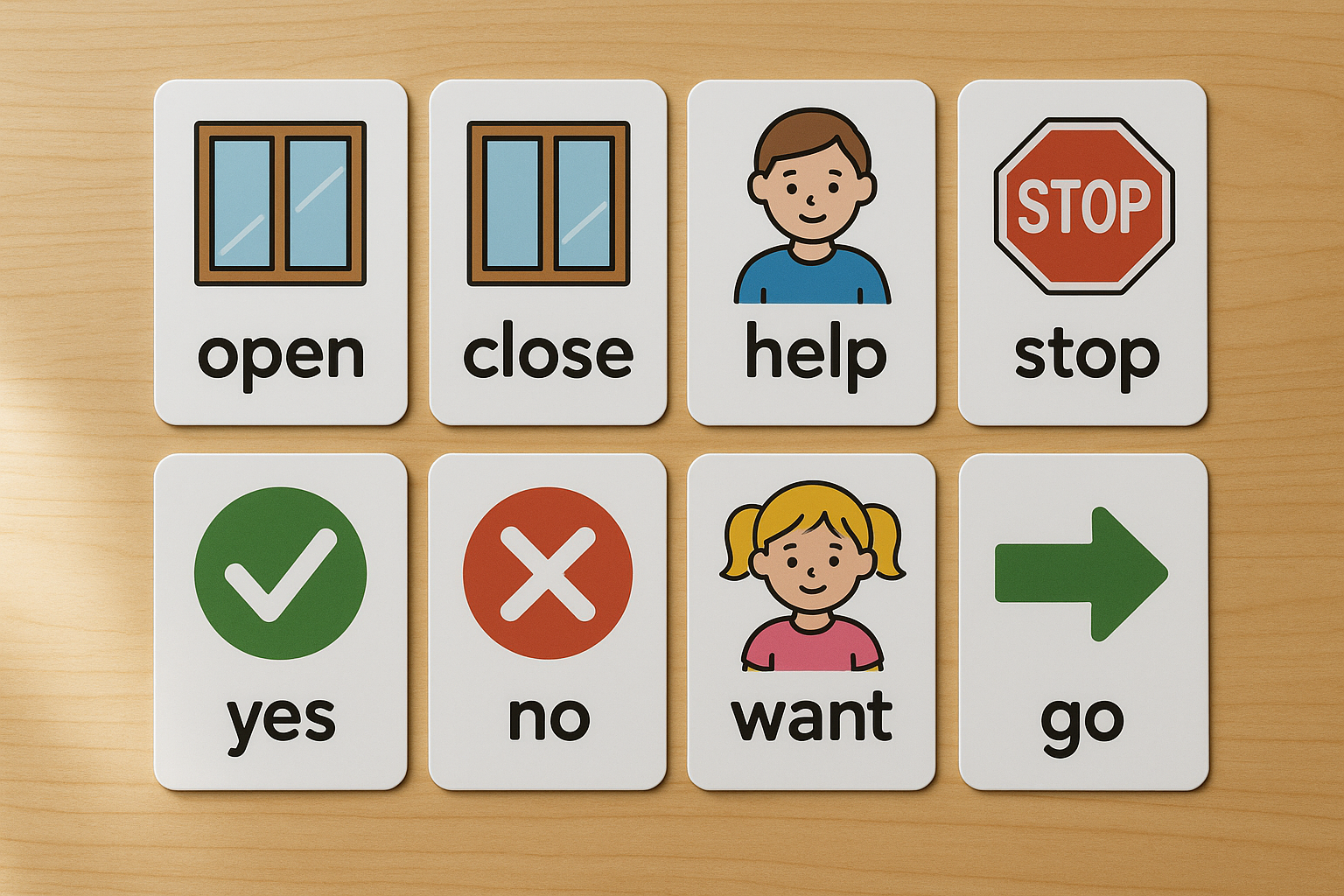
Core vocabulary cards give children repeated, functional words to build stronger communication skills.
5 Steps to Choosing the Right Children's Speech Therapist
Once you have a short list of candidates, a structured process helps you compare providers fairly. Consequently, following these steps reduces guesswork and speeds up the decision.
- Identify your concerns. Write down specific speech or language behaviors that concern you, including when they happen and how they affect daily communication at home or school.
- Gather referrals. Ask your pediatrician, preschool teacher, or local parent network for names of pediatric speech therapists with strong reputations in your area.
- Verify credentials. Confirm each candidate holds a valid state license and an ASHA Certificate of Clinical Competence before scheduling an evaluation.
- Schedule an evaluation. Book an initial assessment so the therapist can observe your child's speech and language skills and recommend an appropriate treatment plan.
- Reinforce skills at home. Use consistent vocabulary and simple story-based or play-based activities between sessions so your child gets extra practice opportunities every day.
Questions to Ask Before Starting Speech Therapy for Kids
Before committing to a provider, ask about their experience with your child's specific age group and diagnosis. In particular, find out how progress is measured, how often sessions occur, and whether parent coaching is part of the plan.
Above all, a good therapist should welcome these questions and explain their approach clearly. Our companion resource, a parent's guide to choosing the right speech therapist, walks through additional interview questions in more depth.
Supporting Progress at Home Between Sessions
Therapy sessions typically last 30 to 60 minutes once or twice a week, which means most language learning still happens at home. Therefore, consistent carryover activities matter as much as the sessions themselves.
Story-based routines that repeat core vocabulary, meaning the small set of high-frequency words used across many situations, give children natural chances to practice new skills. For example, reading the same simple story several times while modeling target words builds familiarity without feeling repetitive to a young child.

Simple story-based routines at home help reinforce what a pediatric speech therapist Glendora providers teach in session.
How Little Speech Corner Complements Local Speech Therapy
Little Speech Corner was created by Gwen Swire, M.A., CCC-SLP, a practicing school-based speech-language pathologist with more than 20 years of experience. Her Core Stories use a Read, Model, Play approach that pairs directly with the core vocabulary and augmentative and alternative communication (AAC) strategies many therapists already teach.
In addition, the Core Stories Foundational 53-Pack, along with core-word tip sheets and planning calendars, gives classroom teams and caregivers a consistent framework between sessions. You can explore the full range of therapy support services or browse the Core Stories collection to see how these materials fit into a home or classroom routine.
Whether you are working with a pediatric speech therapist Glendora clinic or a school-based provider, visit Little Speech Corner to see free introductory core vocabulary samples before purchasing a full resource, or review the complete resource library for additional planning tools.
Frequently Asked Questions About Pediatric Speech Therapist Glendora
What does a pediatric speech therapist in Glendora do?
A pediatric speech therapist evaluates and treats children's speech, language, and communication challenges through individualized therapy plans. They work on sounds, vocabulary, sentence structure, and social communication skills.
How can I find a qualified pediatric speech therapist Glendora families recommend?
Start by asking your pediatrician, school district, or local parent groups for referrals to a trusted pediatric speech therapist Glendora families have used before. You can also check state licensing boards and ASHA's certification directory to confirm credentials.
What age should a child start speech therapy?
Therapy can begin as early as infancy if delays are identified, though many children start between ages 2 and 4. Earlier intervention generally leads to stronger long-term communication outcomes.
How much does pediatric speech therapy cost in Glendora?
Costs vary widely depending on whether services are provided through insurance, school programs, or private practice, ranging from no direct cost in public schools to over $150 per session privately. Contacting local providers directly gives the most accurate estimate.
How long does speech therapy typically take to show results?
Many families notice small improvements within a few months, though full progress often takes six months to two years depending on severity. Consistency between sessions and home practice speeds up results.
What is the difference between a speech therapist and a speech-language pathologist?
These terms are generally used interchangeably; both refer to a licensed professional trained to diagnose and treat speech and language disorders. The formal credential is Speech-Language Pathologist, often abbreviated SLP.
What credentials should I look for in a pediatric speech therapist?
Look for a Certificate of Clinical Competence (CCC) from ASHA and a valid state license. Experience working specifically with young children is also an important factor.
Can core vocabulary and AAC resources help outside of therapy sessions?
Yes, core vocabulary tools and augmentative and alternative communication (AAC) materials reinforce skills between sessions when used consistently at home or in the classroom. They give children more opportunities to practice functional words in everyday routines.
What common mistakes do parents make when choosing a speech therapist?
A frequent mistake is choosing based on availability alone without checking experience with the child's specific needs. Skipping the first evaluation questions can also lead to a mismatch in therapy approach.
Do I need a doctor's referral to see a pediatric speech therapist?
Some insurance plans require a physician referral, while others and many private practices allow direct scheduling. It is best to confirm requirements with your specific insurance provider first.
What should I bring to my child's first speech therapy evaluation?
Bring any prior evaluations, a list of concerns and questions, and insurance information if applicable. Notes about your child's favorite words, routines, and interests also help the therapist personalize the session.
How can I support my child's speech therapy progress at home?
Consistent practice using the same words and strategies the therapist models makes the biggest difference. Story-based and play-based activities that repeat core vocabulary throughout the day are especially effective.
Is early intervention important for speech delays?
Yes, research consistently shows that addressing speech and language delays early leads to better academic and social outcomes. Waiting can make some skills more difficult to build later on.
How do school-based and private-practice speech therapists differ?
School-based therapists focus on skills that affect classroom performance and typically work within an Individualized Education Program (IEP). Private-practice therapists often address broader communication goals and may offer more flexible scheduling.
Final Thoughts
Choosing a pediatric speech therapist Glendora families can rely on takes a bit of research, but the process does not need to feel overwhelming. By identifying concerns early, verifying credentials, and asking the right questions, you can find a provider who fits your child's specific needs.
Finally, remember that therapy works best when it continues at home through simple, repeated practice. Resources like Little Speech Corner's Core Stories, built on a Read, Model, Play approach, can help extend the good work your child's therapist starts in session, giving families and educators one more tool for lasting progress.