
Speech Delay Therapy for Toddlers: A Parent's Guide
Speech delay therapy for toddlers helps young children build language skills early. Learn key signs, proven methods, and how to start therapy today.

Speech delay therapy for toddlers is a structured, play-based approach that helps children ages two to seven build the words, sounds, and social communication skills they need to thrive. As a result, many parents who notice their toddler talking less than peers their age turn to a certified speech-language pathologist, or SLP, a professional trained to diagnose and treat communication disorders. In this guide, we'll walk through what this therapy looks like, how to recognize early signs, and what you can do at home to support progress.
Quick answer: Speech delay therapy for toddlers combines a professional evaluation with regular, play-based sessions where a speech-language pathologist models words, sounds, and phrases the child is missing. Consistent practice at home, alongside these sessions, is what typically drives the fastest progress.
What Is Speech Delay Therapy for Toddlers?
Speech delay therapy for toddlers is a form of pediatric speech-language intervention that targets late or limited verbal communication in children under age five. Therefore, it typically combines structured play, modeling, and repetition to build vocabulary, sentence structure, and social language skills. According to the American Speech-Language-Hearing Association, early intervention between ages two and five generally leads to the strongest long-term outcomes for children with expressive language delays.
In practice, a session might involve reading an interactive story, pausing at key moments so the child fills in a missing word, or playing with toys while the therapist narrates actions using simple, repeated phrases. Consequently, toddlers absorb language the same way they absorb everything else at that age: through repetition, play, and connection. For a closer look at how delays differ from broader developmental concerns, our article on language delays in young children offers helpful context.
A speech-language pathologist uses story-based play during a speech delay therapy for toddlers session.
Signs Your Toddler May Need Speech and Language Therapy
Before starting therapy, it helps to recognize the signs that prompt a referral in the first place. For instance, a toddler who has fewer than 50 words by age two, or who isn't combining two words together by age two and a half, may benefit from an evaluation. Similarly, children who rely heavily on gestures instead of words, or who are difficult for familiar adults to understand, often qualify for services.
In addition, some toddlers show strong receptive skills, meaning they understand what's said to them, but struggle to express themselves verbally. Because these presentations vary so much from child to child, our detailed breakdown of five key signs of a speech delay is a useful starting point for parents who aren't sure whether to seek help. Above all, trust your instincts; pediatricians and SLPs would rather evaluate a child who turns out fine than miss a delay that needed early support.
How Toddler Speech Therapy Works: A Step-by-Step Guide
Once a family decides to move forward, the process generally follows a predictable path. Understanding these steps in advance can ease the anxiety many parents feel walking into that first appointment.
- Get a professional evaluation. Schedule a comprehensive evaluation with a certified speech-language pathologist to assess vocabulary, sentence structure, and sound production compared to age-based milestones.
- Set individualized goals. Work with the therapist to establish specific, measurable goals, such as increasing spoken vocabulary or combining two words together within a set timeframe.
- Attend structured play-based sessions. Participate in weekly or biweekly sessions that use play, songs, and repetitive story routines to model target words and encourage spontaneous communication attempts.
- Practice carryover activities at home. Reinforce therapy goals between sessions by narrating daily routines, reading interactive books, and modeling target words during everyday play and mealtime.
- Monitor progress and adjust the plan. Meet with the therapist regularly to review progress data, celebrate milestones, and adjust goals as the toddler's communication skills continue to develop.
Notably, the CDC's developmental milestones checklist can help parents track progress alongside formal therapy, giving a clearer picture of how a toddler is developing over time.
In-Home vs. Clinic-Based Speech Therapy for Toddlers
Families often ask whether in-home or clinic-based sessions work better for a toddler's speech delay. Generally speaking, neither format is objectively superior; the right choice depends on the child's temperament, the family's schedule, and how well the child transfers new skills between settings.
On one hand, clinic settings offer access to specialized equipment and a distraction-controlled environment. On the other hand, in-home speech therapy often improves carryover because the toddler practices language in the exact environment where they'll use it daily, with familiar toys and routines. Our guide to in-home speech therapy for toddlers walks through the pros and cons in more depth, which can help families decide what fits their situation best.
Supporting Speech Development at Home Between Sessions
Formal sessions are important, but consistent daily practice at home is often what accelerates progress the most. Specifically, narrating routines out loud, such as describing steps during bath time or snack time, exposes toddlers to repeated vocabulary in context.
Additionally, story-based routines that use a "read, model, play" approach let children hear target words in a book, watch an adult use them, and then practice the same words during pretend play. Because screen time can sometimes crowd out these interactive moments, our article on balancing screen time and speech development offers practical tips for protecting language-rich playtime. For families looking for ready-made materials, resources like Little Speech Corner's Core Stories are designed around this same read-model-play framework for home carryover.

Everyday story time helps reinforce goals from speech delay therapy for toddlers between formal sessions.
How Much Does Speech Delay Therapy for Toddlers Cost?
Cost is often a deciding factor for families weighing their options. Typically, private-practice sessions range from $75 to $250 per hour depending on location and provider experience, while public early intervention programs, available to eligible children under age three, often cost little to nothing.
Meanwhile, school-based services become available once a child turns three, provided they qualify through an evaluation. As a result, many families combine free or low-cost public services with private sessions or home-based practice for extra support. If you're ready to search for a local provider, our resource on finding speech therapy near me outlines where to start looking and what questions to ask during your first call.
Frequently Asked Questions About Speech Delay Therapy for Toddlers
What is speech delay therapy for toddlers?
Speech delay therapy for toddlers is a play-based treatment led by a certified speech-language pathologist to help young children develop age-appropriate vocabulary, sentence structure, and communication skills. Sessions typically use modeling, repetition, and structured play to build language naturally.
At what age should a toddler start speech therapy?
Most speech-language pathologists recommend starting therapy as soon as a delay is identified, often between 18 months and 3 years old. Earlier intervention generally leads to faster and stronger progress.
How long does speech delay therapy for toddlers usually last?
Therapy length varies by child, but many toddlers attend sessions for six months to two years depending on the severity of the delay. Consistent home practice can shorten the overall timeline.
What is the difference between a speech delay and a language delay?
A speech delay involves difficulty producing sounds clearly, while a language delay affects understanding or using words and sentences. A child can experience one, both, or neither, which is why a full evaluation matters.
How much does speech delay therapy for toddlers cost?
Costs vary widely, from free early intervention programs to private sessions ranging from $75 to $250 per hour. Many families use a mix of insurance, school-based services, and private practice.
Is in-home speech therapy better than clinic-based therapy?
Neither option is universally better; it depends on the child's comfort level and family schedule. In-home therapy often boosts carryover since practice happens in a familiar environment.
What are common signs a toddler needs speech therapy?
Common signs include having fewer than 50 words by age 2, not combining words by age 2.5, and difficulty being understood by familiar adults. Limited eye contact or gesture use can also signal a need for evaluation.
Can parents do speech therapy activities at home?
Yes, parents play a critical role by modeling language, narrating daily routines, and reading interactive stories together. Consistent home practice reinforces what a child learns in formal sessions.
What mistakes do parents make when addressing a speech delay?
A common mistake is waiting too long to seek an evaluation, hoping the child will simply catch up. Another is correcting a child too often instead of modeling the correct word naturally.
Does insurance cover speech delay therapy for toddlers?
Many insurance plans cover speech therapy when a licensed provider documents medical necessity, though coverage details vary by plan. Public early intervention programs also offer services at low or no cost for eligible families.
How can I find a speech therapist near me for my toddler?
Start by asking your pediatrician for a referral, contacting your local early intervention program, or searching directories from professional associations. Many areas also offer both clinic and in-home options.
What should I expect at the first speech therapy appointment?
The first appointment usually includes a play-based assessment, a review of developmental history, and a discussion of parent concerns. The therapist then outlines a plan with specific, measurable goals.
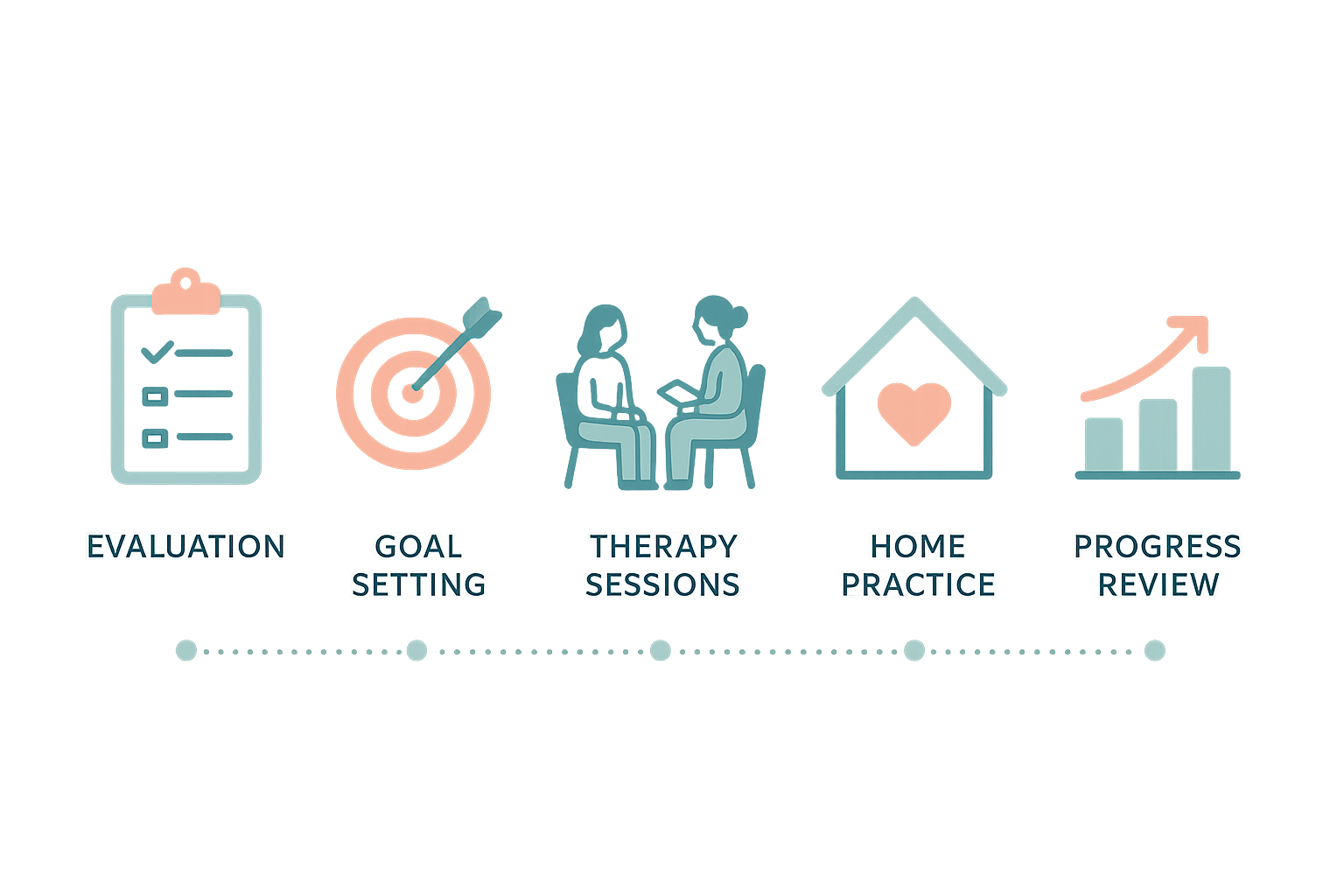
The typical journey through speech delay therapy for toddlers, from evaluation to ongoing progress checks.
Bringing It All Together
In summary, speech delay therapy for toddlers works best as a partnership between a trained professional and consistent practice at home. Whether a family chooses in-home sessions, clinic-based care, or a combination of both, the goal remains the same: helping a young child find their voice with confidence. As research from the field of speech-language pathology continues to show, early, play-based intervention gives toddlers the strongest foundation for long-term communication success. If you suspect your toddler may be behind, don't wait; a simple evaluation is often the first step toward meaningful, lasting progress.