
Speech-Language Pathology Resources for Early Childhood Educators
Find speech-language pathology resources for early childhood educators: story-based core vocabulary tools, tips, and free samples. Explore options now.

Finding speech-language pathology resources for early childhood educators can feel like a maze when your day is full of circle time, snack, and tiny shoes. Good resources are short, flexible, and easy to share with your team. This guide explains what to look for and how to use story-based tools without adding pressure to your day.
Quick answer: Speech-language pathology resources for early childhood educators are classroom-ready materials, like short stories and tip sheets, that help adults model language. Look for ones that are brief, support all communication modes, and fit routines you already have.
What Are Speech-Language Pathology Resources for Early Childhood Educators?
Speech-language pathology resources for early childhood educators are materials built on speech-language pathology principles and designed for classroom use. They might include illustrated stories, vocabulary tip sheets, or planning calendars.
They help teachers model language during everyday routines. However, they do not replace individualized assessment or therapy. An SLP should select speech targets and cues for each child.
These resources provide educational support and do not replace individualized assessment, clinical judgment, or speech-language therapy. An SLP should select speech targets and cues for each child.
Short, shared reading moments fit naturally into an early childhood classroom day.
Why Core Vocabulary Fits Early Childhood Classrooms
Core vocabulary is a small group of high-use words, such as more, go, stop, and help. Children use them across play, snack, and transitions. As a result, one word can be modeled all day.
Core words also matter for augmentative and alternative communication (AAC). AAC includes picture boards, speech-generating devices, signs, and gestures. The American Speech-Language-Hearing Association (ASHA) offers background on AAC and early communication for educators and families.
Aided Language Modeling in Plain Words
Aided language modeling means you point to or select a word on a child's AAC system while you talk. The child sees the word in action. Nobody has to repeat it back.
How Story-Based Resources Support Language Modeling
Stories give adults a predictable frame. The same word appears again and again in a meaningful context. Consequently, modeling feels natural instead of drilled.
Little Speech Corner, created by Gwen Swire, M.A., CCC-SLP (Mrs. Gwen), builds its resources on this idea. Mrs. Gwen is an SLP with more than 20 years of experience across early intervention, preschool, elementary, and family settings. Her credentials describe her background, and they are not an endorsement of any specific product's outcomes. You can learn more on the Little Speech Corner website.
The Read, Model, Play Routine
Read, Model, Play starts with a short Core Story, about five minutes of shared reading and core-vocabulary modeling. Then comes interaction and child-led play. The five minutes describes the routine, not a promised result.
Types of Resources to Look For
| Resource type | Best used for |
|---|---|
| Core Stories | Modeling one core word through shared reading and play |
| Sound Stories | Clinician-selected articulation practice in connected stories |
| Team Supports | Core Word Tip Sheets and a planning calendar for school and home carryover |
The Core Stories Foundational 53-Pack is a TPT bundle with a suggested weekly Core Word of the Week sequence. It is not a complete individualized therapy program. Confirm the current listing for included files and licensing.
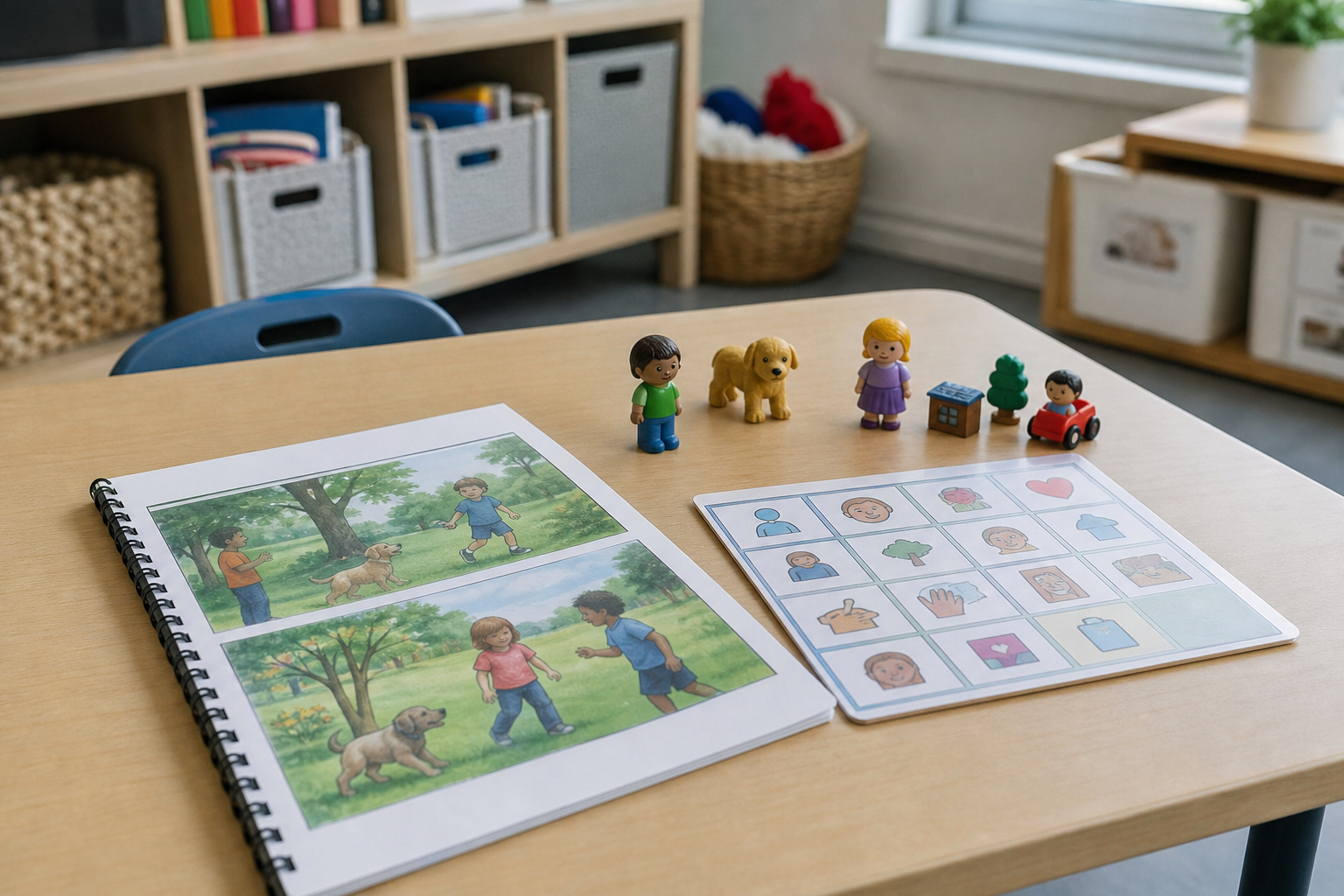
Pairing a story with communication supports keeps every child's full vocabulary within reach.
How to Use a Core Story in Your Classroom
- Pick one core word that suits your group, ideally with your SLP's input.
- Place each child's full communication system within reach.
- Read the story in about five minutes and model the word as you go.
- Move into child-led play and model the word again in natural moments.
- Share the word with families and staff for school and home carryover.
Choosing Resources That Respect Every Communicator
First, keep the child's full communication system available at all times. Second, avoid requiring repetition or forcing speech. Finally, welcome gestures, pictures, signs, devices, and spoken words equally.
For more ideas, see these guides on printable preschool speech and language resources, story-based resources for young children, and resources for busy school-based SLPs. You can also read about early speech intervention and early intervention with SLPs.
Try a Free Sample First
A preview is the easiest way to judge fit. Free samples include the Apples for Anna (THERE) Core Story, a calendar with a sample Core Story, and SW and CH Sound Story samples. Downloads are completed through the Little Speech Corner store on Teachers Pay Teachers (TPT). Storytime Stories and Story Builders are still in development and are not available yet.
Frequently Asked Questions
What are speech-language pathology resources for early childhood educators?
They are materials that help teachers support speech, language, and communication in young children, such as story-based core vocabulary tools and tip sheets. They support classroom routines and do not replace an SLP's assessment or therapy.
Can teachers use SLP resources without being a speech-language pathologist?
Yes, many language-modeling resources are designed for classroom teams. Still, an SLP should select speech targets and cues for each child.
What is core vocabulary?
Core vocabulary is a small set of common words, like go, more, and stop, that make up much of everyday talk. Because these words are used across activities, they are useful to model.
What is AAC?
Augmentative and alternative communication (AAC) includes tools and strategies, such as picture boards, devices, signs, and gestures, that support communication beyond speech alone.
What is aided language modeling?
Aided language modeling means an adult points to or selects words on a child's AAC system while speaking. The child sees how the system works without being asked to respond.
What age range do story-based resources suit?
Little Speech Corner's resources are designed primarily for children ages 2 to 7. Adapt words and expectations to each learner.
How long does a Read, Model, Play session take?
The story portion takes about five minutes, followed by interaction and child-led play. The five minutes describes the routine, not a promised outcome.
Should I make children repeat the target word?
No. Modeling invites participation without pressure, and children can respond in any communication mode they use.
How do I choose between core vocabulary and sound resources?
Core vocabulary resources build shared language for all communicators, including AAC users. Sound-focused stories suit articulation practice, with targets chosen by an SLP.
Are there free speech-language pathology resources for early childhood educators to try?
Little Speech Corner offers free samples, including the Apples for Anna (THERE) Core Story, a calendar with a sample story, and SW and CH Sound Story samples. Downloads are through Teachers Pay Teachers.
Where can I buy Little Speech Corner resources?
Purchases and free downloads are completed through the Little Speech Corner store on Teachers Pay Teachers (TPT). Check the listing for current details.
Can I share a purchased resource with my whole school?
Check the current TPT licensing on the listing before sharing with staff or schoolwide. Terms vary, so confirm before distributing.
Conclusion
The best speech-language pathology resources for early childhood educators are short, flexible, and respectful of every communication mode. Story-based core vocabulary tools make modeling easy to fit into routines, and team supports help carry words across school and home. Start small with a free sample, partner with your SLP on targets, and invite children into the story at their own pace.
