
AAC Activities for Preschool: Fun, Easy Ideas That Work
Discover AAC activities for preschool that build communication skills through play, stories, and daily routines. Explore free resources today!
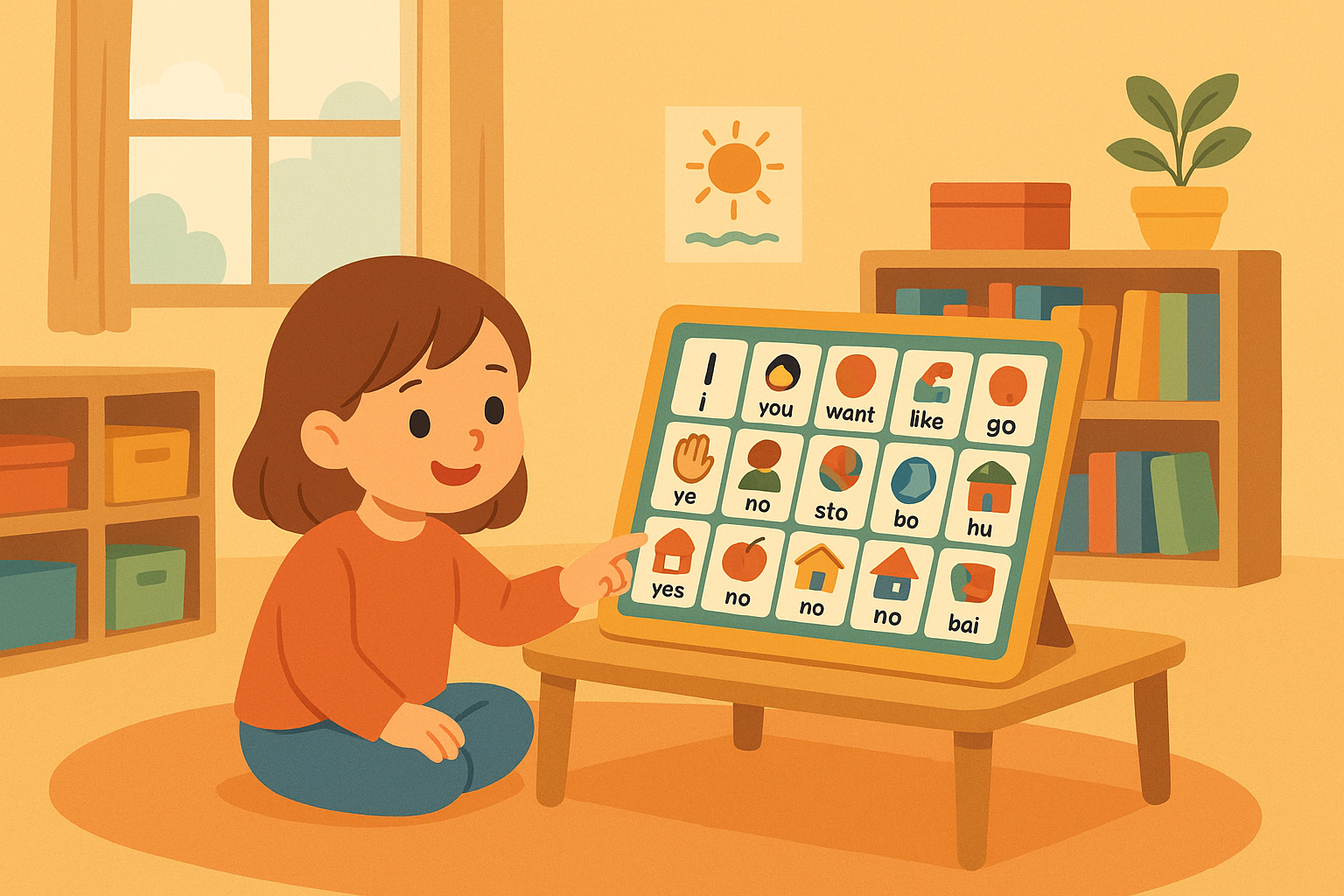
AAC activities for preschool are hands-on, play-based strategies that help children ages 2 to 5 build communication skills using augmentative and alternative communication (AAC) — a term for tools like picture boards or speech-generating devices that support or replace spoken words. For young children who are not yet talking, or who need extra support beyond speech, these activities turn everyday moments into language-learning opportunities. Because preschoolers learn best through repetition and play, effective AAC activities pair core vocabulary words with familiar routines like snack time, story time, and outdoor play. As a result, children get many natural chances to practice pointing to, selecting, or activating symbols that represent what they want to say.
Quick Answer: The most effective AAC activities for preschool combine core vocabulary modeling, structured play, and repeated exposure across daily routines like mealtime, circle time, and free play. Simple strategies — such as aided language input, choice-making games, and story-based practice — help toddlers and preschoolers build functional communication skills fastest.
What Are AAC Activities for Preschool?
AAC activities for preschool are structured or play-based tasks designed to help young children practice using AAC systems in everyday contexts. These systems fall into two broad categories: low-tech tools, such as laminated core boards or symbol cards, and high-tech tools, such as speech-generating apps or dedicated devices.
According to the American Speech-Language-Hearing Association, AAC is used to supplement or replace speech for people whose communication needs are not met through speaking alone. In preschool settings, this often means an adult models words on the child's system throughout the day, rather than only during formal therapy sessions. Consequently, the child sees language modeled the same way a hearing child hears spoken words modeled constantly by caregivers.
Hands-on modeling is at the heart of effective AAC activities for preschool.
Why Augmentative Communication Matters for Early Development
Early communication support matters because the preschool years are a critical window for language growth. In fact, research on core vocabulary suggests that a relatively small set of words accounts for a large share of everyday communication, which is why many core vocabulary resources focus on teaching those high-frequency words first rather than spreading attention across hundreds of nouns.
Furthermore, the Centers for Disease Control and Prevention notes that early identification and support for communication delays leads to better outcomes than waiting. Therefore, introducing AAC early, even before a formal diagnosis, is generally considered a low-risk, high-benefit choice by most speech-language pathologists.
Similarly, reducing frustration matters. When preschoolers have a reliable way to express wants and needs, tantrums and behavior challenges often decrease because the child has an alternative outlet for communication.
Core Vocabulary: The Foundation of Effective AAC Activities
Core vocabulary refers to a small group of versatile words, such as go, more, want, and stop, that appear across almost every activity and setting. In contrast, fringe vocabulary includes specific nouns like "dinosaur" or "trampoline" that are useful only in particular contexts.
Because core words are reused constantly, teaching them first gives preschoolers the most communicative power for the least learning effort. Resources such as core vocabulary teaching materials for AAC are built specifically around this principle, pairing repeated core words with themed stories so children encounter the same vocabulary in multiple meaningful contexts throughout a week.
7 Engaging AAC Activities for Preschool Classrooms and Homes
Below is a practical sequence that classroom teams, private-practice SLPs, and parents can adapt for daily use. Each step builds naturally on the one before it.
- Aided Language Input During Play — Model core words by pointing to or activating symbols while you talk during ordinary play, without requiring the child to respond immediately.
- Core Word of the Day — Pick one high-frequency core word each day and intentionally model it across multiple activities, from breakfast to bath time.
- Choice-Making at Snack Time — Offer two visible snack options paired with symbols so the child practices selecting a preferred item using the AAC system.
- Story-Based Modeling with Books — Read a simple story aloud and model core vocabulary words that match the pictures and actions on each page repeatedly, similar to the approach used in story-based speech therapy resources.
- Symbol Scavenger Hunt — Hide symbol cards around a room and encourage the child to find and match them to matching objects or pictures.
- Music and Movement with AAC — Pair action songs with core word symbols like go, stop, and more so children connect vocabulary to physical movement and rhythm.
- Peer Modeling in Small Groups — Group AAC users with verbal peers during structured play so children see multiple communication styles modeled side by side.
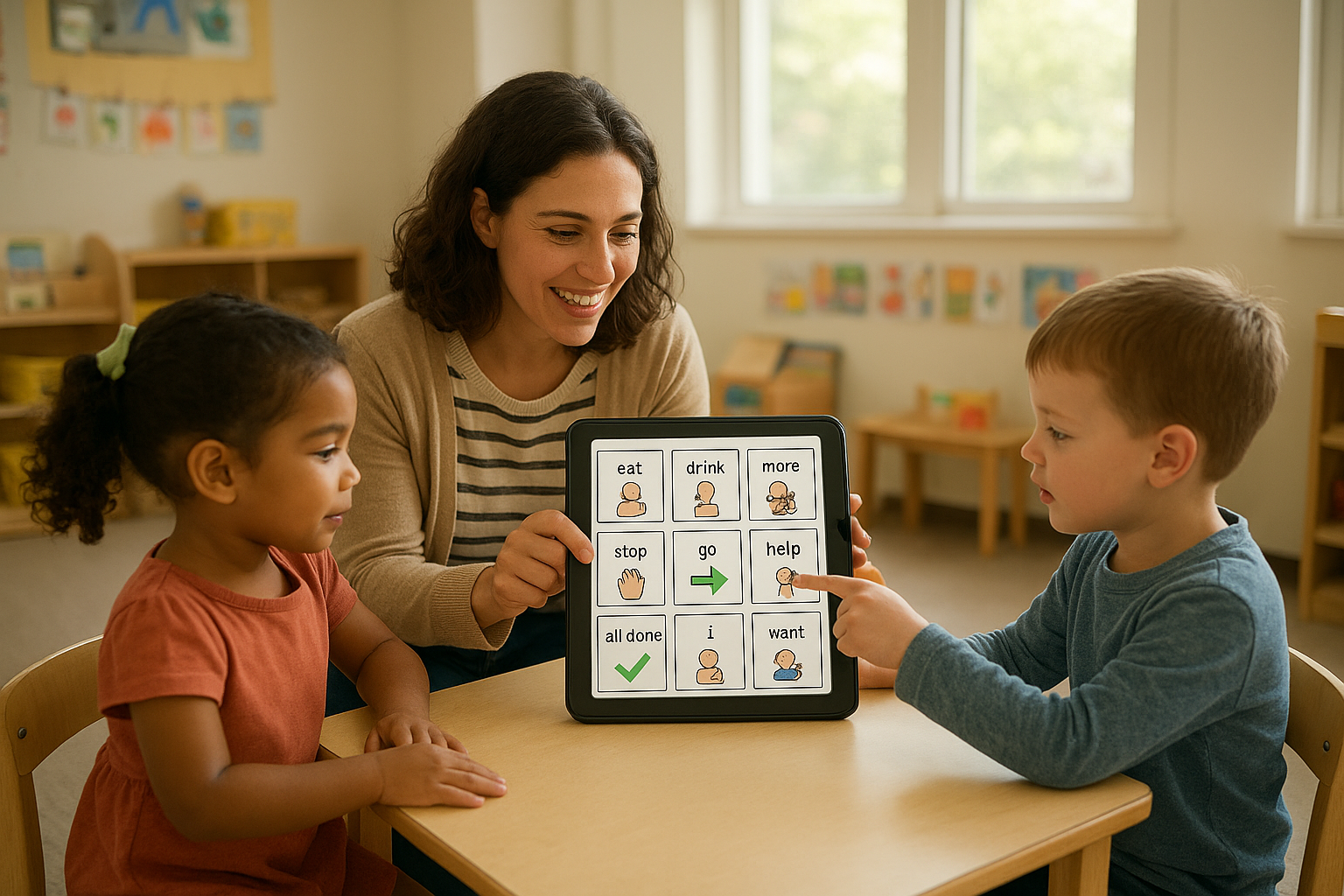
Classroom teams can weave AAC activities for preschool into existing routines with minimal extra prep.
How to Choose the Right AAC Activities for Preschool-Age Children
Choosing the right activity depends on the individual child. Above all, consider current communication level, fine motor ability, and personal interests before selecting materials.
For instance, a child with limited fine motor control may need larger symbol buttons or a partner-assisted scanning approach rather than a small touchscreen grid. In addition, children who love music often respond better to song-based AAC practice than to flashcard-style drills. Consequently, involving a speech-language pathologist in this decision helps match the activity type, vocabulary set, and access method to each child's strengths.
Meanwhile, classroom teams benefit from consistent tools shared between school and home. The everyday activities that boost toddler speech guide offers additional ideas that pair naturally with AAC modeling for younger children still building foundational communication.
Common Mistakes to Avoid With AAC Activities
Even well-intentioned adults sometimes slow AAC progress without realizing it. Below are the most frequent mistakes seen in classrooms and homes.
First, some adults wait for a child to speak before offering AAC, which delays access to communication unnecessarily. Second, treating the AAC system as a reward, rather than a communication tool, sends the wrong message about its purpose. Third, expecting fast, spontaneous results within days rather than weeks or months often leads to premature discouragement. Instead, consistent modeling without performance pressure tends to produce steadier, longer-lasting progress.
Tips for AAC Carryover at Home and School
Carryover between settings matters just as much as the activities themselves. Therefore, sending home a simple tip sheet listing the week's core words helps parents model the same vocabulary shown in the classroom.
Similarly, planning tools like a core-vocabulary calendar keep teams and families aligned on which words to emphasize each week. When school and home use matching vocabulary, children generalize new words faster because they hear and use them in more varied situations. For a closer look at foundational AAC concepts and terminology, the AAC basics overview and this related guide to getting started with AAC are both useful starting points for teams new to these tools.
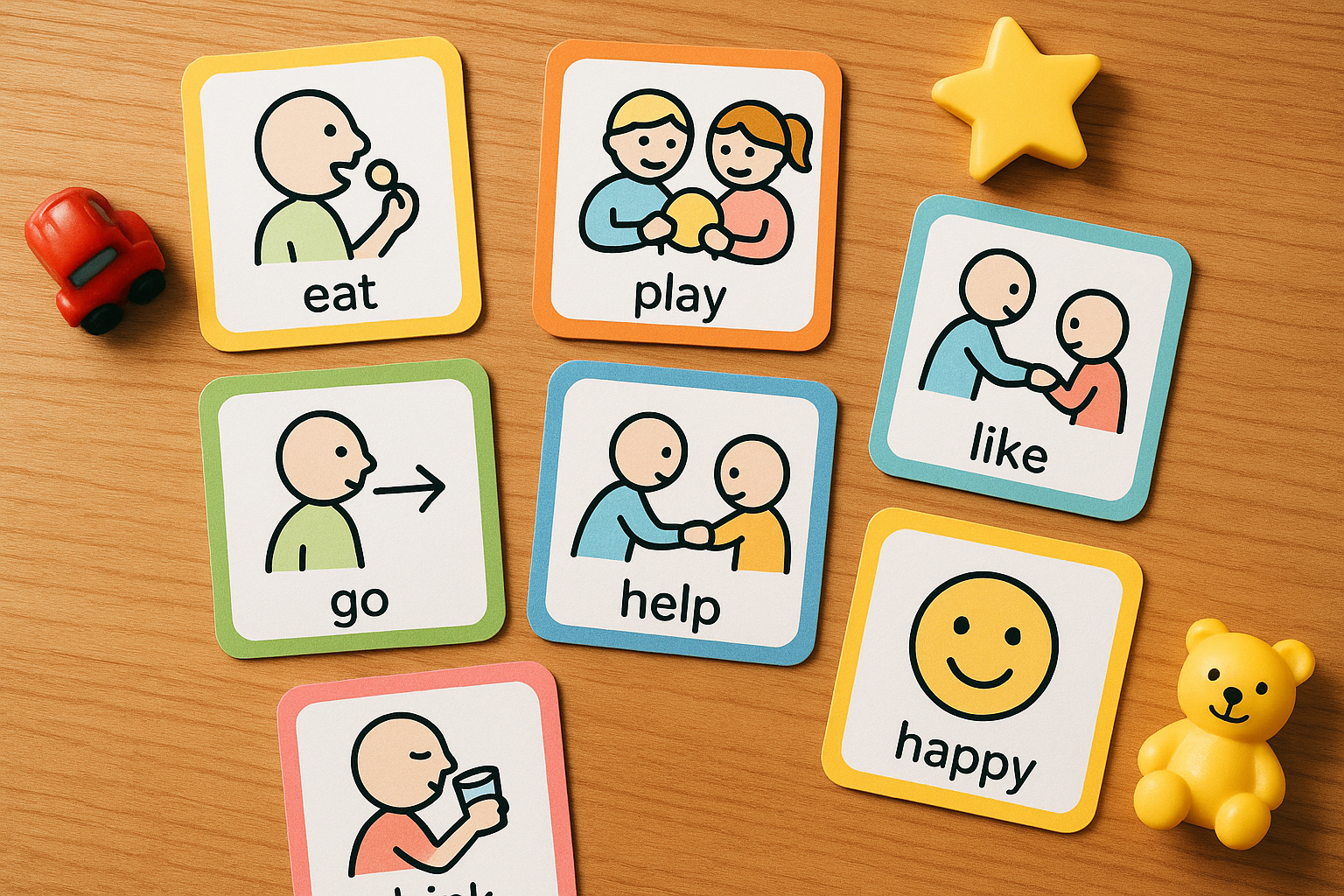
Low-tech symbol cards remain a flexible, affordable option for AAC activities for preschool.
Frequently Asked Questions About AAC Activities for Preschool
What are AAC activities for preschool?
AAC activities for preschool are play-based tasks that help young children practice using augmentative and alternative communication tools, such as picture boards or speech-generating devices, to express wants, needs, and ideas. They pair everyday routines with modeling so children see communication in action.
How do I start AAC activities for preschool at home?
Start by placing a core vocabulary board near a favorite activity and modeling one or two words during play, without requiring your child to respond. Consistency matters more than speed, so short daily sessions during snack time or play work well.
Why are AAC activities for preschool important for language development?
AAC activities give preschoolers who struggle with verbal speech a reliable way to participate in conversations, which supports vocabulary growth, social interaction, and reduced frustration. Early access to communication tools is linked to stronger long-term language outcomes.
What is the difference between AAC and core vocabulary?
AAC is the broader category of tools and strategies that support communication, while core vocabulary refers to the small set of high-frequency words, like go, more, and stop, that make up most of everyday speech. Core vocabulary is often the content taught through AAC systems.
How much do AAC activities for preschool cost to set up?
Low-tech options like printed core boards or symbol cards can cost very little or be free, while dedicated speech-generating devices and apps range from moderate to several hundred dollars. Many SLPs recommend starting with low-tech materials before investing in higher-tech tools.
How long does it take to see progress with AAC activities?
Progress varies by child, but many families and teachers notice increased attention to the AAC system within a few weeks of consistent modeling. Functional, spontaneous use typically develops over several months of regular practice.
What are common mistakes when introducing AAC activities for preschool?
Common mistakes include waiting for a child to speak before offering AAC, treating the system as a reward instead of a communication tool, and expecting instant results. Consistent modeling without pressure to perform tends to work far better.
What are best practices for modeling AAC during play?
Best practices include pointing to or activating symbols as you talk, following the child's lead in play, and using core words repeatedly across different activities. This approach, sometimes called aided language input, shows children how the system works in real time.
Can AAC activities for preschool be used alongside speech therapy?
Yes, AAC activities are typically designed to complement, not replace, speech therapy goals. Many SLPs incorporate AAC directly into sessions while also targeting articulation, language, or social communication skills.
What core words should I target first in AAC activities?
Early core words often include go, stop, more, help, want, and all done, since these are useful across many activities and settings. Choosing versatile words first helps children generalize communication skills faster.
Do AAC activities replace verbal speech development?
No, research consistently shows that AAC does not hinder verbal speech and may actually support it by reducing communication pressure and frustration. Many children continue developing spoken language alongside AAC use.
What materials do I need for AAC activities for preschool?
Basic materials include a core vocabulary board, symbol cards, favorite books, and toys tied to daily routines. Some classrooms and homes also use speech-generating apps or devices alongside printed materials.
How can teachers use AAC activities for preschool in the classroom?
Teachers can embed AAC activities into circle time, centers, and transitions by modeling core words on a classroom-wide display board. Pairing AAC with story-based lessons helps every student see communication modeled naturally throughout the day.
What age is appropriate to start AAC activities?
AAC activities can begin as early as toddlerhood, and there is no minimum age requirement or prerequisite skill needed to start. Early exposure, even before a formal diagnosis, is generally encouraged by speech-language pathologists.
Where can I find free AAC activities for preschool resources?
Many speech-language resource sites, including Little Speech Corner, offer free introductory core vocabulary boards and sample story-based activities to try before purchasing a full set. These samples are a helpful way to test what works for a specific child.
Bringing It All Together
In summary, AAC activities for preschool work best when they are simple, repeated often, and woven into routines children already enjoy, from snack time to story time. Rather than searching for one perfect activity, teams and families tend to see the strongest results by combining core vocabulary modeling, choice-making games, and story-based play across both school and home settings. Above all, patience matters: meaningful communication growth through AAC activities for preschool usually unfolds over weeks and months, not days. With consistent modeling, the right vocabulary focus, and support from a speech-language pathologist, most young children can build genuine, functional communication skills that carry into every part of their day.