
AAC Books for Speech Therapy: A Practical SLP Guide
AAC books for speech therapy support core vocabulary, language growth, and AAC modeling for young children ages 2-7. See top picks and get started.
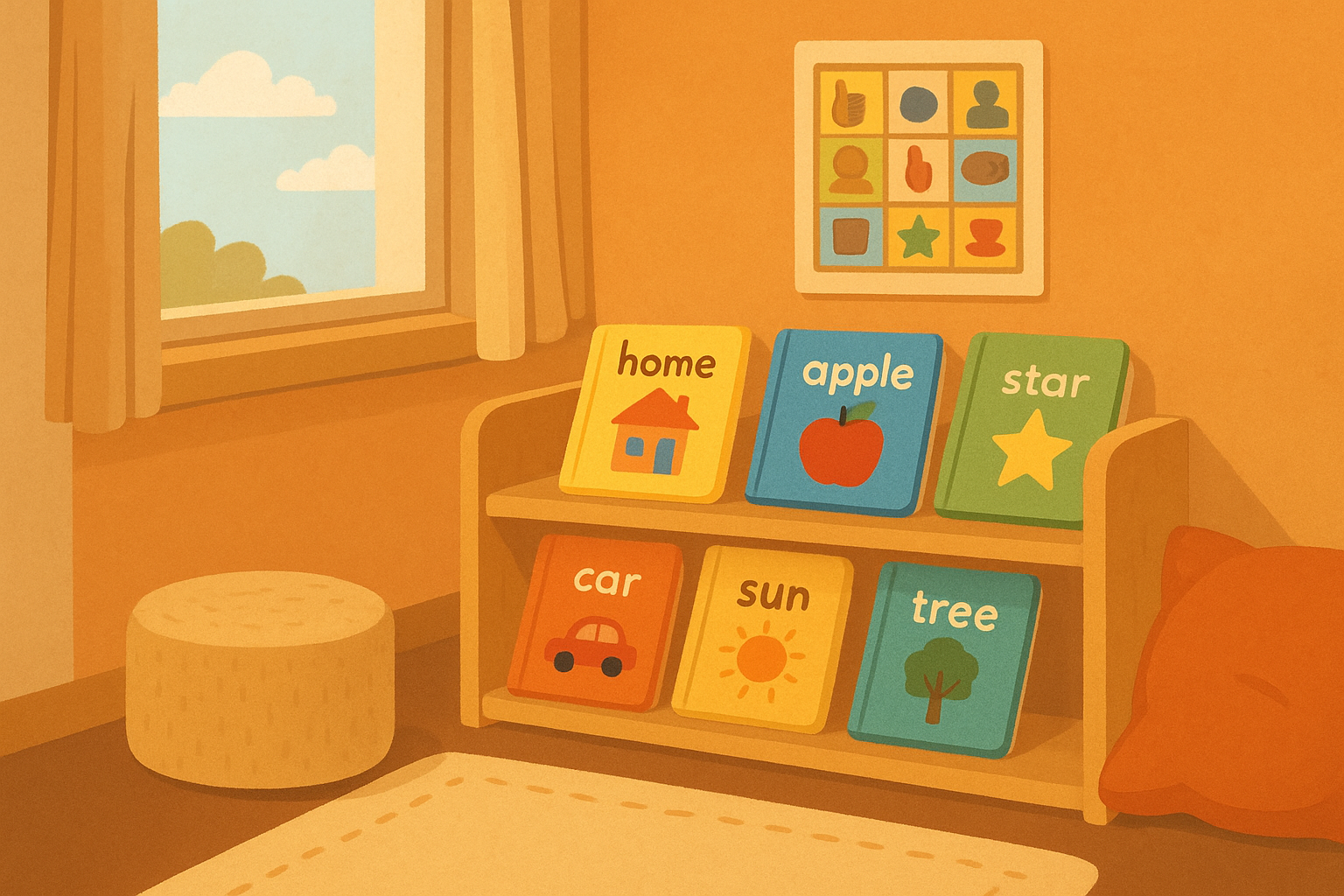
AAC books for speech therapy are story-based tools built around core vocabulary that help children who use little or no verbal speech practice communication in a natural, repeated way. Rather than teaching one-off vocabulary tied to a single picture, these books focus on high-frequency words that show up in nearly every conversation. As a result, they have become a staple in early childhood speech-language pathology, classrooms, and home carryover routines alike. However, "AAC books" is actually an umbrella term that covers two distinct categories — core vocabulary therapy books used for modeling language, and AAC representation picture books that feature characters who communicate using an augmentative and alternative communication (AAC) system. This guide covers both, in far more depth than a typical list of titles.
Quick answer: AAC books for speech therapy are repeated-line story books that pair core vocabulary words with symbols or an AAC system, giving clinicians a simple structure for modeling language during sessions. A second category — AAC representation picture books — features storybook characters who use AAC devices or boards, helping peers understand and accept AAC as a normal way to communicate. Both types work best when paired with play-based follow-up activities that reuse the same words.
What Are AAC Books for Speech Therapy?
AAC books for speech therapy are printed or digital story resources designed around augmentative and alternative communication, or AAC — a term that describes any tool, symbol system, or device that supports communication for people who cannot rely fully on speech. In particular, these books repeat a small set of core words on every page, giving children multiple chances to see, hear, and eventually use the same vocabulary in different situations. Specifically, this category falls into two groups that serve very different purposes in a session or classroom.
Core Vocabulary AAC Story Books
These are the workhorse of most therapy rooms. Unlike a typical storybook, a core vocabulary AAC story book is not primarily about the plot. Instead, the story acts as a vehicle for modeling functional words like go, more, stop, and help. Consequently, clinicians can use the same handful of stories for months, simply changing the activity that follows the reading. These books are designed to be read aloud dozens of times, since repetition — not novelty — is what builds expressive language in AAC learners.
AAC Representation Picture Books
The second category looks and reads more like a mainstream children's book, with a full plot, characters, and illustrations. What sets it apart is that one of the characters communicates using an AAC device, letter board, or communication book within the story itself. These titles are not primarily therapy tools for modeling core words; rather, they build disability awareness and peer acceptance by showing classmates, siblings, and readers that communicating through AAC is simply another valid way to talk. Therefore, while core vocabulary books live in the therapy room, representation picture books often belong in classroom read-alouds, library displays, and sibling bedtime routines.
AAC books for speech therapy are often kept within easy reach for daily modeling.
Why AAC Picture Books Matter for Early Communicators
Research cited by clinicians and organizations such as the American Speech-Language-Hearing Association often notes that a relatively small set of core words accounts for the majority of everyday spoken language. Because of this, AAC picture books that repeat those exact words give children far more practice per page than a book filled with unique, one-time vocabulary.
Above all, this repetition builds confidence. A child who hears and models "go" during a story about a bus, a swing, and a puppy learns that the word transfers across contexts. In addition, caregivers often report that children begin reaching for the communication display on their own once a story becomes familiar, which is a strong sign that generalization is taking hold.
Similarly, AAC picture books support joint attention. Since the adult and child are looking at the same page and pointing to the same symbols, the interaction naturally builds the back-and-forth turn-taking that underlies later conversation skills. Meanwhile, representation picture books contribute a different but equally important benefit: they reduce stigma. When classmates see a character casually press buttons on a speech-generating device mid-story, AAC stops looking unusual and starts looking like an everyday tool — exactly how it should be perceived.
AAC Representation Picture Books vs. Core Vocabulary Books: What's the Difference?
It is easy to confuse these two categories, since both are frequently filed under "AAC books" in search results and catalogs. However, understanding the difference helps teams choose the right tool for the right goal.
- Purpose: Core vocabulary books model specific high-frequency words for direct language practice, while representation picture books build awareness, empathy, and acceptance of AAC as a communication method.
- Setting: Core vocabulary books are typically used one-on-one or in small groups during therapy, whereas representation picture books work well in whole-class read-alouds and library collections.
- Structure: Core vocabulary books repeat the same small word set on every page; representation picture books follow a full narrative arc with a beginning, middle, and end.
- Audience: Core vocabulary books are chosen for the AAC user directly, while representation picture books are often chosen for the AAC user's peers, siblings, and teachers just as much as for the user.
In short, a well-rounded caseload — or a well-stocked classroom library — benefits from both. In particular, pairing a core vocabulary story with a representation picture book on the same theme (for example, a trip to the park) gives children a therapy tool and their classmates a mirror of that experience in the same week.
How to Evaluate AAC Representation Picture Books for Authenticity
Not every book that shows a device on the cover gets the representation right. Therefore, it helps to run new titles through a short authenticity checklist before adding them to a shelf or lesson plan.
- Check whether the AAC-using character has agency in the story — do they make choices, solve problems, and drive the plot, rather than simply being helped or spoken about?
- Look for an author's note or consultation credit, since books developed with input from AAC users, SLPs, or disability advocates tend to portray the device and the user more accurately.
- Confirm the device shown is portrayed as a genuine voice, not a prop, gadget, or plot device that gets "fixed" or abandoned by the story's end.
- Avoid narratives built around a "cure" or "overcoming disability" theme, since these can unintentionally suggest that AAC use is temporary or something to grow out of.
- Favor stories where the AAC-using character has ordinary interests, friendships, and humor, rather than existing in the plot solely to teach other characters a lesson about kindness.
Running new titles through this checklist takes only a few minutes, yet it meaningfully raises the quality of what ends up on a classroom shelf or in a therapy bag. For SLPs juggling dozens of other responsibilities, this kind of quick-reference approach pairs well with the resources curated for busy school-based SLPs.
How to Choose AAC Communication Books for Your Caseload
Selecting the right AAC communication books can feel overwhelming with so many options available. Therefore, it helps to follow a consistent process when reviewing new materials for a caseload or classroom.
- Choose a core-vocabulary book that repeats a small, functional set of words across every page rather than one built around isolated topic vocabulary.
- Preview the communication display or symbol set before the session so you can point to each core word smoothly while reading aloud to the child.
- Model the language without demanding a response, pointing to core words on the display exactly the way a parent models spoken words with a toddler.
- Pause at predictable moments in the story to give the child a chance to anticipate, request, or comment using the AAC system at their own pace.
- Extend the story with a related play-based activity that reuses the same core words, helping the child generalize vocabulary beyond the book itself.
Following this five-step process keeps sessions predictable for the child while still allowing room for new stories and themes throughout the school year.
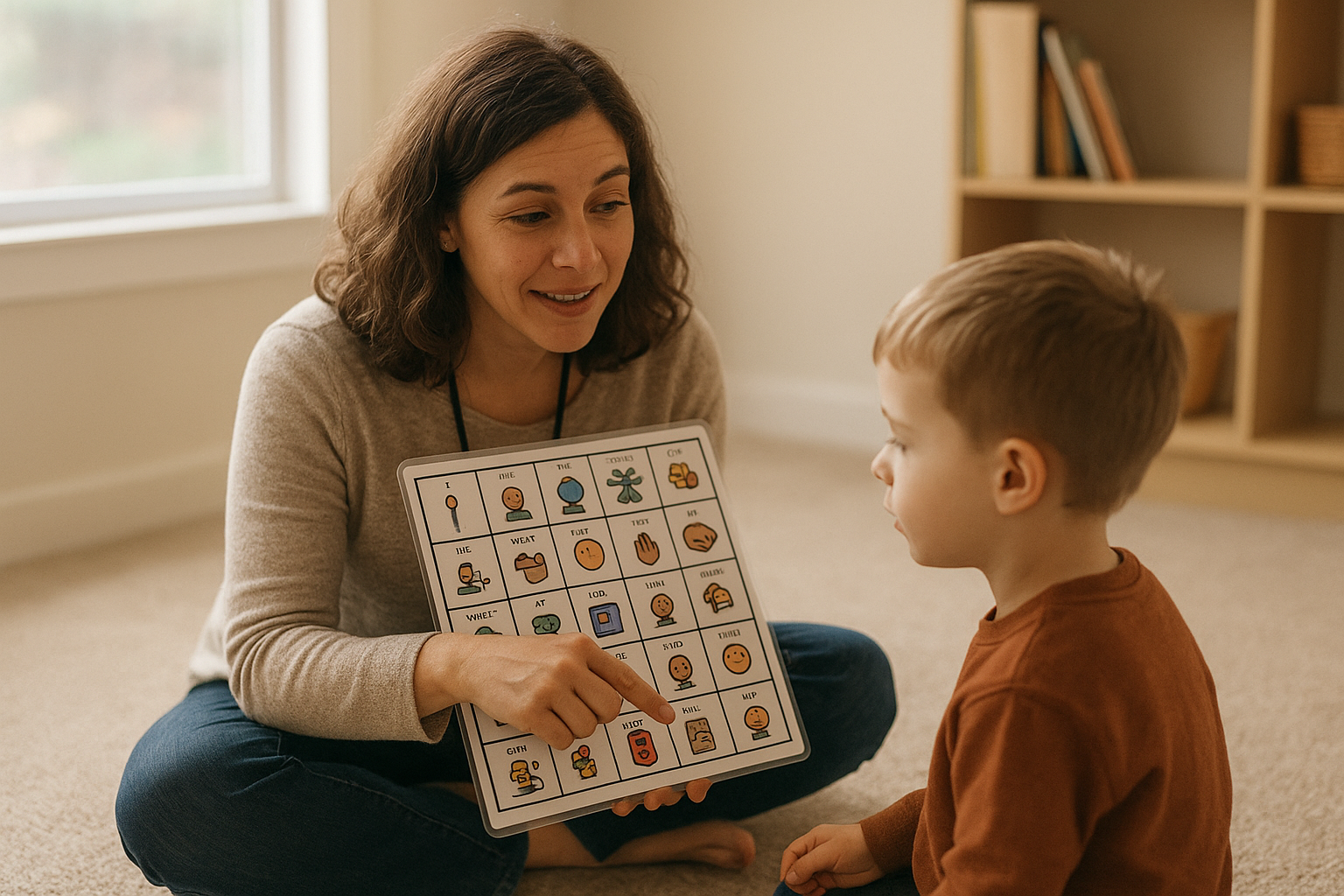
Modeling core words consistently is central to the Read, Model, Play approach.
Core Vocabulary Books and the Read, Model, Play Approach
Many current AAC story books follow a structure often described as "Read, Model, Play." First, the adult reads the story while modeling core words on a display or device. Next, the child is invited to join in during predictable, repeated lines. Finally, the vocabulary is extended into a hands-on play activity that mirrors the story's theme.
Little Speech Corner's Core Stories follow exactly this framework, pairing story-based sessions with matching play ideas so that school-based and private-practice SLPs can move from book to activity without extra prep. For instance, the guide to core vocabulary books for SLPs and teachers walks through how to select stories that match a caseload's current core-word goals. Clinicians who want a broader overview of story-based options can also review this roundup of story-based speech therapy resources before building a session plan.
Using AAC Representation Books to Build Peer Acceptance in the Classroom
Representation picture books earn their place in a classroom read-aloud rotation, not just a therapy bag. Specifically, a teacher can introduce a story featuring an AAC-using character, then pause afterward for a short discussion rather than rushing to the next activity.
Useful discussion prompts include asking classmates what they noticed about how the character "talked," why pointing to pictures or pressing buttons counts as real communication, and how they might include an AAC-using friend in a game at recess. Furthermore, pairing the read-aloud with a simple classroom AAC display — even a laminated core board taped to a table — lets every student try pointing to a word themselves, which builds empathy far faster than discussion alone.
Consequently, these books work best as a planned unit rather than a one-time read. Revisiting the same title a few times across a semester, especially around a new student's arrival or an AAC awareness week, keeps the message current instead of fading after a single lesson.
Best Practices for Using AAC Story Books in Sessions
In particular, consistency matters more than novelty when it comes to AAC story books. Reusing the same three or four stories across several weeks lets a child build real fluency with the core words rather than constantly starting over with new vocabulary.
Furthermore, it helps to involve the whole team. Classroom teachers, paraprofessionals, and caregivers can all model the same core words from the same book, which reinforces learning far beyond the therapy room. For ideas on extending this practice at home and school, the story-based speech therapy activities guide for ages 2 to 7 offers practical carryover suggestions.
Consequently, tracking progress becomes easier too. When the same book and the same core words are used repeatedly, an SLP can more clearly note whether a child has moved from simply watching, to imitating, to spontaneously requesting with the display.
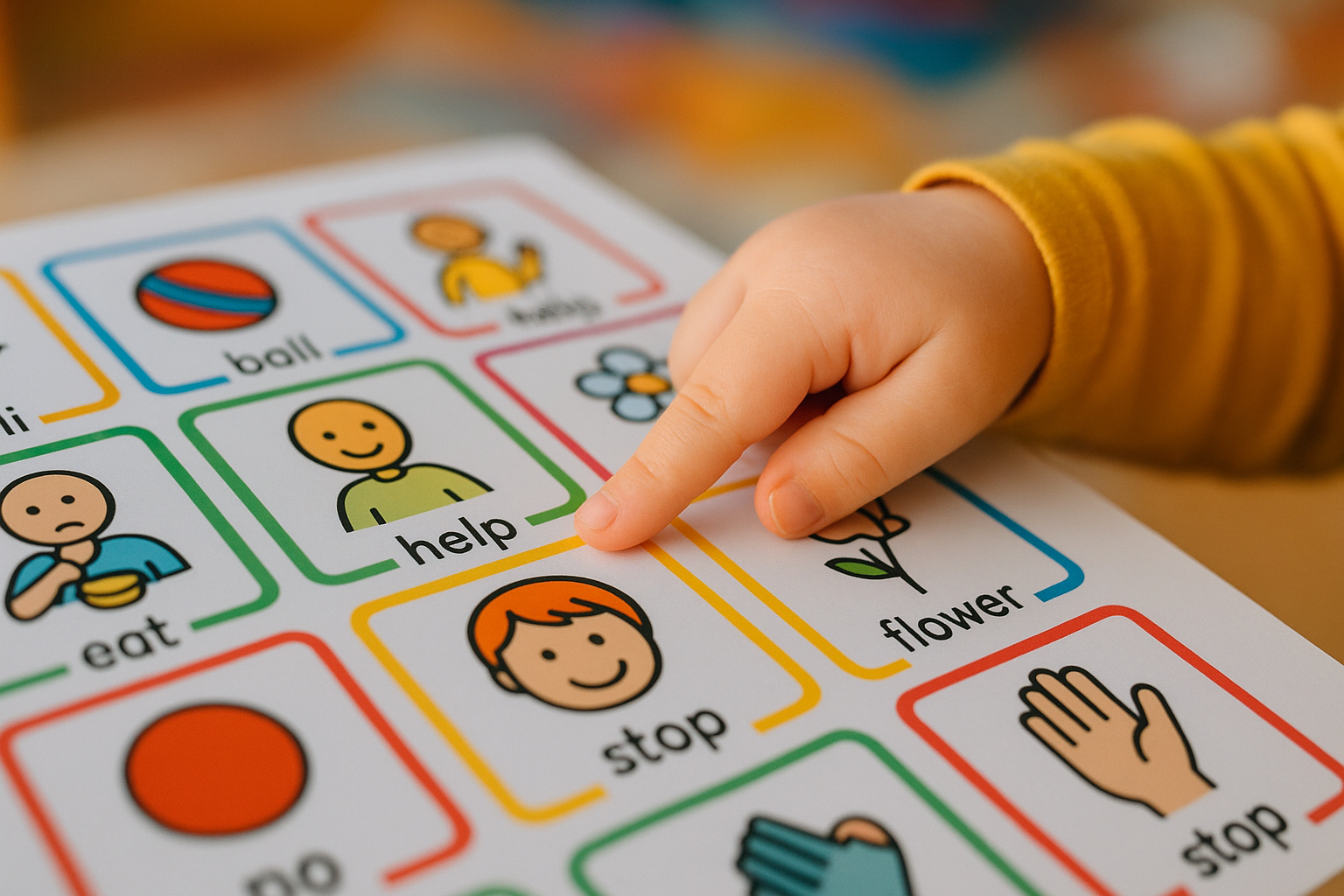
Repeated pointing and modeling helps children build independence with AAC books for speech therapy.
Common Mistakes to Avoid With Core AAC Resources
One frequent mistake is treating the AAC display like a test, asking a child to "find the word" instead of simply modeling it during natural reading. This can unintentionally reduce a child's motivation to communicate. Instead, aided language input — modeling on the display while speaking — tends to build far more genuine engagement.
Another common misstep is introducing too much new vocabulary at once. Since core vocabulary depends on repetition, spreading a child's attention across dozens of unfamiliar words each session slows progress. A smaller, well-practiced set of words almost always outperforms a large, unfamiliar one.
With representation picture books, a similar mistake shows up in a different form: choosing a title simply because it has an AAC device on the cover, without checking whether the character is portrayed with real agency. Likewise, treating a single read-aloud as a complete "AAC awareness lesson" rarely sticks. In contrast, a brief, repeated exposure across the year builds lasting acceptance far better than a one-off assembly.
Finally, some teams overlook the free introductory resources many publishers provide. Sampling a free core vocabulary story, such as those offered through Little Speech Corner's website, is a practical way to confirm a fit before committing to a full bundle. For a deeper look at how AAC fits into broader therapy planning, the site's AAC resource hub is a useful starting point.
Where AAC Books Fit Alongside Devices and Other Tools
AAC books do not replace speech-generating devices; rather, they complement them. Low-tech books are portable, inexpensive, and easy to send home, which makes them ideal for reinforcing the exact vocabulary a child is also learning on a dedicated device. For a broader external overview of AAC as a field, the Wikipedia entry on augmentative and alternative communication offers helpful background, while the CDC's early childhood development resources provide context on communication milestones ages 2 through 7.
Therefore, many school-based teams treat books and devices as two parts of the same system rather than competing tools. A child might model "more" on a laminated display during a book, then transfer that same word to a speech-generating device later in the day.
AAC Picture Books by Age and Communication Stage
Because readiness varies so widely, matching a book to a child's current communication stage matters more than matching it strictly to age in years.
- Ages 2-3, early emerging communicators: Choose core vocabulary books with two to four words per page and very simple, repetitive lines.
- Ages 4-5, context-dependent communicators: Introduce slightly longer repeated lines and begin pairing a representation picture book with the core story to build early peer awareness.
- Ages 6-7, independent communicators: Add representation picture books with fuller plots and chapter-style stories, alongside core vocabulary books that introduce new combinations of familiar words.
- Older students with complex communication needs: Core vocabulary frameworks still apply, though the stories themselves should reflect age-appropriate themes rather than early-childhood plots.
Frequently Asked Questions About AAC Books for Speech Therapy
What are AAC books for speech therapy?
AAC books for speech therapy are story or picture books built around core vocabulary that pair spoken language with symbols, pictures, or an AAC system. They give clinicians and caregivers a consistent way to model language for children who use little or no verbal speech.
How do AAC books differ from typical picture books?
Typical picture books focus on vocabulary tied to a single scene, while AAC books repeat a small set of core words across every page. This repetition helps children generalize high-frequency words like more, go, and stop across many contexts.
What are picture books that feature AAC users?
Picture books that feature AAC users are mainstream-style storybooks with a full plot where a character communicates using a device, letter board, or communication book. Unlike core vocabulary books, their primary goal is building peer awareness and acceptance rather than modeling specific words.
How do representation picture books differ from core vocabulary AAC books?
Representation picture books follow a complete story and are usually read to a whole class to build empathy, while core vocabulary AAC books repeat a small set of functional words and are used directly with an AAC learner to teach language.
How do speech-language pathologists use AAC books in sessions?
SLPs typically read the story aloud while pointing to core words on a communication display, then pause to let the child fill in a word or make a choice. Afterward, they extend the vocabulary into a related play-based activity for carryover.
Why is core vocabulary important in AAC books?
Core vocabulary consists of a small set of high-frequency words that make up most of everyday conversation. Because these words appear across countless situations, teaching them through AAC books gives children flexible, reusable language rather than single-use labels.
What age range benefits most from AAC books for speech therapy?
Children roughly ages 2 to 7 tend to benefit most, since this is a critical window for building foundational communication skills. However, older students with complex communication needs can also use core-vocabulary books effectively.
How much do AAC books typically cost?
Digital AAC books and core-vocabulary story bundles are often sold individually or as bundles, commonly ranging from a few dollars to around 20 to 40 dollars for a full pack. Many publishers also offer a free sample story so clinicians can preview the format first.
How long does it take to see progress using AAC books?
Progress varies by child, but many caregivers and SLPs notice increased attention to the communication display within a few weeks of consistent modeling. Consistent, repeated exposure across home and school settings tends to speed up generalization.
What common mistakes should be avoided when using AAC books?
A common mistake is testing the child by asking them to point to a word instead of simply modeling it, which can reduce motivation to communicate. Another is introducing too many new words at once instead of focusing on a small, repeated core set.
Can parents use AAC books at home for carryover?
Yes, parents can use the same AAC books and core-word tip sheets at home to reinforce what happens in therapy sessions. Consistent modeling across settings is one of the strongest predictors of language growth for AAC learners.
What is the difference between AAC books and dedicated AAC devices?
AAC books are low-tech, printable or digital story materials, while dedicated AAC devices are electronic speech-generating systems with voice output. Many clinicians use AAC books alongside a device to teach and reinforce the same core vocabulary.
How many core words should an AAC book include?
Most core-vocabulary programs focus on a foundational set of around 20 to 50 high-frequency words at a time rather than the full vocabulary at once. Starting small and repeating those words often supports faster, more confident use.
What best practices improve AAC book sessions?
Best practices include modeling core words without demanding a response, pairing the book with hands-on play, and repeating the same story across multiple sessions. This repetition builds familiarity, which in turn builds confidence.
Are AAC books suitable for children with autism or complex communication needs?
Yes, AAC books are widely used with children who have autism, apraxia, Down syndrome, or other complex communication needs. Their predictable structure and repeated vocabulary make them especially supportive for learners who benefit from consistent routines.
Where can SLPs find quality AAC books for speech therapy?
SLPs can find AAC books through specialized publishers, professional marketplaces like Teachers Pay Teachers, and free introductory samples offered by resource creators. Little Speech Corner, for example, offers Core Stories built specifically for core vocabulary and AAC modeling.
Key Takeaways
In summary, AAC books for speech therapy give SLPs, educators, and caregivers a repeatable, low-pressure way to model core vocabulary for young communicators, while a second category — AAC representation picture books — builds the peer understanding that makes everyday AAC use feel normal rather than novel. By choosing books with a small, functional word set, following a Read, Model, Play structure, evaluating representation titles for authenticity, and reinforcing the same vocabulary across home and school, teams can help children build communication skills that transfer well beyond a single story. Ultimately, the right AAC books for speech therapy work best not as isolated activities, but as one consistent piece of a child's everyday language environment.