
Core Vocabulary Parent Handouts That Boost Carryover
Core vocabulary parent handouts help families model key words at home. Discover free samples and SLP-designed tools from Little Speech Corner.
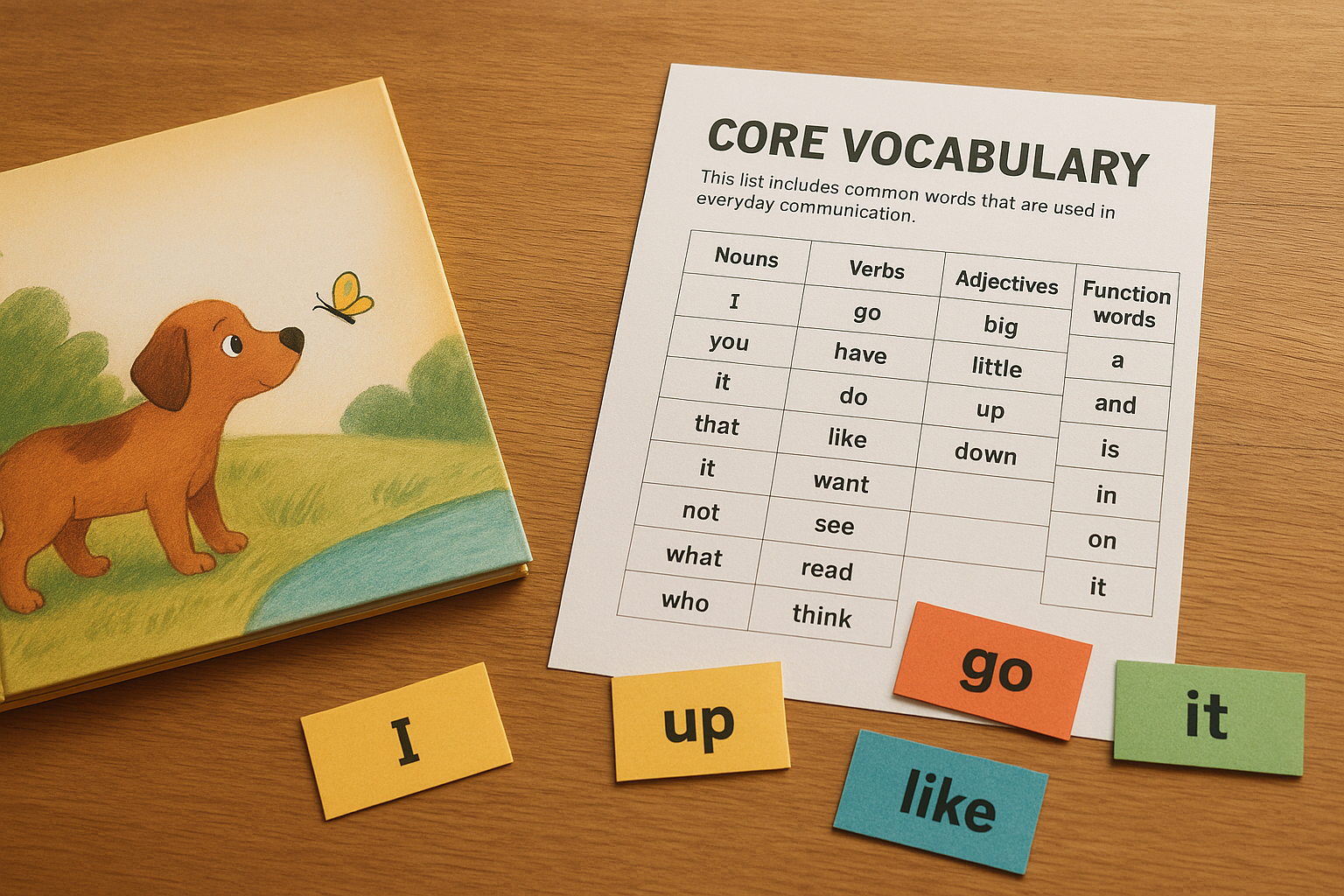
Core vocabulary parent handouts give families a simple way to model the same small set of powerful words that children use across every part of their day. For speech-language pathologists and early childhood teams, these handouts bridge therapy sessions, classrooms, and home routines so one core word gets practiced in many settings instead of just one. In particular, this guide explains what core vocabulary parent handouts are, why they matter for young communicators ages 2 to 7, and how the Read, Model, Play approach turns a short story into a week of meaningful language modeling.
Quick answer: Core vocabulary parent handouts are one-page, SLP-designed sheets that show families how to model a single high-frequency word, such as go, more, or stop, during everyday routines like meals, bath time, and play. They work best when paired with a short shared story and consistent weekly repetition.
What Are Core Vocabulary Parent Handouts?
Core vocabulary parent handouts are one- or two-page resources that pair a single core word with simple visuals, example phrases, and ideas for home practice. Specifically, each handout focuses on one word rather than a long list, which keeps the modeling task manageable for busy families and classroom teams alike.
Core vocabulary itself refers to a small bank of high-frequency words, such as go, stop, want, and help, that children and adults use repeatedly across nearly every topic and setting. According to the ASHA Practice Portal on augmentative and alternative communication, a relatively small set of core words accounts for a large share of everyday spoken language, which is why many SLPs prioritize core vocabulary over narrow, single-use "fringe" words. As a result, teaching one core word thoroughly tends to generalize further than teaching many fringe words briefly.
Little Speech Corner builds its Core Words guide around this same principle, connecting each handout to a related Core Story and a suggested weekly focus so the word shows up consistently at home, in therapy, and in the classroom.
Why Core Vocabulary Handouts for Parents Matter
Therapy time is limited, so carryover into daily life matters enormously. Consequently, core vocabulary handouts for parents give families a clear, low-pressure script for modeling language without needing a speech therapy background.
Instead of guessing what to say, a caregiver can glance at the handout and model the target word naturally during a snack, a car ride, or bath time. Furthermore, because the handout ties back to a short shared story, children hear the word in a meaningful context before adults model it during play. This combination of story exposure and real-life modeling is explored further in a related guide to the best core vocabulary handouts for teachers and parents, which compares formats and use cases in more detail.
In short, a well-designed handout turns an abstract therapy goal into a concrete, repeatable home habit.
Core vocabulary parent handouts pair a single target word with a short story and home practice ideas.
How Core Word Tip Sheets Support Home Carryover
Core word tip sheets, a close cousin of the parent handout, give adults quick-reference phrases and sentence starters for one target word. Typically, a tip sheet lists a handful of natural phrases, such as "go in the car" or "all done eating," so parents and teachers model the word consistently rather than inventing new phrasing each time.
Because tip sheets use the same core word across the home and classroom in the same week, children hear it repeated by multiple adults in multiple contexts. This cross-setting consistency is exactly the kind of support highlighted in a broader look at resources that help SLPs carry core vocabulary from therapy into the classroom.
For teams juggling many students, a planning calendar that sequences one core word per week also prevents the vocabulary from feeling random or disconnected from the child's current goals.
Read, Model, Play: Turning a Core Story Into a Handout
Little Speech Corner's signature method, Read, Model, Play, uses a short Core Story of about five minutes to introduce a core word in context before any formal modeling begins. After the story, the adult models the word using whatever communication supports the child relies on, including speech, signs, or an AAC device.
Then comes the play portion, where the word gets modeled again and again during child-led activity. Notably, this sequence mirrors recommendations from augmentative and alternative communication research, which emphasizes modeling language during natural interaction rather than isolated drill practice.
The Core Stories Foundational 53-Pack packages this entire approach into a ready-made collection, with a suggested Core Word of the Week sequence that pairs each story with its own handout and tip sheet.
Step-by-Step: Using Core Vocabulary Parent Handouts at Home
Because consistency drives carryover, following a simple weekly routine helps families get the most from any handout. The steps below outline one practical sequence.
- Choose one core word handout. Select a single core vocabulary parent handout that matches the current week's focus word, making sure the vocabulary fits the child's communication system and current therapy goals.
- Read the Core Story together. Share the related Core Story for about five minutes, pointing to pictures and modeling the target word naturally within the story instead of quizzing the child.
- Model the word during play. Use the handout's suggested phrases to model the core word across routines like snack time, bath time, and play, pairing speech with AAC supports whenever relevant.
- Repeat across the week. Revisit the same handout across multiple days and settings so the child hears consistent modeling, since repetition builds stronger carryover than one exposure.
- Track and share progress. Note which routines prompted attempts to use the word, then share those observations with the SLP or classroom team to guide the next handout's focus.

A short shared story sets up the word before parents model it during play.
Core Vocabulary Printables for Parents and Classrooms
Beyond single handouts, many teams also rely on broader core vocabulary printables that combine a handout, a tip sheet, and a planning calendar into one packet. These printable sets make it easier for a classroom team to keep every adult, from paraeducators to parents, modeling the same word during the same week.
A detailed comparison of formats, including laminated cards, take-home folders, and digital versions, appears in this guide to core vocabulary printables for AAC classroom use. Meanwhile, free samples, such as the THERE Core Story and its sample calendar, let families try the format before committing to a full bundle.
For many SLPs, previewing a free sample through the Little Speech Corner website is the simplest way to decide whether a printable set fits a given caseload before purchasing the full collection on Teachers Pay Teachers.
Choosing the Right Core Vocabulary Resources for AAC Learners
Not every handout fits every learner, so matching vocabulary to the child's communication system matters as much as the handout itself. For a child who uses a speech-generating device, the handout's example phrases should map directly onto buttons or symbols already available on that device.
Similarly, for a child using sign or gesture, the handout should suggest pairing the spoken word with the matching sign rather than speech alone. A fuller walkthrough of selecting materials by communication style is available in this overview of core vocabulary teaching materials for AAC language. In addition, the CDC's developmental milestones page offers useful context for setting realistic expectations by age.
Above all, the handout should feel usable to the adult modeling it, since a complicated resource rarely gets used consistently at home.
Common Mistakes When Sharing Core Vocabulary Handouts With Families
One frequent mistake is treating the handout as a quiz sheet, asking a child to produce the word on command rather than simply modeling it during natural activity. Children generally learn core vocabulary more readily through repeated modeling than through pressured testing.
Another common issue is switching focus words too often. If a new word arrives every day, no single word gets enough repetition to generalize. Likewise, handouts that ignore a child's AAC system, such as suggesting speech-only phrases for a device user, create a mismatch between the handout and the child's actual communication tools.
Finally, teams sometimes send handouts home without any explanation, leaving parents unsure how to use them. A short note or sample calendar, like the one included with Little Speech Corner's free resources, usually solves this problem quickly.
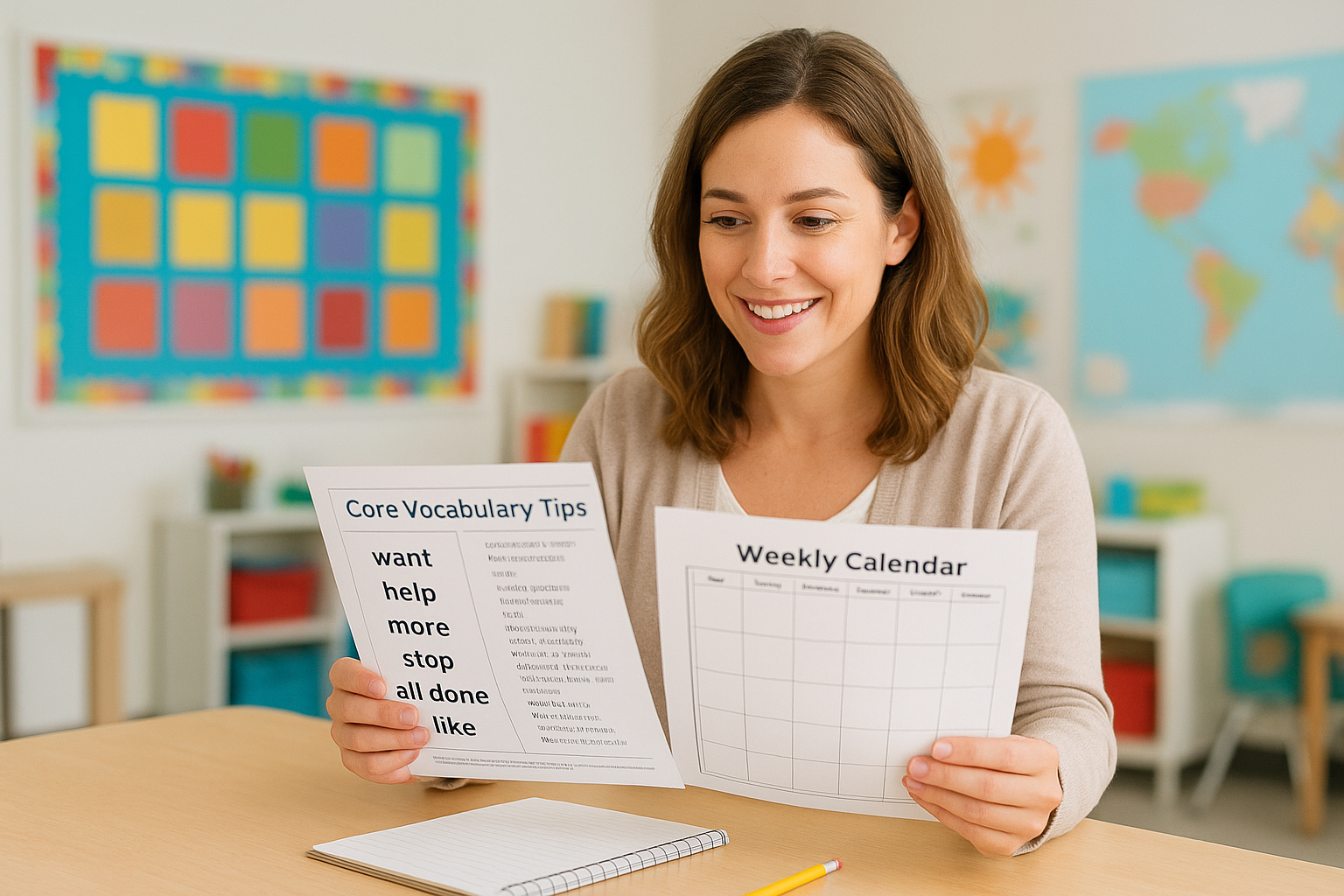
A short tip sheet and calendar help classroom teams model the same core word all week.
Frequently Asked Questions About Core Vocabulary Parent Handouts
What are core vocabulary parent handouts?
Core vocabulary parent handouts are short, SLP-designed take-home sheets that show families how to model one high-frequency core word, such as go, more, or stop, during everyday routines like meals, bath time, and play.
How do core vocabulary parent handouts support AAC users?
They give families example phrases and visual prompts that match a child's augmentative and alternative communication system, so the same core word gets modeled consistently whether the child uses speech, signs, or a device.
Why is core vocabulary important for young communicators?
A small set of core words can be combined in countless ways across situations, which gives young children flexible, reusable language rather than single-use labels tied to one object or activity.
How are core vocabulary handouts different from fringe vocabulary lists?
Core words like go, more, and help apply across nearly every setting, while fringe words are specific nouns, such as dinosaur or spaghetti, that apply to fewer situations. Handouts generally favor core words because they generalize better.
How much do core vocabulary parent handouts cost?
Pricing varies by listing and bundle, so current cost and licensing details should always be confirmed on the Teachers Pay Teachers store before purchase. Some samples, like the free THERE Core Story, are available at no cost.
How long does it take to see carryover results with these handouts?
Carryover timelines vary by child, but repeated modeling across a full week with the same core word tends to support stronger generalization than a single exposure. Consistency across settings usually matters more than speed.
What common mistakes should parents avoid with core vocabulary handouts?
A common mistake is quizzing a child to say the word instead of simply modeling it during natural play. Another is switching core words too frequently instead of repeating one word across several days.
What are best practices for using core vocabulary parent handouts at home?
Best practice is to read the related Core Story first, then model the target word naturally during play, meals, and routines, pairing speech with AAC supports whenever the child uses one.
Can core vocabulary parent handouts be used alongside AAC devices?
Yes, the handouts are designed to support flexible language modeling, including augmentative and alternative communication, so families can point to the word on a device or communication board while modeling it aloud.
Where can I get core vocabulary parent handouts?
Little Speech Corner's Core Stories, team supports, and core word tip sheets are available for purchase and free download through the Little Speech Corner store on Teachers Pay Teachers.
Who creates Little Speech Corner's core vocabulary resources?
Gwen Swire, M.A., CCC-SLP, known as Mrs. Gwen, is a licensed speech-language pathologist with more than 20 years of experience who designs the Core Stories, Sound Stories, and related handouts.
Are core vocabulary parent handouts only for therapy, or can teachers use them too?
Both. The handouts and tip sheets are built so SLPs, classroom teachers, and families can model the same core word in therapy rooms, classrooms, and at home during the same week.
Key Takeaways
Core vocabulary parent handouts work best as part of a bigger system rather than as a one-time printout. Specifically, pairing a short Core Story with a focused handout, a tip sheet, and consistent weekly repetition gives children far more opportunity to generalize a word than any single tool used alone.
In the end, the goal is simple: help every adult around a child, from SLPs to classroom teams to parents, model the same core word in the same week. Families and educators ready to try this approach can preview a free Core Story sample or browse the Core Stories Foundational 53-Pack through Little Speech Corner before choosing the full set of core vocabulary parent handouts that fits their classroom or caseload.
