
Core Vocabulary Printables for AAC & Classroom Use
Core vocabulary printables help build AAC and language skills for kids ages 2-7. Explore free samples, practical tips, and SLP-created resources today.
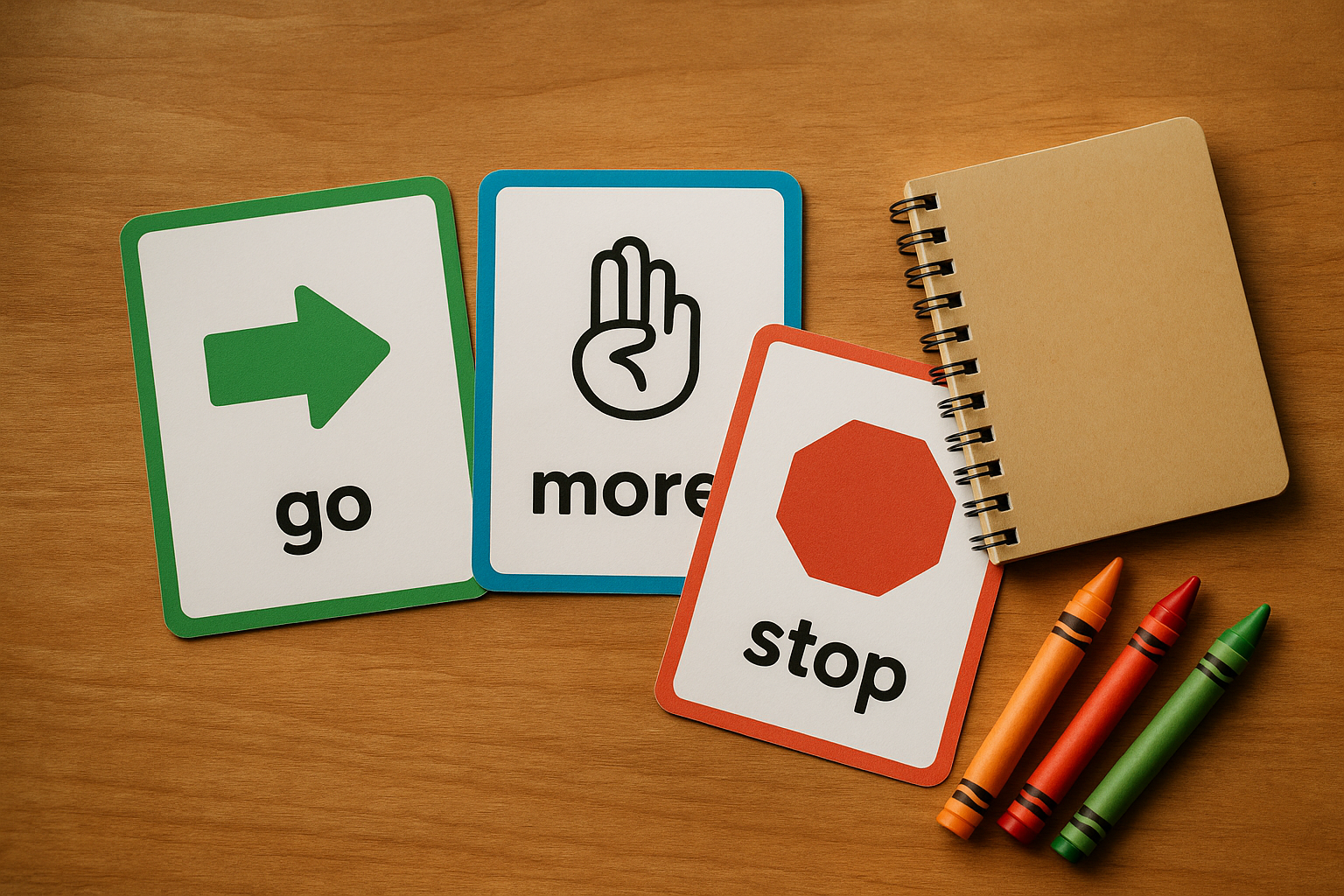
Core vocabulary printables are simple, ready-to-use pages that give children ages 2 to 7 repeated, hands-on practice with the small set of words they need most, like go, stop, more, and help. In fact, these printables work best when they travel with a child across the entire day, not just during a single therapy session. For speech-language pathologists, classroom teachers, and families, core vocabulary printables turn research-backed vocabulary instruction into something you can print, model, and send home immediately — no lamination required to get started.
Below, you'll find a complete, practical walkthrough: what core vocabulary printables are, why they matter for AAC (augmentative and alternative communication) users, how to weave them into every part of the day, and where to find both free samples and full bundles. By the end, you'll have everything you need to put core vocabulary printables to work — without digging through a dense PDF to find the one idea that applies to your classroom.
What Are Core Vocabulary Printables?
Core vocabulary printables are downloadable pages — flashcards, boards, or activity sheets — that target a fixed set of high-frequency words rather than a single topic. Consequently, they help children build flexible, functional language instead of only labeling nouns. Many SLPs and teachers use them alongside AAC systems and classroom stories so the same target word shows up in more than one place during the day.
Unlike fringe vocabulary, which covers specific topics like farm animals or holidays, core words such as go, want, look, and more work in almost any conversation. As a result, a child who masters even a handful of core words can communicate across play, mealtime, and classroom activities. This is why core vocabulary printables are considered a foundational tool, not just a seasonal worksheet.
Core vocabulary printables often include simple word cards that pair with play and story routines.
Why Core Word Printables Support AAC and Early Language Growth
Core word printables matter because a surprisingly small vocabulary carries most of everyday communication. According to research summarized by the American Speech-Language-Hearing Association, a core set of roughly 200 to 400 words accounts for nearly 80 percent of what people say in daily conversation. Therefore, focusing therapy and classroom time on these words offers a strong return on effort.
For children who use AAC, this matters even more. Specifically, a core word programmed on a device becomes far more useful when the child also sees it printed, hears it modeled, and practices it in a story. The National Institute on Deafness and Other Communication Disorders notes that consistent, multi-modal exposure supports stronger language outcomes for children with complex communication needs. In addition, teams looking for a deeper walkthrough of programming and vocabulary selection can review these core vocabulary teaching materials for AAC and language for practical next steps.
Above all, repetition across settings is what builds true carryover. A printable used only once in a session rarely sticks, but the same page reused during a story, a game, and a home activity gives the brain multiple chances to connect the word with its meaning. Similarly, the CDC's Learn the Signs. Act Early. program highlights ages 2 through 7 as a critical window for language growth, which lines up exactly with the age range core vocabulary printables are designed for.
Using Core Vocabulary Printables Across the Day: A Routine-by-Routine Planner
Many teams know core words matter, but they struggle to picture what this looks like minute-to-minute. Therefore, here is a practical breakdown of how core vocabulary printables fit into six common daily routines, whether you work in a classroom, a therapy room, or a home setting.
Arrival and Greeting
During arrival, keep a printable near the door featuring words like go, in, more, help. As children enter, model one target word on the printable while greeting them, such as pointing to "go" while saying, "Let's go inside!"
Circle Time
Circle time offers a natural spot for a larger shared printable, such as a poster-sized core board. Because the whole group can see it, every child practices the same target word, like "look" or "my turn," at their own communication level.
Centers and Play
During free play, a small laminated printable tucked into a toy bin keeps core words like more, in, out, stop within arm's reach. As a result, adults can model the word in context the moment a play opportunity arises, rather than searching for materials first.
Snack and Mealtime
Mealtime is rich with natural motivation, so a printable featuring more, want, done, help fits perfectly on the snack table. In particular, waiting a few extra seconds before handing over food gives the child a chance to request using the printable or a paired AAC device.
Outdoor Time and Transitions
Transitions between activities are ideal for words like go, stop, up, down. A weatherproof or laminated printable clipped to a lanyard travels easily outside, so modeling does not pause just because the setting changed.
Departure and Home Carryover
Finally, send the same printable home in a family folder. Consequently, caregivers can model the identical word the child practiced all day, which is exactly the kind of repetition that research points to for strong carryover.
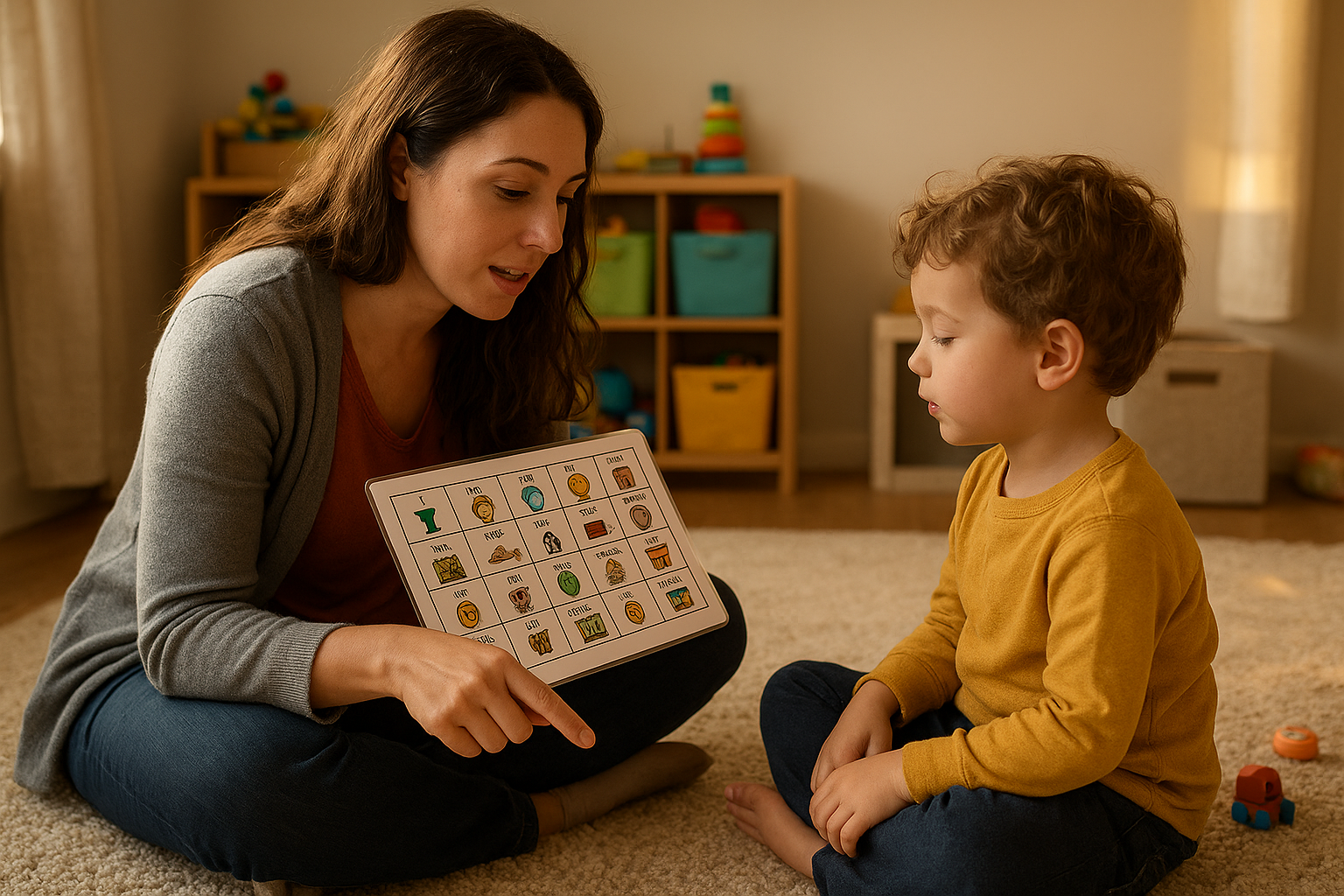
Pairing core vocabulary printables with play-based modeling helps target words stick.
How to Use Core Vocabulary Tools in Therapy Sessions and Classrooms
Using core vocabulary tools well is less about the printable itself and more about the routine built around it. The following steps outline a simple process that works for both 1:1 therapy and small classroom groups.
- Identify target core words. Start by choosing two to four core words that fit the child's current goals, such as go, stop, or more, so every printable stays purposeful and easy to model.
- Print and prep the page. Print the printable in color or black-and-white, laminate it if you plan to reuse it, and gather matching picture cards or story books.
- Model the word first. Before asking the child to respond, point to the word yourself while saying it aloud during play, snack time, or a shared story.
- Create repeated practice opportunities. Use the printable during several short activities across the day, such as a core story, a game, and a snack routine.
- Send it home for carryover. Copy the printable for the family folder so caregivers can model the identical word at home, reinforcing generalization.
For a ready-made version of this routine, many SLPs pair printables with story-based speech therapy activities for ages 2 to 7, which naturally build in the repetition described above.
Teaching Strategies That Make Core Vocabulary Printables Work
A printable alone rarely teaches a word. Instead, it needs to be paired with a strategy that gives the child repeated, meaningful exposure. Below are the four approaches that pair most naturally with core vocabulary printables.
Aided Language Input
Aided language input, sometimes called aided language stimulation, means pointing to words on the printable or device as you speak, rather than only asking the child to point. In other words, you become the model, which lowers pressure while still building the word's meaning.
Expectant Delay
After modeling a word, pause and wait with an expectant look. This brief delay — often just three to five seconds — gives the child time to initiate, rather than the adult filling every silence.
Self-Talk and Parallel Talk
Narrating your own actions ("I want more blocks") or the child's actions ("You want more blocks") while pointing to the printable keeps the target word present without demanding a response every time.
Errorless Prompting
For newer communicators, prompt immediately after modeling so the child experiences success right away. Then, gradually fade the prompt as the child begins initiating independently.
Printable Core Words vs. Core Vocabulary Books: What's the Difference?
Printable core words and core vocabulary books solve related but different problems. A printable is typically a single page built for quick, repeated practice, while a book delivers a full story built around one or two target words, giving that word context and meaning.
In contrast to a standalone worksheet, a story gives children a reason to use the word, such as asking a character to "go" or "stop." Consequently, many teams read the story first and then reinforce the same word with a printable during a follow-up activity. For a closer look at how these formats compare, this core vocabulary books guide for SLPs and teachers breaks down selection criteria in more detail. Similarly, the broader core words guide explains how to choose a starter word list before deciding which format to use first.
Low-Tech vs. High-Tech: Pairing Printables With AAC Devices
Core vocabulary printables are considered "low-tech AAC" because they require no battery or software. However, they are not a replacement for a child's AAC device — they are a partner to it. For example, if a word like "help" is programmed on a speech-generating device, the same word printed on a board reinforces the symbol, location, and meaning every time the child sees it.
Furthermore, low-tech printables serve as a reliable backup when a device is charging, left at home, or simply unavailable in the moment. As a result, communication does not stop just because the technology does. Teams supporting AAC users should aim to match the printable's layout, symbols, and word order to the child's device whenever possible, so the two systems feel like one consistent language.
Where to Find Free and Paid Printables for Core Vocabulary
Free samples are a practical starting point before committing to a full set. Little Speech Corner, founded by school-based SLP Gwen Swire, M.A., CCC-SLP, offers introductory core vocabulary printables and sample stories at no cost, so teams can test the Read, Model, Play approach before buying a full bundle.
For a more complete year-round system, the Core Stories Foundational 53-Pack bundles story-based sessions with matching printables, core-word tip sheets, and planning calendars for school and home use. In addition, downloadable resources are also sold through Teachers Pay Teachers for teams who prefer that marketplace. Above all, whichever source you choose, look for printables that connect clearly to a broader routine rather than a one-off worksheet.
How to Build Your Own Core Vocabulary Printable
Sometimes the fastest path is building a printable yourself. Here is a simple process for creating one in under fifteen minutes.
- Pick two to four target words that match the routine you're building for, such as snack time or outdoor play.
- Use simple, high-contrast symbols or clear photos rather than busy clip art, so the word is easy to locate at a glance.
- Arrange words in a consistent grid so the layout stays predictable across every printable you create.
- Print, laminate, and attach a binder ring or lanyard clip so the page travels easily between settings.
- Label the printable with the routine's name, such as "Snack Time Core Words," so anyone on the team can grab the right page quickly.
Tracking Progress With Core Vocabulary Printables
Because carryover takes time, tracking small wins keeps teams motivated and informs next steps. Consider a simple tally sheet clipped behind the printable, noting whether the child imitated, initiated, or needed a full prompt each time the word appeared. Over several weeks, this record shows whether a word is ready to retire into the "mastered" pile or needs more targeted modeling. In addition, sharing this data with families at conferences or in the home folder keeps everyone aligned on the same goals.
Tips for Choosing Effective Core Word Printables
Not every printable is created equal. Therefore, keep these practical guidelines in mind when selecting or designing your own materials:
- Choose two to four words per printable rather than a long, overwhelming list.
- Look for printables tied to a story, game, or routine so the word has context.
- Pick clear, uncluttered visuals so children can find the target word quickly.
- Prioritize words that transfer across settings, such as go, more, and help.
- Send a copy home so caregivers can model the same word outside of sessions.

Sending core vocabulary printables home helps caregivers model the same target words outside of sessions.
Common Mistakes to Avoid With Core Vocabulary Printables
Even well-designed printables can fall flat if a few common pitfalls creep in. First, avoid introducing too many words at once; depth beats breadth when a child is still building functional use of a single word. Second, resist using a printable without modeling it yourself first — handing a page to a child and simply asking them to point rarely builds real understanding. Third, don't let a printable sit in one room; the biggest gains come from moving it across routines and sending it home. Finally, avoid swapping printables too frequently, since consistency in layout and symbols helps a child locate words faster over time.
Frequently Asked Questions About Core Vocabulary Printables
What are core vocabulary printables?
Core vocabulary printables are downloadable pages, such as flashcards, boards, or worksheets, that target a small set of high-frequency words like go, want, and more. They give children repeated, purposeful practice with words that work across many settings.
How do core vocabulary printables differ from fringe vocabulary printables?
Core vocabulary printables focus on flexible words usable in almost any situation, while fringe vocabulary printables target specific nouns tied to one topic, like animals or foods. Core words carry more communicative power because children reuse them constantly throughout the day.
What ages benefit most from core word printables?
Children ages 2 to 7 typically benefit most, since this is when foundational language and early AAC use develop rapidly. However, older students who use AAC or are building expressive language can also use simplified versions successfully.
How many core words should a beginner printable include?
Most SLPs start with two to four core words per printable so the child can focus without feeling overwhelmed. Adding more words gradually, once the first set is mastered, keeps progress steady and manageable.
Can core vocabulary printables be used with AAC devices?
Yes, core vocabulary printables work well alongside AAC devices because they reinforce the same core words already programmed into the system. Pairing a printable with device modeling helps children generalize the word across low-tech and high-tech tools.
Are core vocabulary printables free anywhere?
Many creators, including Little Speech Corner, offer free sample core vocabulary printables so teams can try the format before purchasing a full set. Free samples are a practical way to test which layout and word list fit a specific child.
How long does it take to see progress using core vocabulary printables?
Progress varies, but many teams notice more consistent word use within four to six weeks of daily, repeated exposure. Consistency across therapy, classroom, and home matters more than the total number of sessions.
What is the biggest mistake teams make with core word printables?
The most common mistake is introducing too many words at once instead of building depth with a few core words first. Rotating in new words too quickly can prevent a child from mastering functional use of any single word.
How do I choose the right core vocabulary printable for my caseload?
Start by matching the printable's word list to each child's current goals and communication level rather than picking a generic set. In addition, look for printables that connect to stories or play activities so the word appears in a meaningful context.
Do core vocabulary printables work for classroom groups, not just 1:1 therapy?
Yes, core vocabulary printables adapt well to small groups and whole classrooms because every child can practice the same target word at their own level. Teachers often post a shared printable as a visual reminder during group activities.
What's the difference between core vocabulary printables and core vocabulary books?
Core vocabulary printables are typically single-page tools for quick practice, while core vocabulary books tell a full story built around one or two target words. Many teams use both together, reading the story first and then reinforcing the word with a printable.
How can I use core vocabulary printables across different times of the day?
Place a small, routine-specific printable in each key location — the door, the snack table, the play area, and the family folder — so target words appear naturally during arrival, meals, play, and departure. This "across the day" approach, covered in detail above, builds far more repetition than a single session ever could.
Can I make my own core vocabulary printables at home or in the classroom?
Yes, building a simple core vocabulary printable takes under fifteen minutes with two to four clear symbols and a consistent grid layout. However, many teams prefer SLP-created sets since the word choice and layout are already tested with real caseloads.
Where can I find core vocabulary printables from Little Speech Corner?
Little Speech Corner offers core vocabulary printables through its Core Stories collections, including the Core Stories Foundational 53-Pack, along with free introductory samples on its website. These resources use a Read, Model, Play approach designed for ages 2 to 7.
Bringing It All Together
In summary, core vocabulary printables give children ages 2 to 7 focused, repeated practice with the words that matter most across therapy, classroom, and home life. As shown above, they work best when a small set of words is modeled first, woven into every routine of the day, reinforced through play or story activities, and then sent home for consistent carryover. Whether you start with a free sample or a complete bundle like the Core Stories Foundational 53-Pack, choosing printables tied to real routines will always outperform generic worksheets. Ultimately, the goal of any core vocabulary printable is the same: helping a child use a few powerful words, again and again, until communication becomes second nature.