
Downloadable Speech Therapy Resources for Early Childhood
Explore downloadable speech therapy resources for early childhood, including story-based Core Stories and Sound Stories. Preview free samples today.

Downloadable speech therapy resources for early childhood are digital, print-and-go story materials that help speech-language pathologists (SLPs), special educators, and classroom teams model core vocabulary, practice speech sounds, and build language skills with children roughly ages 2 to 7. Instead of assembling therapy materials from scratch, clinicians and teachers can open a short, illustrated story and use it as the anchor for a whole session. As a result, planning time shrinks while consistency across sessions goes up.
Quick answer: Downloadable speech therapy resources for early childhood are printable or PDF story-based materials used to model core words, practice target speech sounds, and support early language skills. Little Speech Corner's Core Stories and Sound Stories are two examples, each built around a short shared-reading moment followed by interactive play.
Shared reading is the first step in using downloadable speech therapy resources for early childhood effectively.
What Are Downloadable Speech Therapy Resources for Early Childhood?
Downloadable speech therapy resources for early childhood give adults a ready-made way to combine story time with targeted language or speech-sound practice. Rather than designing separate activities for vocabulary, articulation, and play, a single downloadable story can cover all three. For instance, a five-minute Core Story introduces one core word, which an adult then models repeatedly through the rest of the session.
Because the materials are digital, they can be reused across multiple children, printed as needed, or projected on a screen. In addition, many sets include companion tip sheets so the same vocabulary gets reinforced beyond a single session.
Why Story-Based Speech and Language Resources Work for Young Communicators
Story-based speech and language resources work well for young children because stories naturally repeat key words and phrases, which supports learning through context rather than drills. According to the National Institute on Deafness and Other Communication Disorders, nearly 1 in 12 children ages 3 to 17 in the United States has had a disorder related to voice, speech, language, or swallowing in the past year, which is one reason early, consistent language modeling matters so much during the preschool years. Specifically, hearing a core word modeled inside a familiar story, and then again during play, gives a child several chances to connect the word to meaning.
Similarly, the American Speech-Language-Hearing Association notes that early language exposure in meaningful, repeated contexts supports stronger long-term communication outcomes. Therefore, pairing a short story with hands-on play is not just convenient; it reflects how young children actually build language.
The Read, Model, Play Approach Behind These Materials
The Read, Model, Play approach, used throughout Little Speech Corner's resources, starts with roughly five minutes of shared reading using a short Core Story. During that time, the adult models a target core word using whatever communication method fits the child, including AAC. After the story, the adult carries that same word into interactive, child-led play.
This structure keeps sessions predictable for children while still leaving room for flexibility. As a result, SLPs can adapt the pacing for a toddler in early intervention or a kindergartener working on more complex language goals.
Types of Printable and Digital Speech Therapy Materials for Preschoolers
Printable and digital speech therapy materials for preschoolers generally fall into a few categories, each serving a different therapy or classroom goal. Understanding the differences helps teams pick the right starting point instead of guessing.

Sound Stories give clinicians repeated, natural opportunities to practice a target speech sound.
Core Stories for Vocabulary and AAC Modeling
Core Stories are short, illustrated stories built around a single core vocabulary word, along with related modeling ideas and activity suggestions. Because core words show up across many situations, modeling just one per week, as the Foundational 53-Pack suggests, builds a strong, reusable vocabulary base over time. Teams browse by title or by core word and download the set through Teachers Pay Teachers.
Sound Stories for Articulation Practice
Sound Stories are illustrated, sound-loaded narratives written to give repeated opportunities to hear and practice a clinician-selected speech sound. For example, a story loaded with /s/ words gives a child many natural chances to hear and attempt that sound in connected language, rather than isolated drill lists. Free SW and CH samples let a clinician test the format before choosing additional targets.
Team Supports for Classroom and Home Carryover
Team Supports, including core-word tip sheets and a planning calendar, help every adult around a child model the same vocabulary. Consequently, a word practiced in a therapy room on Monday can be reinforced in the classroom on Tuesday and at home on Wednesday, which strengthens generalization.
How to Choose the Right Early Childhood Speech Therapy Resources
Choosing the right early childhood speech therapy resources becomes easier with a simple, repeatable process. The following steps outline how a clinician or teacher can move from "where do I start" to a working weekly plan.
- Identify the child's current communication goal. Decide whether the priority is core vocabulary and language use, articulation of a specific sound, or AAC modeling support.
- Match the resource type to that goal. Choose a Core Story for vocabulary and AAC goals, or a Sound Story when the focus is a clinician-selected target speech sound.
- Preview a free sample before purchasing. Try Apples for Anna or an SW or CH Sound Story sample to check reading level and format fit.
- Build a weekly modeling plan with the team. Use tip sheets and a planning calendar so the classroom, therapy room, and home model the same word or sound consistently.
Where to Find Free Speech Therapy Samples for Early Learners
Free speech therapy samples for early learners are a practical way to test an approach before buying a full set. Little Speech Corner offers the Core Story Apples for Anna built around the core word THERE, a core-vocabulary calendar that includes a sample story, and SW and CH Sound Story samples. These downloads, along with the full catalog, are available through Little Speech Corner and purchased through its Teachers Pay Teachers store.
For teams wanting a broader comparison of formats, it also helps to review a guide to printable speech and language resources for preschool SLPs and a roundup of story-based speech therapy resources for young children before settling on a starting set.
Building These Resources Into Everyday Routines
Downloadable speech therapy resources for early childhood work best when they become part of a routine rather than a one-time activity. In particular, repeating the same core word across a week, in several short bursts, tends to produce stronger carryover than a single long session. Likewise, literacy-based activities can extend this same shared-reading structure into broader story comprehension work.
Teams looking to connect speech-sound practice with story comprehension more broadly may find it useful to review literacy-based speech therapy activities for preschoolers and a collection of printable articulation stories for speech therapy wins alongside the Core Story and Sound Story sets.
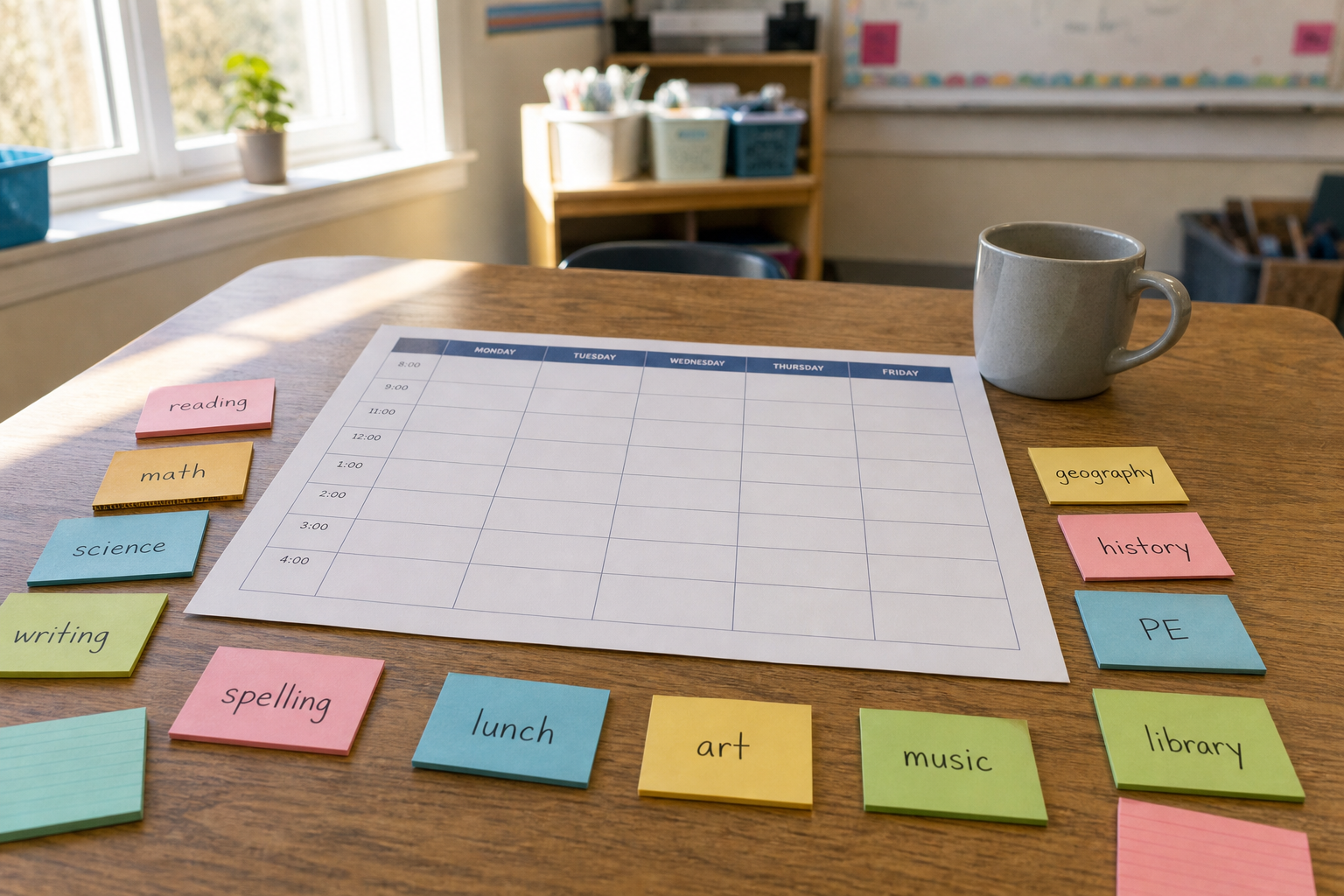
A simple weekly calendar keeps core-word modeling consistent across the classroom, therapy room, and home.
About the Creator Behind These Resources
Gwen Swire, M.A., CCC-SLP, known to many as Mrs. Gwen, brings more than 20 years of experience across early intervention, preschool, elementary school, and family settings to these materials. She holds ASHA certification, California SLP licensure, and a Clinical or Rehabilitative Services Credential, along with M.A. and B.A. degrees in Communication Disorders from California State University, Fullerton. That background shapes the practical, session-ready design of each Core Story and Sound Story.
Frequently Asked Questions About Downloadable Speech Therapy Resources for Early Childhood
What are downloadable speech therapy resources for early childhood?
Downloadable speech therapy resources for early childhood are digital, print-and-go story materials that SLPs and teachers use to model core vocabulary, practice target speech sounds, and build early language skills with children roughly ages 2 to 7. They are typically purchased or downloaded as PDFs for use in therapy, classrooms, or at home.
How does the Read, Model, Play approach work?
Read, Model, Play starts with about five minutes of shared reading using a short Core Story, during which an adult models a target core word with the child's communication supports. Afterward, the adult carries that same word into interactive, child-led play.
Who are Core Stories and Sound Stories designed for?
Core Stories and Sound Stories are designed for SLPs, special educators, and classroom teams working with young communicators, including children who use AAC. They also suit families who want consistent vocabulary modeling at home.
What age range benefits most from these resources?
Most of these materials are written for children approximately ages 2 to 7, spanning early intervention through early elementary grades. Adults can adjust complexity based on each learner's communication level.
How much time does a Core Story session take?
A Core Story is designed to take about five minutes to read aloud, though this is a general guideline rather than a guaranteed outcome. The follow-up play and modeling time can extend as needed.
Are these resources appropriate for AAC users?
Yes, Core Stories are built to support flexible language modeling, including augmentative and alternative communication. Adults can model the target core word on a child's AAC system while reading and playing.
What is the Core Stories Foundational 53-Pack?
The Core Stories Foundational 53-Pack is a bundled collection of 53 Core Stories sold through Teachers Pay Teachers, organized around a suggested weekly core-word sequence. It pairs with a planning calendar and tip sheets for team-wide modeling.
How are Sound Stories different from Core Stories?
Core Stories focus on modeling a single core vocabulary word for language development, while Sound Stories are built around a clinician-selected speech sound for articulation practice. Both rely on short, repeated story-based exposure.
Where can I buy or download these resources?
Little Speech Corner's Core Stories, Sound Stories, and team supports are purchased and downloaded through the Little Speech Corner Teachers Pay Teachers store. Always confirm price, format, and licensing on the current listing before buying.
Are free samples available before purchasing?
Yes, free samples include the Core Story Apples for Anna, a core-vocabulary calendar with a sample story, and SW and CH Sound Story samples. These let teams try the approach before committing to a bundle.
What is a common mistake when using story-based speech resources?
A common mistake is treating the story reading as the entire lesson instead of a springboard into modeling and play. The real language-building value comes from repeating the target word during interaction afterward.
How can classroom teams support carryover at home?
Classroom teams can share core-word tip sheets and a planning calendar so families know which word is being modeled each week. Consistent modeling across school and home helps a child use the same vocabulary everywhere.
How do I choose which resource to start with?
Start by identifying whether the immediate goal is vocabulary and language modeling or articulation practice, then choose Core Stories or Sound Stories accordingly. Previewing a free sample first helps confirm the format fits before purchasing a full bundle.
Final Thoughts
Downloadable speech therapy resources for early childhood give SLPs, educators, and families a practical, consistent way to model language and practice speech sounds without reinventing session plans each week. By pairing a short story with hands-on modeling and play, teams can build core vocabulary and articulation skills through routines that already fit naturally into a classroom or therapy day. Above all, starting with a free sample and building a simple weekly plan makes it easier to see which resources, including Core Stories, Sound Stories, and team supports, fit a particular group of young communicators best.
