
Printable Articulation Stories for Speech Therapy Wins
Printable articulation stories make speech therapy sessions engaging and effective. Discover tips, activities, and free resources for SLPs today.
Printable articulation stories combine speech-sound practice with short, engaging narratives that hold a young child's attention far longer than a stack of flashcards ever could. For school-based SLPs (speech-language pathologists, the professionals trained to diagnose and treat speech and language difficulties) and early childhood educators, these story-based worksheets turn repetitive drill work into something that feels like storytime instead of therapy time. Because every page builds in dozens of chances to practice a target sound, children get the repetition they need without losing interest halfway through. Below, you'll find exactly what printable articulation stories are, why they outperform both flashcards and single-activity dice games, and how to use them with the Read, Model, Play approach found in the Sound Stories collection at Little Speech Corner.
What Are Printable Articulation Stories?
Printable articulation stories are downloadable, read-aloud worksheets that embed a specific speech sound — like /r/, /s/, or /l/ — into a short story a child can read, listen to, or act out while practicing that sound again and again. Unlike single-word flashcards, they give children the chance to produce a target sound in connected speech (talking in full sentences rather than isolated words), which mirrors how sounds are actually used in real conversation.
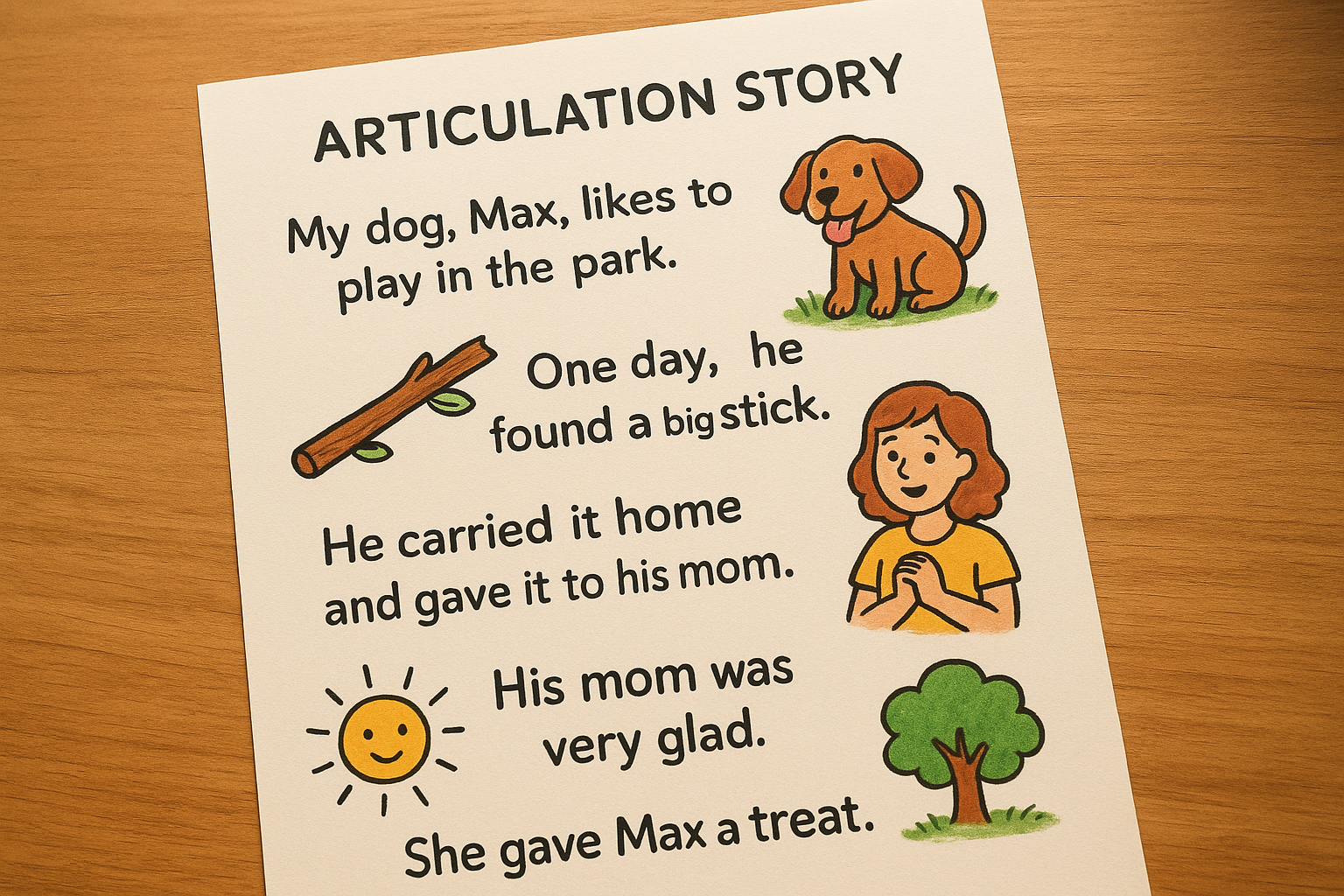
Most printable articulation stories bold or highlight every occurrence of the target sound, pair the text with simple illustrations, and keep sentence length short enough for a young reader. As a result, a single page can pack in 20 to 30 repetitions without feeling repetitive to the child, since the story context keeps shifting even though the target sound stays the same. In other words, the child never notices how much practice they're actually getting.
A sample page from printable articulation stories, with target sounds bolded throughout the text.
Why Articulation Story Printables Outperform Drill Cards and One-Off Games
Speech sound difficulties are more common than many parents realize. According to the American Speech-Language-Hearing Association (ASHA), an estimated 8% to 9% of young children have a speech sound disorder. This is exactly why engaging, high-repetition tools matter so much in early intervention. Because printable articulation stories combine visual support, narrative structure, and built-in repetition, they tend to hold attention longer than isolated drill sheets or a single novelty game.
In addition, the story format naturally supports generalization — the ability to use a skill outside the exact context it was learned in. Instead of practicing a sound only in single words, a child hears and produces it inside sentences, questions, and short dialogue, much closer to how the sound will actually be used outside the therapy room. Consequently, many SLPs report faster carryover when stories are used alongside traditional drill work rather than in place of it.
However, not every articulation activity is built the same way. Some popular tools, such as roll-a-dice or "spin and say" games, focus almost entirely on novelty and motivation, often at the cost of actual repetition volume. A printable articulation story, by contrast, is designed from the ground up to maximize both engagement and sound repetitions on a single page.
Printable Articulation Stories vs. Roll-and-Tell Dice Games: Which Should You Choose?
Dice-based "roll and tell" articulation games are a fun warm-up activity, but they typically ask a child to say one target word per roll, then build a sentence around it on the spot. That works well for a quick five-minute filler. For deeper, structured sound practice, though, printable articulation stories offer several advantages worth considering before you decide which format fits your session.
| Feature | Roll-and-Tell Dice Game | Printable Articulation Story |
| Repetitions per page | Varies by roll (often fewer than 10) | Typically 20–30 built in |
| Context | Single words or short phrases | Full sentences and connected speech |
| Carryover support | Limited — no take-home story | Strong — same page sent home |
| Best used for | Warm-ups, quick motivation boosts | Core drill, generalization, homework |
In practice, the two formats work best together rather than as competitors. Many SLPs use a dice roll as a five-minute warm-up, then move into the printable articulation story as the main event. We'll show you exactly how to blend both approaches in the next section.
How to Use Printable Articulation Stories in a Session
Using a printable articulation story effectively takes more than simply handing it to a child. The following six-step process keeps the activity structured while still feeling playful, and it works whether you're in a clinic room, a classroom corner, or at a kitchen table.
- Pick the right story. Choose a printable story that targets the child's current sound and word position, such as initial /s/ or final /r/, so every repetition matches the active therapy goal.
- Read it aloud first. Read the entire story aloud once while the child simply listens, modeling clear and slightly exaggerated production of each target sound in context.
- Model and highlight target words. Point to or circle each bolded target word as you say it again, giving the child a visual cue for exactly which sound to focus on during practice.
- Have the child read or retell. Let the child read the story independently or retell it in their own words, pausing to correct and re-model the target sound whenever needed.
- Add a roll-and-tell twist. Roll a die or spin a wheel so the child picks which story character or sentence to re-read, adding a quick game element that boosts motivation without losing repetition volume.
- Extend and send home. Reinforce the sound with a related play task, such as acting out the story, then send the same page home so caregivers can repeat the pattern for carryover.

An SLP models target sounds while reading a printable story with a young client.
Free Printable Speech Sound Story Game Variations to Try
If a child needs more novelty than straight reading provides, layer one of these variations onto the same printable articulation story rather than switching materials entirely:
- Dice roll re-read: Roll a die and re-read the matching sentence number for bonus repetitions.
- Highlighter hunt: Have the child circle or highlight every target word before reading, which doubles as a visual scanning task.
- Bingo tie-in: Pair target words from the story with a simple bingo card for a quick group activity.
- Act-it-out: Assign characters and have the child perform the story as a short scene, saying each target word in role.
Choosing the Best Printable Speech Sound Stories for Your Caseload
With so many options available, selecting the right printable speech sound stories comes down to a few practical factors. First, consider the child's current sound stage and whether the story targets that sound in the correct word position — initial, medial, or final. Second, look at interest level, since a five-year-old and a seven-year-old rarely respond to the same characters or themes, so variety matters across a caseload.
For a closer look at matching activities to specific age ranges, this guide to story-based speech therapy activities for ages 2–7 breaks down what tends to work best at each stage. Similarly, this roundup of story-based speech therapy resources compares formats so clinicians can decide what fits their session structure.
Matching Printable Articulation Stories to Developmental Sound Norms
Speech sounds develop on a fairly predictable timeline, which makes it easier to pick the right story. Early sounds like /p/, /b/, and /m/ are usually in place by age 3, while later sounds such as /r/, /s/, /l/, and consonant blends often continue developing until age 7 or 8. The CDC's developmental milestones resource is a useful reference point when deciding whether a sound error is age-appropriate or worth targeting in therapy.
Pairing Articulation Printables with Core Vocabulary and Play
Articulation printables do not have to work in isolation. Many SLPs pair a target-sound story with core vocabulary words — the small set of high-frequency words like "go," "more," and "stop" that show up across nearly every activity. Doing so lets a single session address both speech sound accuracy and functional language goals at once, which is especially useful on a packed caseload.
This guide to teaching core vocabulary through stories walks through how the Read, Model, Play approach layers naturally onto articulation practice. Likewise, this collection of printable resources for preschool SLPs highlights materials designed specifically for blending the two goal areas in one short session.
Using Printable Articulation Stories for Home Carryover
Carryover between sessions is often where progress stalls, so sending printable articulation stories home can make a real difference. Because caregivers already have the exact same page used in therapy, they do not need special training to support practice — they simply follow the same read, model, and repeat pattern shown during the session.
For additional support, pairing a sent-home story with a short core-word tip sheet gives parents simple language to use without feeling like homework. The Sound Stories line is built around exactly this kind of take-home consistency, and the preschool SLP resource roundup includes several free samples worth trying first. For general background on typical speech and language milestones, the National Institute on Deafness and Other Communication Disorders (NIDCD) offers a helpful reference point for families.
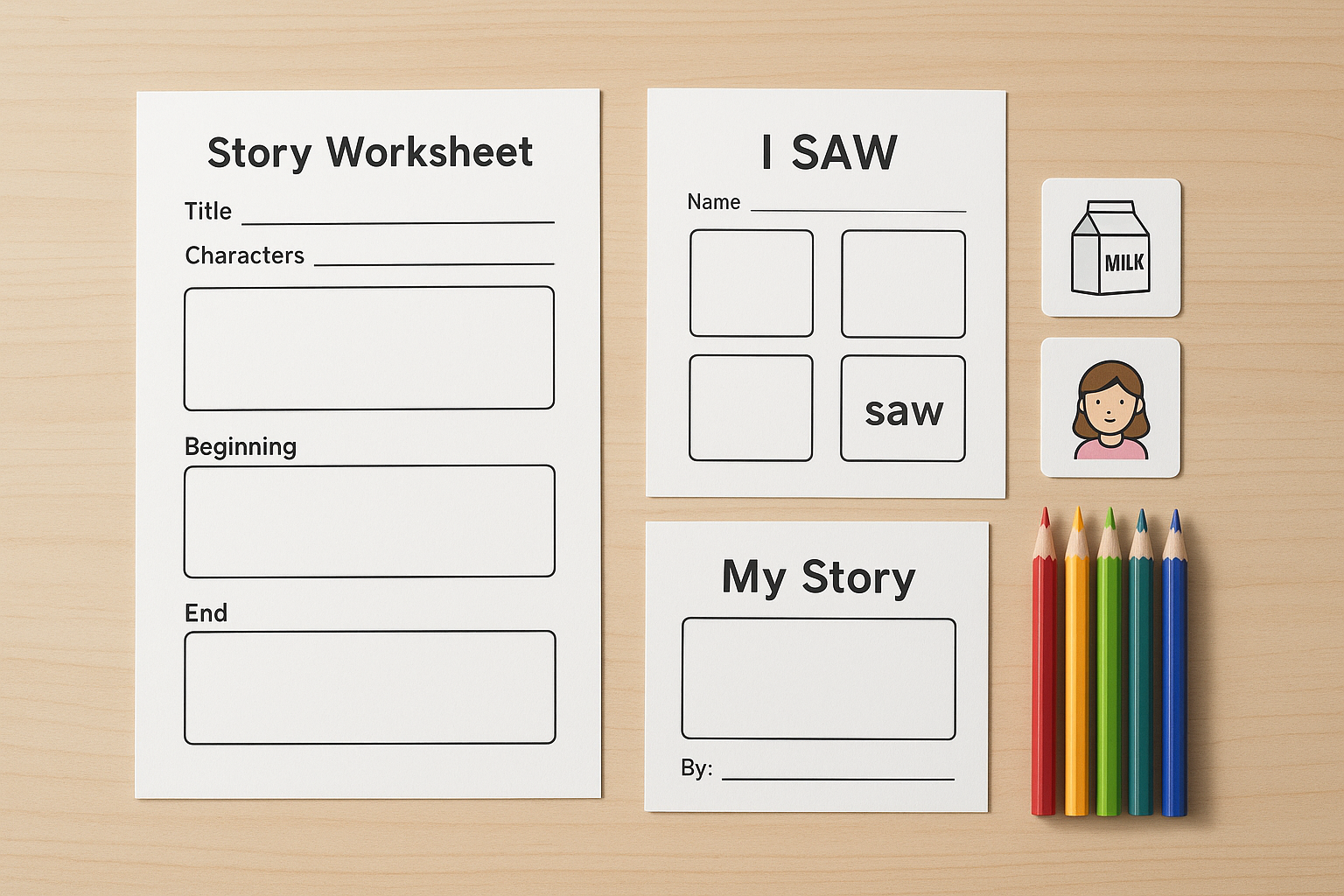
Printable speech therapy materials organized for both clinic and home use.
How to Make Your Own Printable Articulation Story
Sometimes a ready-made set doesn't quite match a child's interests, and that's when a homemade version comes in handy. Start by picking one target sound and one word position. Then write five to eight short sentences, each containing two or three target words, using vocabulary the child already knows. Bold every target word so it stands out visually, and add a simple hand-drawn or clip-art picture for each sentence to keep younger readers engaged.
Finally, test the story with the child before using it as a core drill tool. If a sentence feels awkward to say aloud, it will likely feel awkward for the child too — so simplify it. Over time, building a small personal library of homemade printable articulation stories alongside a purchased set gives maximum flexibility for interest-based motivation.
Common Mistakes That Undermine Articulation Story Practice
Even a well-designed printable articulation story can fall flat if a few common pitfalls creep in. Choosing a story above the child's current sound stage is the most frequent mistake, since it sets the child up for repeated failure instead of success. Skipping the modeling step is another, because children need to hear the target sound clearly before attempting it themselves.
Similarly, moving too quickly through a story without enough repetition limits how much motor practice the child actually gets. Above all, treating the printable as a one-time worksheet rather than a reusable tool wastes its biggest advantage — the same page can be re-read across multiple sessions for stronger retention.
Frequently Asked Questions About Printable Articulation Stories
What are printable articulation stories?
Printable articulation stories are downloadable, read-aloud worksheets that build a specific speech sound into a short story so children practice that sound repeatedly in connected speech rather than in isolated words.
How do printable articulation stories help with speech therapy?
They give children many natural opportunities to produce a target sound while staying engaged in a story, which supports motor planning and carryover better than isolated drill alone.
What ages benefit most from printable articulation stories?
Children roughly ages 3 to 7 benefit most, since this is when many speech sounds are still developing and short, picture-supported stories match their attention spans.
How many practice opportunities should a printable articulation story include?
A well-designed articulation story typically includes 20 to 30 repetitions of the target sound across the page, which supports stronger retention through repeated motor practice.
Are printable articulation stories effective for home practice?
Yes, caregivers can use the same printable at home to reinforce a sound practiced in session, which strengthens carryover between the therapy room and daily life.
Which sounds can be targeted with articulation story printables?
Most sound classes can be targeted, including early sounds like /p/, /b/, and /m/, as well as later-developing sounds such as /r/, /s/, /l/, and consonant blends.
How do printable articulation stories differ from traditional flashcards?
Flashcards isolate single words, while articulation stories embed the target sound in connected sentences, mirroring how sounds are actually produced in everyday conversation.
Can parents use printable articulation stories without an SLP?
Parents can use them for light practice and fun, but a licensed speech-language pathologist should confirm the target sound and correct production cues for best results.
How much do printable speech therapy resources typically cost?
Many printable articulation and core vocabulary packets range from free samples to budget-friendly bundles, often priced between a few dollars and around thirty dollars for a full set.
What common mistakes happen when using articulation stories?
Common mistakes include choosing a story above the child's current sound stage, skipping the modeling step, and moving too quickly without enough repetition.
How long does a typical articulation story session take?
Most sessions using one printable story take between ten and fifteen minutes, which fits well within a standard 20 to 30 minute therapy slot.
What is the best way to track progress with printable articulation stories?
Mark correct versus incorrect productions directly on the printable or a simple data sheet each session, then compare accuracy percentages over several weeks.
Can printable articulation stories be combined with core vocabulary practice?
Yes, pairing a target sound story with core vocabulary words lets children practice speech sounds and functional language goals in the same activity.
Where can I find free printable articulation stories to try first?
Many SLP resource sites, including Little Speech Corner, offer free introductory samples so clinicians and families can test the format before purchasing a full set.
What is a Roll and Tell articulation story, and how does it compare to a printable articulation story worksheet?
A Roll and Tell activity uses a die to pick a word or sentence to say aloud, which works well as a quick warm-up. A printable articulation story, however, provides far more built-in repetition and connected-speech practice in a single page, making it better suited for core drill work.
Can I create my own printable articulation stories at home?
Yes, writing five to eight short sentences around one target sound, bolding the target words, and adding simple pictures is enough to create an effective homemade version.
Are printable articulation stories available as digital downloads like Boom Cards or TPT resources?
Many SLP resource creators offer both print-and-go PDF versions and interactive digital formats, so clinicians can choose whichever fits their teletherapy or in-person setup best.
Do printable articulation stories work for blends and multisyllabic words, or just single sounds?
Printable articulation stories can absolutely target consonant blends and multisyllabic words, not just single sounds, by building sentences around words like "street," "splash," or "butterfly" as the goal requires.
Bringing It All Together
Printable articulation stories give speech-language pathologists and caregivers a practical way to blend repetition with real engagement. Because the format embeds a target sound inside a story instead of a list of isolated words, children practice in a way that more closely reflects everyday conversation. For background on speech sound development more broadly, the Wikipedia overview of speech sound disorders offers useful general context alongside clinical sources like ASHA and NIDCD.
Ultimately, whether used in a clinic, a classroom, or at the kitchen table, printable articulation stories work best when paired with clear modeling, consistent repetition, and a little bit of play — including a quick roll-and-tell twist when motivation dips. Starting with a few free samples, then building toward a fuller set as goals progress, remains the simplest way to bring printable articulation stories into any caseload.