
Teaching Core Vocabulary Through Stories: SLP Guide
Learn how teaching core vocabulary through stories builds AAC and language skills in children ages 2-7, with tips from a veteran school-based SLP.
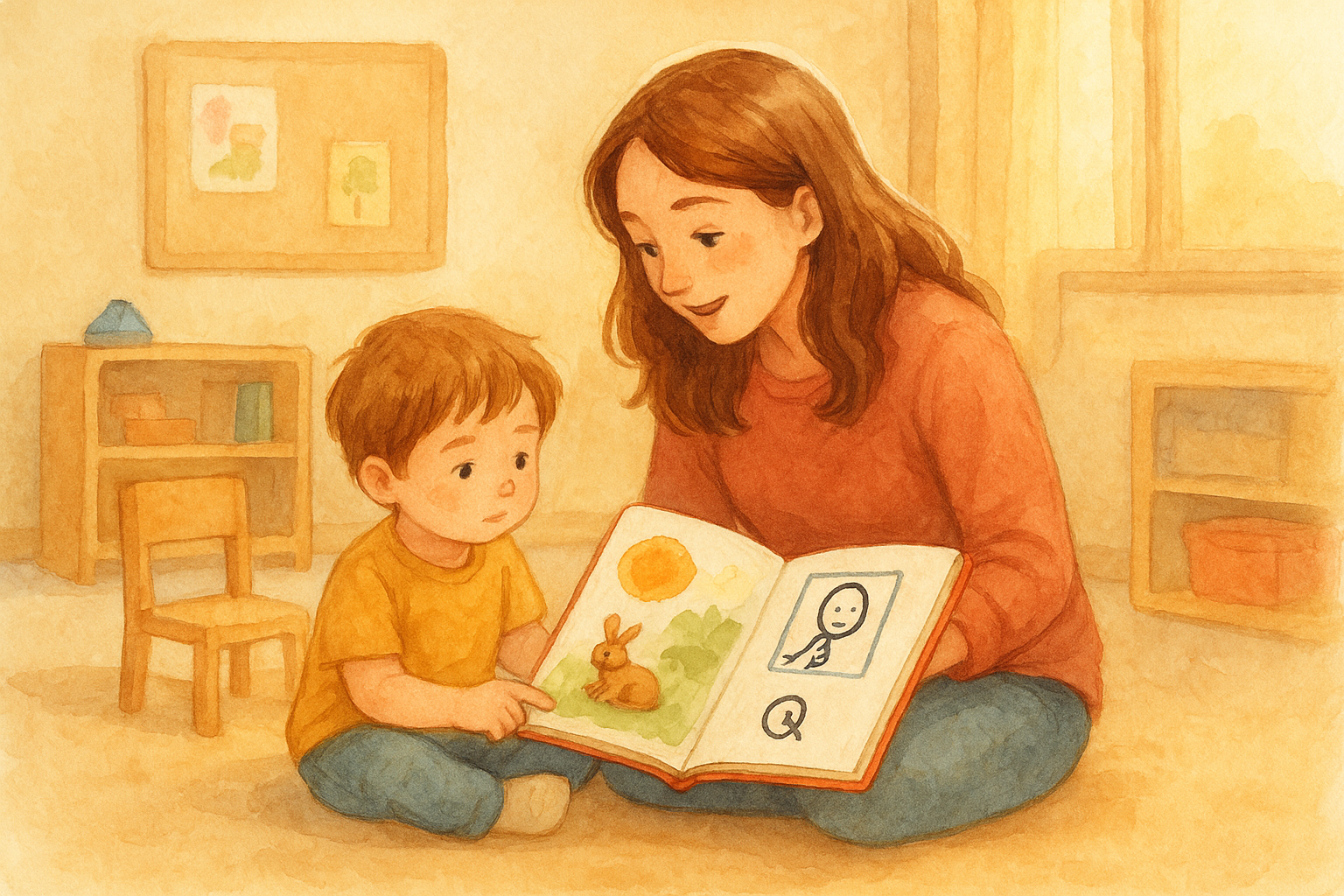
Teaching core vocabulary through stories is the single most reliable way speech-language pathologists (SLPs), special education teachers, and early childhood providers build lasting, functional communication in young children. Rather than drilling isolated words on flashcards, this approach weaves high-frequency words — called core vocabulary — into a repeated narrative so children absorb them the way they absorb language at home: through context, repetition, and connection. As a result, children who use augmentative and alternative communication (AAC), tools and strategies that support or replace spoken language, get consistent, meaningful practice with the exact words that unlock communication across every part of their day.
This guide goes further than a simple list of themed books. In addition to explaining exactly what core vocabulary story teaching looks like in practice, it also covers month-by-month story themes, book adaptation steps, IEP goal language, data collection tips, and the common mistakes that quietly stall progress. Whether you are a school-based SLP, a special education teacher building a yearlong plan, or a parent supporting carryover at home, you can also browse the full library of ready-made resources at Little Speech Corner for story-based materials built specifically for this method.
Teaching core vocabulary through stories works best when adults read, model, and play with target words together.
What Is Teaching Core Vocabulary Through Stories?
Teaching core vocabulary through stories is a method where a small set of high-frequency words — such as go, more, want, and stop — are repeatedly highlighted, modeled, and practiced inside a story rather than drilled in isolation. In short, the story becomes the vehicle, and the core words are the destination.
Unlike traditional flashcard drills, this approach places words inside meaningful, predictable contexts. Consequently, children encounter the same core words on nearly every page, which builds the repetition needed for true learning without feeling repetitive or boring to the child. Over time, that repetition becomes the foundation for spontaneous, independent communication rather than rote imitation.
Why Core Vocabulary Instruction Matters for Young Communicators
Core vocabulary instruction matters because a surprisingly small set of words carries most of everyday spoken language. According to the American Speech-Language-Hearing Association (ASHA), core words make up roughly 80% of what people say in typical conversation, while topic-specific fringe words make up the remaining 20%.
Therefore, focusing early instruction on core words gives children maximum communicative power with minimum vocabulary. For children who use AAC, this focus is especially critical because therapy time gets spent on words that transfer across the school day, the dinner table, and playtime, not just a single activity. For a broader look at how early language skills typically unfold, the National Institute on Deafness and Other Communication Disorders (NIDCD) offers helpful developmental background.
In addition, core words tend to be grammatically flexible. A single word like "go" can appear in dozens of sentences across dozens of contexts, which makes it far more useful to teach deeply than a narrow word like "dinosaur" that only applies to one topic.
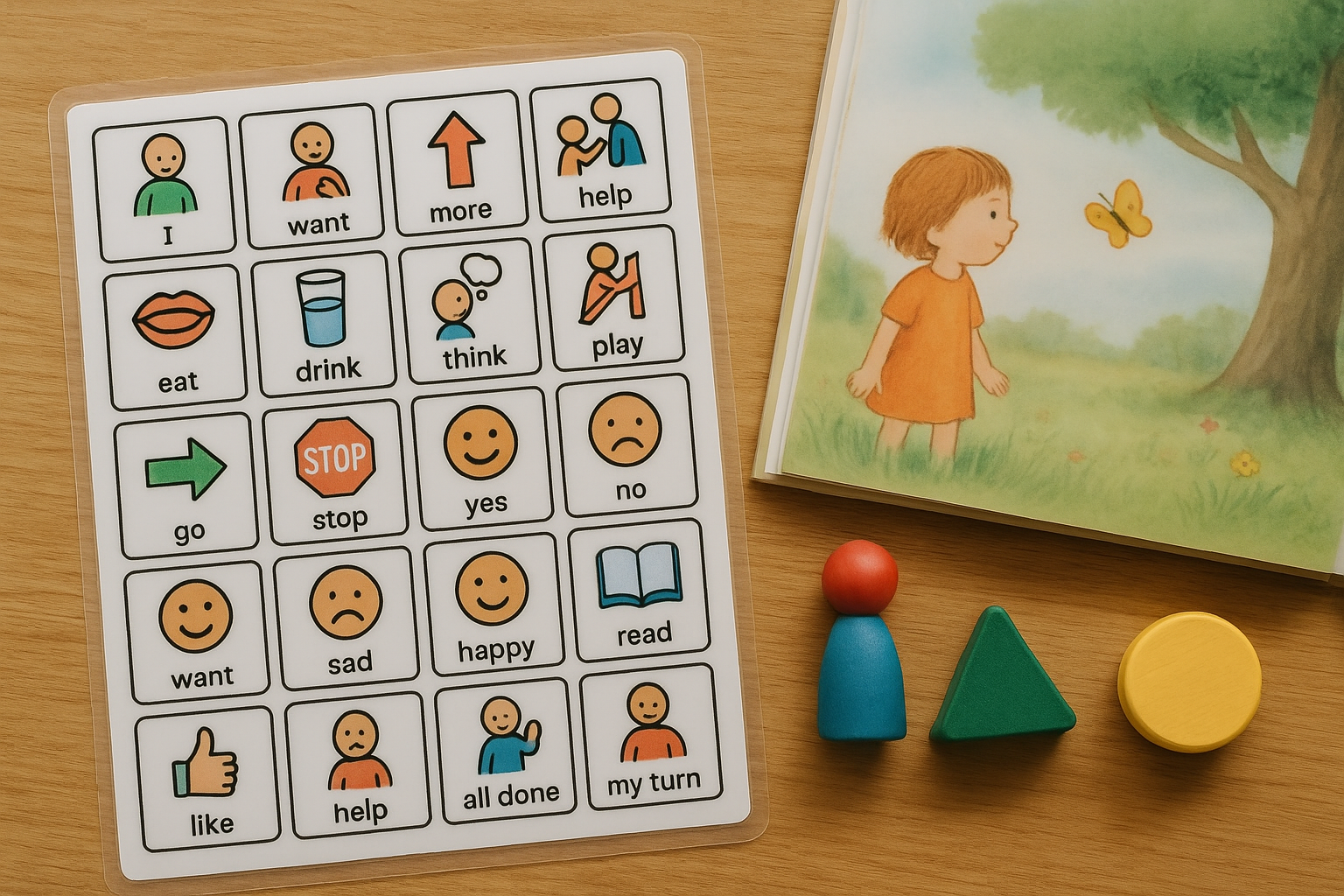
A core vocabulary board paired with a repeated story gives children multiple chances to see and use the same words.
How Story-Based Learning Builds Core Word Skills
Story-based learning builds core word skills because repetition inside a predictable narrative structure mirrors how children naturally acquire language at home. Specifically, when a child hears "go" modeled on nearly every page of a story about a bus ride, the word becomes anchored to a clear, memorable context.
Furthermore, stories naturally invite joint attention, meaning the adult and child focus on the same object or event at the same time. This shared focus is one of the strongest predictors of early language growth, as documented in decades of developmental research summarized by the Wikipedia entry on joint attention.
Similarly, repeated readings let children predict what happens next, which frees up cognitive resources to focus on the language itself rather than the plot. As a result, children often begin filling in the core word themselves after just a few readings — a milestone many SLPs look for during progress monitoring.
The Read, Model, Play Framework in Action
Little Speech Corner's signature Core Stories rely on a three-step framework called Read, Model, Play. This structure gives children multiple, varied exposures to the same core words rather than a single pass through a book. Below is the basic sequence most SLPs and teachers follow when running a session or classroom lesson built around a core word story.
- 1Read the story aloud with intention. Read the core-word-rich story slowly, emphasizing the two to four target words each time they appear, and pause briefly so the child can process each one before moving on.
- 2Model the core words using speech or AAC. Immediately after reading a target word, model it again on the child's communication device, board, or through clear spoken repetition, page after page, so the child sees it used in a real context.
- 3Play and practice beyond the book. Extend the story into a related hands-on activity, such as acting out the words with toys or a sensory bin, so the child practices the same vocabulary outside the pages of the book.
Above all, consistency across all three steps — not just one — is what drives lasting retention. Skipping the play stage, for instance, often means the words stay tied to the book and never generalize into daily communication.
Monthly Core Vocabulary Story Themes for Every Season
Many special education classrooms already organize instruction around monthly or seasonal themes. The good news is that teaching core vocabulary through stories fits naturally into that structure, as long as the seasonal theme stays secondary to the core word target. Below is a simple calendar to get started.
Fall Core Vocabulary Themes (August–November)
- Back-to-school (August/September): target "go," "stop," and "help" with a story about riding the bus or starting a new classroom routine.
- Apples and harvest (October): target "more," "want," and "look" with a story about picking apples or visiting a pumpkin patch.
- Thanksgiving (November): target "eat," "give," and "more" with a story about a shared family meal.
Winter Core Vocabulary Themes (December–February)
- Winter holidays (December): target "open," "give," and "want" with a gift-opening or celebration story.
- New year and cold weather (January): target "on," "off," and "cold" with a story about getting dressed for snow.
- Valentine's Day (February): target "like," "love," and "give" with a story about sharing cards or treats.
Spring and Summer Core Vocabulary Themes (March–July)
- Spring growth (March/April): target "grow," "up," and "more" with a story about planting a garden.
- Spring celebrations (April/May): target "find," "look," and "more" with a story about a seasonal egg or object hunt.
- Summer (June/July): target "go," "stop," and "in" with a story about swimming, a water table, or outdoor play.
Notice that the seasonal theme changes every month, but the underlying core words repeat across the whole year. This is the opposite approach of swapping an entirely new fringe vocabulary set every month, and it is exactly why these themes generalize so well. For more age-specific activity ideas that pair naturally with this calendar, see our guide to story-based speech therapy activities for ages 2 to 7.
Adapting Any Book Into a Core Vocabulary Story
You do not need a purpose-built resource to start teaching core vocabulary through stories. In fact, almost any classroom read-aloud or library book can be adapted using the same principles.
- Scan the book for repeating action and concept words. Look for two to four words, such as "go," "more," or "stop," that appear naturally across several pages.
- Build a simple core board or program the AAC device. Create a low-tech paper overlay or program the target words into the child's existing communication system before the lesson begins.
- Pause on each target page to model. Rather than reading straight through, stop briefly at each occurrence of the word to point, model, and emphasize it clearly.
- Extend into a related activity. Finish with a short play-based extension, such as acting out the story with props, to reinforce the same words outside the book.
This adaptation method means you are never limited to one publisher's catalog. Instead, you can build a customized, yearlong library using books you already own. For a curated starting list, our core vocabulary books guide for SLPs and teachers breaks down strong title choices by age and ability level.
Practical Strategies for Using Core Word Stories at School and Home
First, choose one story and stick with it for at least a full week rather than switching books daily. Repetition, not novelty, is what builds strong word recognition for early communicators.
Next, limit your target words to two or three per story so the child is not overwhelmed. For example, a story about getting dressed might focus only on "on," "off," and "help."
In addition, send the same story home so caregivers can continue the Read, Model, Play routine outside the classroom. Little Speech Corner's core words guide includes tip sheets designed specifically for this kind of school-to-home carryover.
For children also working on speech sound accuracy alongside vocabulary, pairing a core word story with a related Sound Story can reinforce articulation targets in the same themed session. Likewise, building a genuinely language-rich environment at home strengthens everything learned during therapy or classroom instruction.
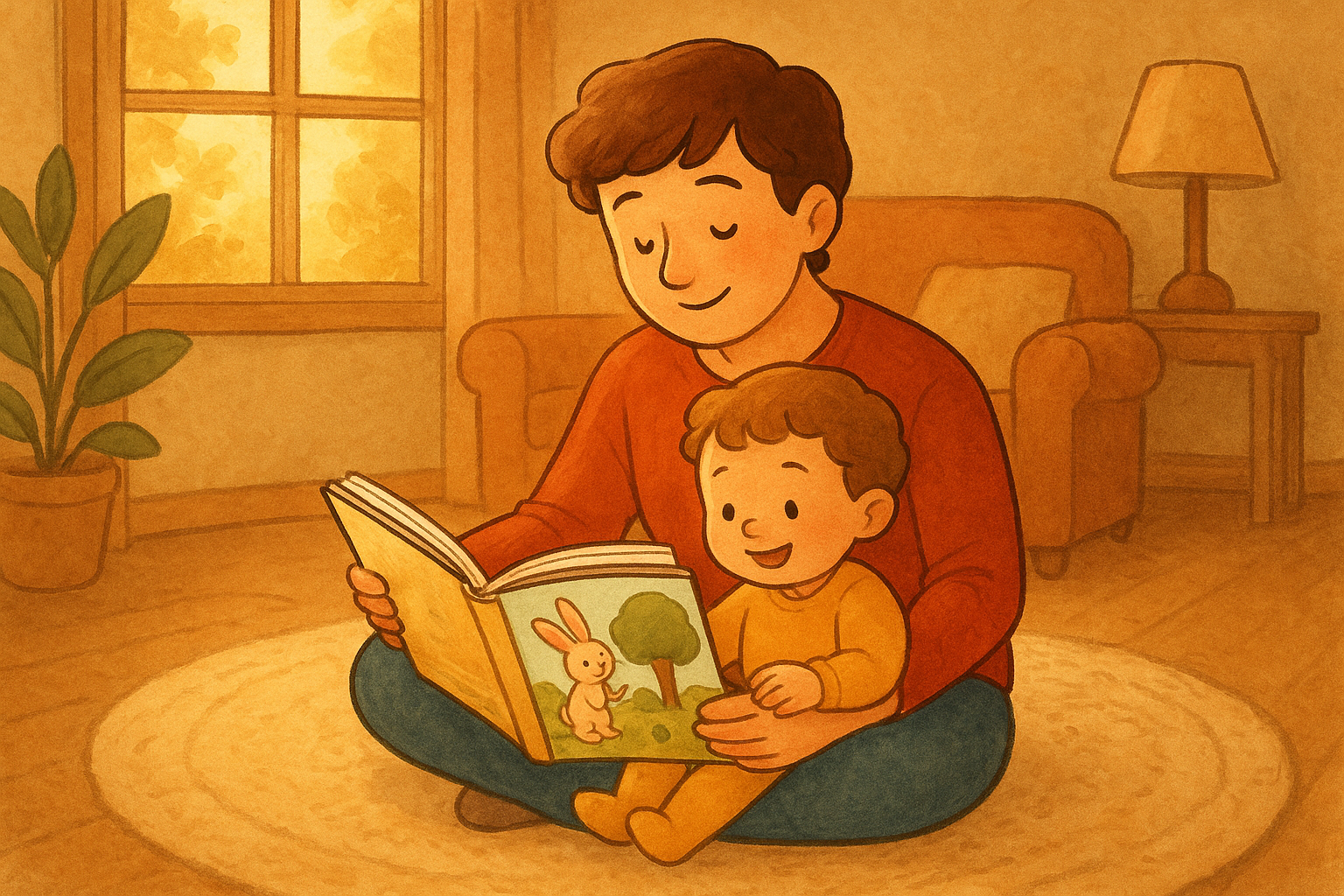
Consistent carryover at home strengthens what children practice during core vocabulary story sessions.
Aligning Core Vocabulary Stories with IEP Goals and Progress Monitoring
For special education teams, teaching core vocabulary through stories can map directly onto Individualized Education Program (IEP) goal language. For example, a measurable goal might read: "By the end of the grading period, the student will use AAC to request a desired item using the core word 'want' in 4 of 5 opportunities across 3 consecutive data collection sessions."
Meanwhile, simple tally-based data sheets work well for tracking this kind of progress. Specifically, record whether the child recognized the word, imitated it after a model, or produced it independently during each story session. Over several weeks, these tallies reveal whether a word is ready to retire or needs continued focus.
Finally, because core vocabulary stories work across access methods, including eye gaze, switch scanning, PECS, and high-tech speech-generating devices, the same story and the same data sheet can serve an entire classroom of learners with very different communication profiles.
Common Mistakes to Avoid When Building Core Vocabulary Skills
One common mistake is introducing too many new core words at once, which can overwhelm an early communicator and slow progress rather than speed it up. Instead, narrow your focus and add new words gradually as previous ones become solid.
Another frequent pitfall is rushing through a story without pausing to model. Consequently, the child never actually sees the word demonstrated on their AAC system or hears it emphasized enough to notice it.
Finally, many adults skip the play extension entirely, treating the story as a standalone activity. However, without a follow-up activity, core words often stay trapped inside the book instead of transferring into daily routines like snack time or recess.
Frequently Asked Questions About Teaching Core Vocabulary Through Stories
What is teaching core vocabulary through stories?
Teaching core vocabulary through stories is a method where high-frequency, functional words like go, want, and more are highlighted, modeled, and practiced within a repeated storybook or narrative. It pairs meaningful context with repetition so children can use the same words across many settings.
How does teaching core vocabulary through stories support AAC users?
Stories give AAC users repeated, natural opportunities to see core words modeled on a device or board while a real narrative unfolds. This repetition builds recognition and motor planning, both essential for independent AAC use over time.
Why is core vocabulary important for early communication?
Core vocabulary words make up roughly 80% of what people say in everyday conversation, so mastering them gives children maximum communicative power with a small word set. Fringe vocabulary, by contrast, is topic-specific and used far less often.
What age group benefits most from core word stories?
Children ages 2 to 7 typically benefit most, since this is when foundational language and early AAC skills are developing. That said, older students with complex communication needs can also benefit from the same routine.
How long does it take to see progress with story-based core vocabulary teaching?
Many caregivers and clinicians notice increased word recognition within a few weeks of consistent, repeated readings. Expressive use of new core words often takes longer and varies depending on each child's individual profile.
What is the difference between core vocabulary and fringe vocabulary?
Core vocabulary includes small, flexible words used across almost every topic, such as more, stop, and in. Fringe vocabulary, however, is specific to one context, like dinosaur names, and appears far less frequently.
How much do Core Stories resources cost?
Individual Core Stories are sold as affordable downloadable resources through Teachers Pay Teachers, while the Core Stories Foundational 53-Pack bundle offers a lower per-story cost for a full year of material. Free introductory samples are also available for anyone who wants to try the approach first.
What common mistakes should be avoided when teaching core words through stories?
A common mistake is introducing too many new core words at once, which overwhelms early communicators. Skipping repetition, rushing through pages, or forgetting to model on an AAC device are other frequent pitfalls.
Can parents use story-based core vocabulary teaching at home?
Yes, parents can use story-based core vocabulary teaching during regular bedtime or playtime reading. Following the same Read, Model, Play routine used in therapy sessions helps reinforce skills through consistent carryover.
What is the Read, Model, Play approach?
Read, Model, Play is a three-step framework where an adult reads a core-word-rich story aloud, models the target words using speech or AAC, and then extends learning through a related hands-on activity. This structure gives children multiple exposures to the same words in different contexts.
How many core words should be targeted in a story session?
Most clinicians target two to four core words per story session to avoid overwhelming the child. Focusing on a small set allows for deeper repetition and better retention across multiple readings.
Do children need to talk to benefit from core vocabulary stories?
No, children do not need to talk to benefit from core vocabulary stories. Pre-verbal and AAC-using children still gain receptive language, joint attention, and word recognition simply from repeated exposure and modeling.
What materials are needed to start teaching core vocabulary through stories?
At minimum, you need a repetitive core-word-rich story, a visual core vocabulary board or AAC device, and a related follow-up activity. Ready-made resources like Core Stories bundle all three elements together for convenience.
How is progress measured when teaching core vocabulary through stories?
Progress is typically measured through data tracking sheets that record how many times a child recognizes, imitates, or independently uses a targeted core word across sessions. Many SLPs also track whether the word generalizes outside the story context.
Where can SLPs find ready-made core word story resources?
SLPs can find ready-made core word story resources, including Core Stories and Sound Stories, through Little Speech Corner's downloadable resource library. You can browse examples like Little Lily's Language Leap story or explore the broader Lily story collection for a hands-on preview of the Read, Model, Play method.
Can core vocabulary stories be organized by month like AAC book companions?
Yes, many SLPs and special education teachers organize core vocabulary stories around monthly or seasonal themes, similar to AAC book companions. Pairing a predictable seasonal theme, such as apples in October or planting in April, with two to three core words keeps the Read, Model, Play routine fresh while still prioritizing high-frequency vocabulary over topic-specific fringe words.
How do you adapt a classroom read-aloud into a core vocabulary story?
To adapt a classroom read-aloud, first identify two to four core words that repeat naturally across the pages, such as go, more, or stop. Next, build a simple core board or program those words onto students' AAC devices, then pause on each target page to model the word before extending it into a related hands-on activity.
A quick reminder: consistency beats novelty. Reusing one well-chosen story for several sessions in a row almost always builds stronger core word retention than moving through a new book every day.
Bringing It All Together
Teaching core vocabulary through stories works because it combines proven ingredients: meaningful repetition, shared attention, and a flexible structure that scales across the whole school year. Instead of isolated drills or a one-time monthly theme, children encounter core words embedded in a narrative they enjoy returning to again and again.
In summary, the Read, Model, Play framework gives SLPs, special education teachers, and parents a simple, repeatable structure for turning any storybook, seasonal theme, or classroom read-aloud into a core vocabulary lesson. By choosing one story, limiting target words, modeling consistently, aligning to IEP goals, and extending learning through play, you give every child — verbal or AAC-using — a genuine chance to build functional communication skills that transfer far beyond the classroom or therapy room.