
Early Childhood AAC Training Resources for SLPs & Teams
Discover early childhood AAC training resources from Mrs. Gwen, M.A., CCC-SLP. Explore Core Stories, free samples, and TPT tools to get started.
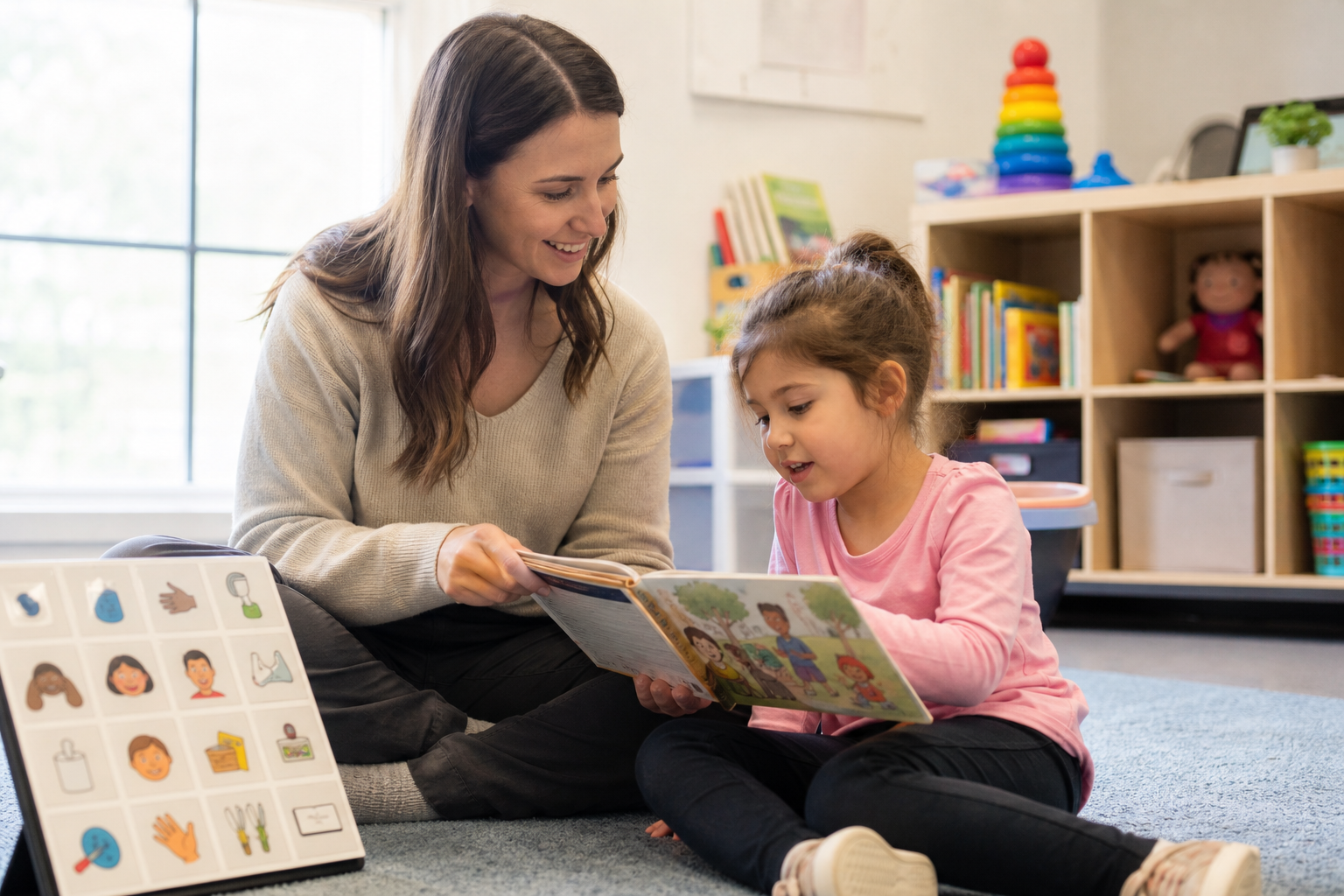
Early childhood AAC training resources give speech-language pathologists, special educators, and classroom teams a practical way to model augmentative and alternative communication with young children. Instead of relying on scattered worksheets, these resources typically pair a short story with core-vocabulary modeling and guided play. As a result, adults get a repeatable structure they can use in a therapy room, a classroom, or at the kitchen table. This article explains what these resources look like, why early modeling matters, and how one story-based method, Read, Model, Play, puts the research into daily practice.
Early childhood AAC training resources often combine shared reading with hands-on modeling.
What Are Early Childhood AAC Training Resources?
Early childhood AAC training resources are stories, visuals, and planning tools built specifically to help adults model augmentative and alternative communication with children roughly ages two through seven. In particular, they focus on one or two core words at a time instead of long vocabulary lists. Because young children need many repeated, meaningful exposures to a word before using it themselves, these resources are designed around repetition rather than one-time instruction.
Most collections include an illustrated story, a short modeling script, and a related play or activity idea. Some, like core-word tip sheets, extend the same vocabulary into the classroom and home. Consequently, a single resource can support a therapy session, a classroom circle time, and a family dinner conversation using the exact same target word.
Why Early AAC Modeling Matters for Young Communicators
Adult modeling is one of the most consistently cited supports for early language development, including language supported by AAC. According to the American Speech-Language-Hearing Association, modeling AAC use alongside natural communication gives children repeated demonstrations of how symbols and words work before they are expected to use them independently. In other words, a child learns a system by watching it used, not by being asked to perform it cold.
Early intervention research, including guidance summarized by the Centers for Disease Control and Prevention, also points to the importance of starting communication support as early as possible. Therefore, resources that make early modeling simple to repeat, rather than complicated to plan, remove a real barrier for busy teams. Augmentative and alternative communication itself, as described on Wikipedia, covers any tool beyond natural speech that supports communication, from simple picture boards to speech-generating devices, which is exactly why flexible, story-based modeling resources work across such a wide range of learners.
The Read, Model, Play Approach to AAC Resources
Little Speech Corner's signature method, Read, Model, Play, was built by Gwen Swire, M.A., CCC-SLP, after more than twenty years across early intervention, preschool, and elementary settings. A short Core Story provides about five minutes of shared reading and core-vocabulary modeling. Afterward, the adult follows the child into interaction and child-led play, keeping the same target word in focus.
This structure supports flexible language modeling, including AAC, because the adult is not scripted into speech alone. Instead, the word can be modeled on a device, a core board, a sign, or spoken language, depending on what the child uses. You can learn more about the full approach and browse the catalog directly on the Little Speech Corner website. For session ideas that pair well with this method, see these easy AAC activities for preschool and additional AAC activities for speech therapy sessions.
How to Put AAC Training Resources Into Practice
Turning a resource into a repeatable routine takes a clear sequence. The steps below reflect how Read, Model, Play is typically used in a session or classroom block.
- Select a core vocabulary target. Choose one high-utility word that matches the child's current communication system rather than introducing several new words at once.
- Share a short Core Story. Read the illustrated story aloud for about five minutes, pointing to the target word naturally as it appears.
- Model the word on the child's AAC supports. Demonstrate the word on a device, board, or sign several times without demanding an immediate response.
- Extend into child-led play. Follow the child's interests with a related toy, continuing to model the same word during natural pauses.
- Carry the word across settings. Share a simple tip sheet with classroom staff and family so the word gets modeled again at school and home that week.

Classroom teams can reinforce the same core word introduced during therapy.
Core Stories and Sound Stories as AAC and Speech-Sound Tools
Individual Core Stories focus on one Core Word at a time, with related modeling and activity ideas built in. For teams wanting a ready-made sequence, the Core Stories Foundational 53-Pack bundles 53 stories with a suggested Core Word of the Week plan, an annual calendar, and team modeling supports. This bundle is sold through TPT, so it is worth confirming the current listing for exact files and licensing before purchase.
Sound Stories serve a different, related purpose. Rather than targeting AAC vocabulary, they are illustrated, sound-loaded narratives built for clinician-selected articulation and speech-sound practice. Consequently, a team might use Core Stories during AAC-focused sessions and Sound Stories during the same week for a child also working on speech sounds, keeping planning simple without duplicating effort.
Choosing the Right Early Childhood AAC Training Resources
Not every resource fits every caseload, so a few questions help narrow the choice. Specifically, consider whether the material targets a manageable number of core words, whether it includes a modeling script an assistant or family member could follow, and whether it offers a free sample before purchase.
For school-based SLPs juggling large caseloads, resources that can be reused across sessions with minimal prep tend to hold up best over a full school year. A broader roundup of options appears in this guide to speech therapy resources for busy school-based SLPs, alongside this collection of story-based speech therapy resources for young children.
Free Samples to Try Before You Commit
Before committing to a full bundle, it helps to see the format in action. Free samples currently available include "Apples for Anna," a Core Story built around the word THERE, a core-vocabulary calendar with a sample story included, and SW and CH Sound Story samples for articulation practice. In addition, a broader library of AAC-focused posts and guides lives on the site's AAC blog section, which is a useful next stop after trying a free download.
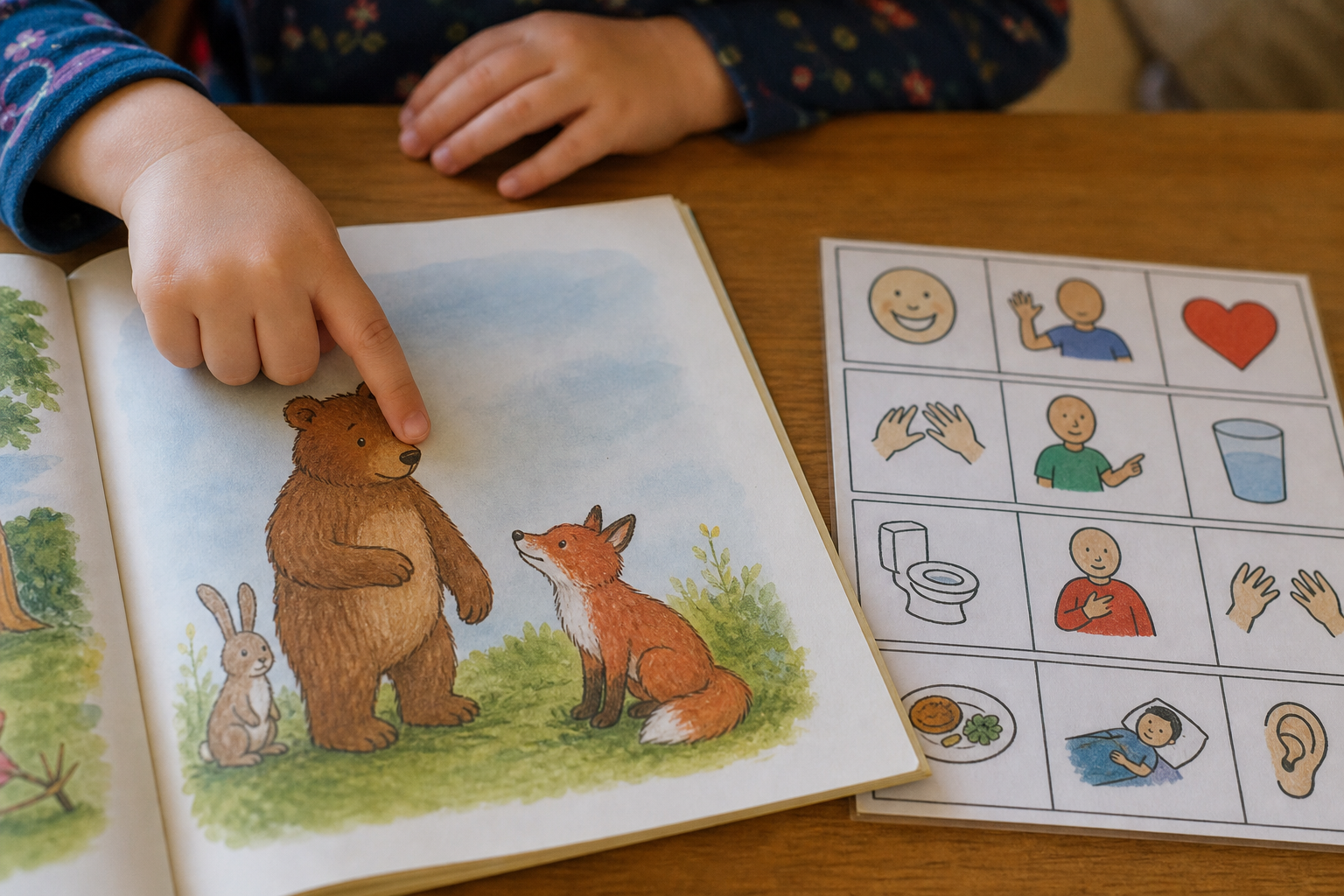
A simple communication board paired with a story makes modeling easy to repeat at home.
A Credentialed SLP Behind the Resources
Gwen Swire, M.A., CCC-SLP, known as Mrs. Gwen, holds ASHA certification, a California SLP license, and a Clinical or Rehabilitative Services Credential. She earned her M.A. and B.A. in Communication Disorders from California State University, Fullerton, and has spent more than twenty years working across early intervention, preschool, elementary, and family settings. That clinical background shapes resources designed for real session constraints, not just theoretical lesson plans.
Quick fact: five minutes is roughly how long a Core Story reading takes, not a promised outcome timeline. Progress with any communication goal depends on the individual child and consistency of modeling across settings.
Frequently Asked Questions About Early Childhood AAC Training Resources
What are early childhood AAC training resources?
Early childhood AAC training resources are stories, visuals, and tip sheets that help adults model augmentative and alternative communication with young children. They typically pair a short shared reading activity with core-vocabulary modeling and guided play.
How do early childhood AAC training resources support emerging communicators?
They give adults a consistent script and vocabulary target, so modeling feels natural rather than improvised. Repetition across a story, a lesson, and home carryover helps a child encounter the same core word in several meaningful contexts.
Why is early AAC modeling important for young children?
Modeling shows a child how a word or symbol works before any expressive attempt is expected. This adult-first approach is widely supported as a key input for building both verbal and AAC-supported communication.
What is the difference between AAC training resources and traditional speech therapy worksheets?
Traditional worksheets usually ask a child to complete a task independently. AAC training resources, by contrast, are built around adult modeling first, followed by child-led interaction, which better matches how young children acquire language.
How much do early childhood AAC training resources typically cost?
Pricing varies by listing and bundle size on marketplaces such as Teachers Pay Teachers. Individual stories are generally priced lower than full bundles, so it helps to compare the current listing details before purchasing.
How long does it take to see progress with AAC modeling?
Progress depends on the individual child, so no specific timeline can be promised. Consistent, repeated modeling across therapy, classroom, and home settings is generally considered more influential than any single session length.
What age range benefits most from early childhood AAC training resources?
Most early childhood AAC training resources are designed for children roughly ages two through seven. This range covers early intervention, preschool, and early elementary communicators who are building foundational vocabulary.
What common mistakes do teams make when introducing AAC?
A frequent mistake is waiting for a child to initiate before modeling a word, which delays learning. Another is using AAC only during therapy instead of across classroom and home routines, which limits generalization.
What best practices should SLPs follow when selecting AAC resources?
Choose resources with a small set of high-utility core words rather than large vocabulary lists. In addition, look for materials that pair a model-and-play structure with simple tip sheets teams can actually use.
Can AAC training resources be used at home as well as in therapy?
Yes, many early childhood AAC training resources are designed for shared use across therapy rooms, classrooms, and homes. Core-word tip sheets and planning calendars specifically help families model the same vocabulary a child is practicing elsewhere.
What is the Read, Model, Play approach?
Read, Model, Play is a short-story method where an adult shares a five-minute Core Story, models a target word using the child's communication supports, and then follows the child's lead into play. It is designed to fit naturally into busy therapy and classroom schedules.
Are free samples available before purchasing a full resource?
Yes, free samples such as a Core Story, a vocabulary calendar, and sound-focused story samples are available to preview the approach. These let an SLP or teacher try the format before committing to a full bundle.
How do Sound Stories differ from Core Stories?
Core Stories focus on core vocabulary and AAC modeling, while Sound Stories are built around repeated exposure to a clinician-selected speech sound within a connected narrative. Both use illustrated storytelling, but the practice goal differs.
Who creates Little Speech Corner's early childhood AAC training resources?
Gwen Swire, known as Mrs. Gwen, is a licensed and ASHA-certified speech-language pathologist with more than twenty years of experience across early intervention, preschool, and elementary settings. Her clinical background shapes the practical, session-ready design of each resource.
Final Thoughts on Choosing AAC Training Resources
Ultimately, early childhood AAC training resources work best when they are simple enough to repeat, flexible enough to fit a child's communication system, and consistent enough to carry across therapy, classroom, and home. The Read, Model, Play structure behind Little Speech Corner's Core Stories and Sound Stories was built with exactly that repetition in mind, drawing on more than two decades of clinical experience from Mrs. Gwen. Whether a team starts with a free sample or moves straight to the Foundational 53-Pack, the goal stays the same: give young communicators frequent, natural models of the words they need most.
