
Early Childhood Communication Resources for SLPs
Explore early childhood communication resources for SLPs: story-based core vocabulary, sound practice, and team supports. Preview a free sample today.

Finding early childhood communication resources can feel like sorting through a very full therapy closet, whether you are an SLP, a teacher, or a parent. The best materials are easy to prep, flexible for different learners, and simple to share with the adults around a child. Below, you will find the main types of resources, what to look for in each, and how story-based tools fit into a busy week.
What Are Early Childhood Communication Resources?
Early childhood communication resources are books, tools, programs, and supports that help adults encourage communication in young children, usually ages 2 to 7. They include illustrated stories, vocabulary tip sheets, sound practice texts, visual supports, and communication tools such as AAC.
Good resources respect every communication mode. Speech, gestures, signs, pictures, and devices all count. In addition, they leave room for the SLP to choose targets and cues for each child.
Types of Communication Resources for Young Children
Resources fall into a handful of groups. Most families and teams use a mix, so it helps to know what each one offers.
Books and Story-Based Materials
Short, predictable stories give children a shared focus and repeated, meaningful exposure to words. Parent guides can also explain interaction strategies for everyday routines. For more on this style, see our overview of story-based speech therapy resources for young children.
Trusted Organizations and Websites
Professional and family organizations share plain-language information. For example, the American Speech-Language-Hearing Association (ASHA) explains speech and language development and where to find an SLP. The Hanen Centre offers parent-focused language programs.
Apps and Technology
Some apps support AAC, and others offer video-based speech play. Apps can be useful, but they work best alongside live interaction. Meanwhile, screen use deserves a plan. These screen time and speech tips for parents can help families balance both.
Visual Supports, Signs, and Sensory Tools
Visual schedules, social stories, and basic sign resources can make routines clearer. Sensory tools may help some children feel regulated. However, they support communication only indirectly, so treat them as one piece of a larger plan.
Professionals and Support Networks
Speech-language pathologists, developmental pediatricians, occupational therapists, and special education advocates each bring a different view. Local parent groups can also offer practical encouragement. Together, they help families make informed choices.
These resources provide educational support and do not replace individualized assessment, clinical judgment, or speech-language therapy. An SLP should select speech targets and cues for each child.
Why Story-Based Tools Work Well With Young Learners
Young children enjoy short, predictable stories. As a result, adults get a natural moment to point out one word again and again. The story gives context, and the pictures give a shared focus.
Shared reading gives adults a simple, low-pressure way to model words.
Core Vocabulary and AAC Support
What is core vocabulary?
Core vocabulary is the small group of common words, such as go, more, stop, and there, that appear in most everyday talk. Because these words work in many settings, they are a practical focus for early communicators.
How AAC fits in
Augmentative and alternative communication (AAC) means tools and strategies that support or replace speech, such as picture boards or speech-generating devices. With aided language modeling, the adult points to or selects the word on the child's system while speaking. The child's full vocabulary stays available at all times. For fresh ideas, try these AAC activities for preschool.
Child-led play and communication modes
Follow the child's interests and accept every response, whether it is a word, a gesture, a sign, or a button press. No one needs to ask a child to repeat a word. Modeling is an invitation, not a demand.
The Read, Model, Play Routine
Little Speech Corner, created by Gwen Swire, M.A., CCC-SLP, known as Mrs. Gwen, uses a routine called Read, Model, Play. A short Core Story takes about five minutes. Then the adult models the core word and follows the child's lead into play. Five minutes is a format, not a promised outcome.
| Step | What the adult does |
|---|---|
| Read | Share a short illustrated Core Story. |
| Model | Use the core word on the child's communication supports. |
| Play | Follow the child's lead and model during play. |
How to Choose Preschool Speech and Language Materials
Follow these steps to match a resource to a learner.
- Pick the goal: core vocabulary, speech sounds, or shared team vocabulary, based on your own assessment.
- Preview the resource and check the pictures, text load, and fit with the learner's supports.
- Read the story in about five minutes, pointing out the target word without asking for repetition.
- Model the word during child-led play, using the child's AAC or other supports.
- Share a tip sheet or note with teachers and family so the word is modeled across the week.
For a wider look at what to stock, see these printable speech and language resources for preschool SLPs.
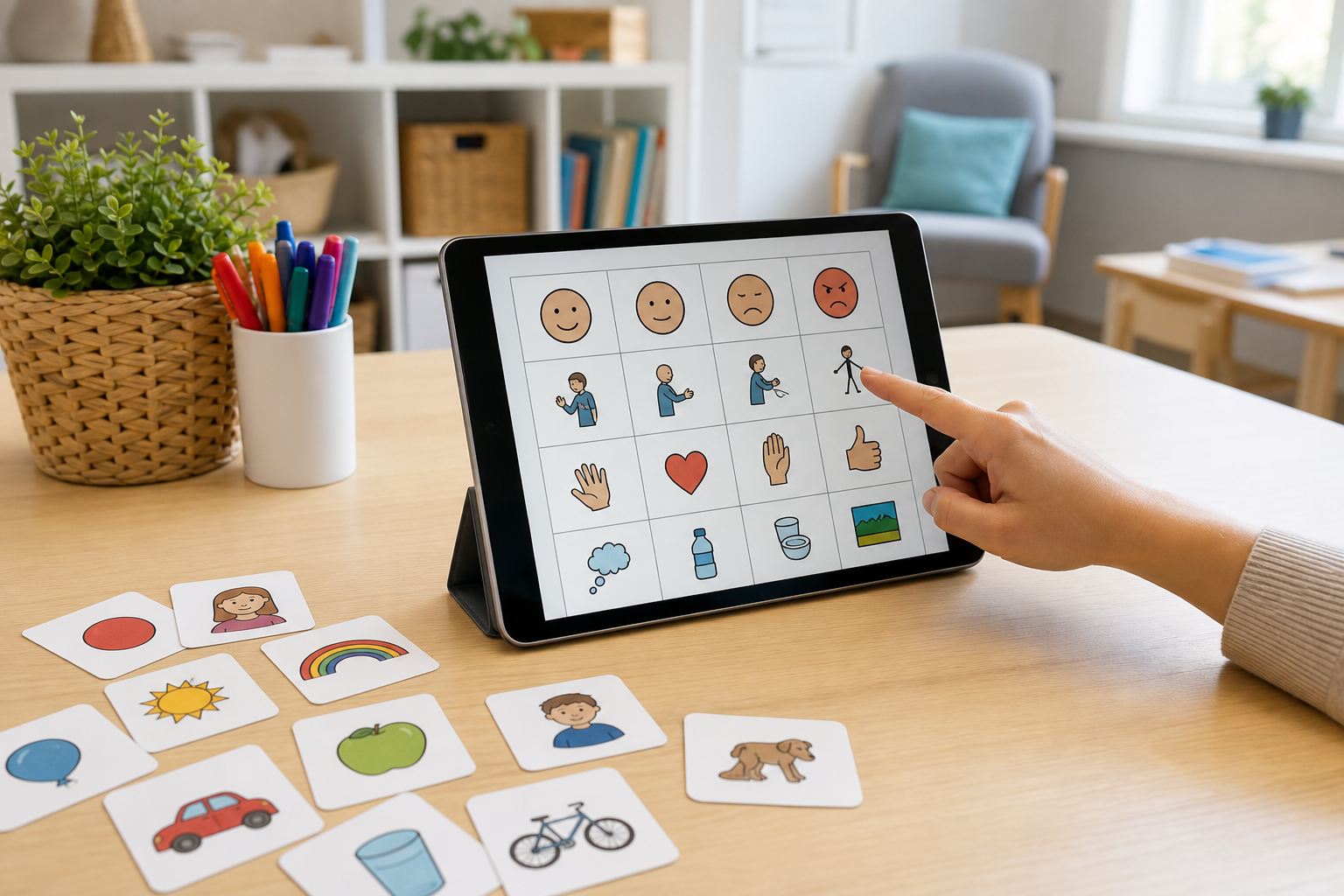
Modeling on the child's own communication system keeps every word accessible.
Tracking Milestones Alongside Resources
Resources work best when adults know what to expect at each age. Our guide to essential communication milestones for toddlers offers a helpful frame. If you have concerns, read about early speech intervention and talk with an SLP.
Sound Stories for Articulation Practice
Sound Stories are illustrated, sound-loaded narratives. They give repeated chances to hear selected target speech sounds in connected language. The SLP chooses the sounds and follow-up practice for each child.
Free SW and CH samples are available through Teachers Pay Teachers (TPT), so you can preview the style first. These resources provide educational support and do not replace individualized assessment, clinical judgment, or speech-language therapy. An SLP should select speech targets and cues for each child.
Team Supports and School-Home Carryover
Children hear words in many places. Therefore, Core Word Tip Sheets and a planning calendar help adults model the same vocabulary at school and home. The Core Stories Foundational 53-Pack is a TPT bundle with a suggested Core Word of the Week sequence. It is not a complete individualized therapy program. Check the current TPT listing for included files and licensing before sharing with staff.
If you juggle a large caseload, this roundup of resources for busy school-based SLPs may help.
Try a Free Sample First
Free examples include Apples for Anna (THERE), a calendar with a sample Core Story, and SW and CH Sound Story samples. Storytime Stories and Story Builders are still in development and are not yet available. Explore the full approach at Little Speech Corner.
Frequently Asked Questions
What are early childhood communication resources?
They are books, tools, programs, and supports that help adults encourage communication in children, usually ages 2 to 7. Examples include illustrated stories, core word tip sheets, and sound practice narratives.
What is core vocabulary?
Core vocabulary is the small set of common words, like go, more, and stop, that make up most of what people say. These words are useful across many activities and settings.
What does AAC stand for?
AAC stands for augmentative and alternative communication. It includes tools and strategies such as speech-generating devices, picture boards, signs, and gestures that support communication.
What is Read, Model, Play?
Read, Model, Play is Little Speech Corner's approach. A short Core Story is shared in about five minutes, the adult models the core word, and then child-led play follows.
Why use stories for core vocabulary?
Stories offer repeated, meaningful exposure to a word in context. They also give adults an easy, predictable way to start modeling.
Can these resources be used with AAC users?
Core Stories support flexible language modeling, including AAC. Keep the child's full communication system available and model on it as you read and play.
Do I need to ask the child to repeat words?
No. Modeling does not require repetition or pressure to speak. Children can respond in any way they communicate.
How are Sound Stories different from Core Stories?
Sound Stories are sound-loaded narratives for articulation practice, while Core Stories focus on core-vocabulary modeling. An SLP should choose the target sounds for each child.
Is there a free way to try these resources?
Yes. Free samples include Apples for Anna (THERE), a calendar with a sample Core Story, and SW and CH Sound Story samples through TPT.
What is the Core Stories Foundational 53-Pack?
It is a TPT bundle of 53 Core Stories with a suggested Core Word of the Week sequence. It is not a complete individualized therapy program.
How can teams share vocabulary across settings?
Core Word Tip Sheets and a planning calendar help adults model the same word at school and home. Check current TPT licensing before sharing materials with staff.
Do these resources replace therapy?
No. They provide educational support and do not replace individualized assessment, clinical judgment, or speech-language therapy.
Conclusion
The best early childhood communication resources are flexible, respectful of every communication mode, and easy to share with a child's team. Books, trusted organizations, AAC tools, short stories, core-vocabulary modeling, sound-loaded narratives, and simple tip sheets can all support that work. Every child is different, so start with a free sample, see how it fits your learners, and let an SLP's clinical judgment guide every choice.
