
Early Communication Lesson Plan Downloads for SLPs
Find early communication lesson plan downloads: Core Stories, Sound Stories, and free samples from Little Speech Corner. Browse options on TPT today.

Early communication lesson plan downloads solve one of the biggest headaches in pediatric speech therapy: finding a ready-to-use, research-informed session plan without spending another weekend printing, laminating, and guessing what will hold a child's attention. Instead of building every activity from scratch, a clinician, teacher, or family member can open a short, story-based download and move straight into shared reading, modeling, and play. Below, you'll find exactly what these downloads include, how the Read, Model, Play approach works, how to evaluate a resource before buying it, and how to put it to work with speech, sign, or AAC (augmentative and alternative communication — tools or systems that support communication for people with limited speech).
Quick answer: Early communication lesson plan downloads are printable or digital, story-based resources that pair a short Core Story or Sound Story with modeling prompts and play ideas. They let an adult model core vocabulary or speech sounds in roughly five minutes, and they work equally well for spoken language, sign, or AAC.
What Are Early Communication Lesson Plan Downloads?
Early communication lesson plan downloads are digital resources built around one repeatable routine rather than a long worksheet packet. In practice, each download pairs a short illustrated story with clear modeling cues, so an adult knows exactly which word, phrase, or sound to emphasize before the session even starts. As a result, a therapist or teacher can plan a session in minutes instead of designing new materials every single week.
Specifically, Little Speech Corner organizes its early communication lesson plan downloads into three practical categories: Core Stories for vocabulary, Sound Stories for articulation, and Team Supports for classroom and home carryover. Because each category targets a different goal, an SLP can pick a resource that matches a current objective rather than adapting a generic story after the fact.
Unlike generic worksheet bundles, these downloads are built around one target at a time. This narrow focus matters: research on language intervention consistently shows that repeated, meaningful exposure to a single word or sound in varied contexts supports generalization far better than scattering attention across dozens of unrelated targets in one sitting.
Short, story-based sessions make early communication lesson plan downloads easy to fit into a busy schedule.
Why Early Communication Resources Matter for Young Communicators
According to the American Speech-Language-Hearing Association, early vocabulary and sound development set the foundation for later reading and classroom participation (ASHA's developmental guidance). Therefore, consistent, repeated modeling during the preschool years matters far more than occasional, isolated drills.
In addition, the Centers for Disease Control and Prevention tracks communication milestones that vary widely between ages 2 and 5 — exactly the window these downloads target (CDC developmental milestones). Because development is so uneven at this stage, flexible, story-based tools tend to outperform rigid, one-size-fits-all scripts.
Similarly, the National Institute on Deafness and Other Communication Disorders notes that early, naturalistic language exposure strongly predicts later communication outcomes (NIDCD on speech and language). For a closer look at how short sessions fit into a packed schedule, see this related guide on five-minute speech and language activities for preschoolers.
Inside the Read, Model, Play Approach
Read, Model, Play is the routine behind Little Speech Corner's Core Stories, and it is the engine that makes these early communication lesson plan downloads work in real sessions. First, an adult reads a brief story aloud, usually in about five minutes. Next, the adult models the target core word using the child's own communication system — spoken language, sign, or an AAC device (more on AAC). Finally, the pair moves into child-led play that keeps reinforcing the same word in a new context.
Because the structure stays the same across every story, children quickly learn what to expect, and adults spend less time explaining the activity and more time actually modeling language. For practical AAC pairing ideas, this collection of AAC activities for preschool expands on the modeling step with ready-to-run examples.
Above all, the predictability of Read, Model, Play is a feature, not a limitation. Children with language delays, autism, or motor speech differences often respond best to routines they can anticipate — which is exactly what a repeatable, five-minute lesson plan provides week after week.
Types of Early Language Download Resources Available
Not every child needs the same focus, so Little Speech Corner organizes its catalog of early communication lesson plan downloads around three practical categories. Below is a quick comparison of what each type offers and who it tends to suit best.
| Resource | Primary Focus | Typical Session Length | Best For |
|---|---|---|---|
| Core Stories | One core vocabulary word per story | ~5 minutes + play | Early language and AAC modeling |
| Sound Stories | One clinician-selected speech sound | ~5–10 minutes | Articulation practice |
| Team Supports | Shared planning across adults | Ongoing, weekly | Classroom and home carryover |
Core Stories for Everyday Vocabulary
Each Core Story is a short illustrated story built around one functional word. Because the vocabulary is "core" — meaning it's used often across many situations, like go, more, or there — modeling it repeatedly tends to generalize well beyond the story itself and into everyday requests, comments, and play.
Sound Stories for Speech Sound Practice
Sound Stories work differently. Instead of a vocabulary focus, they load a narrative with one target speech sound, such as SW or CH, chosen by the clinician. As a result, a child hears and practices the sound repeatedly within a natural story rather than through isolated drill cards that feel disconnected from real conversation.
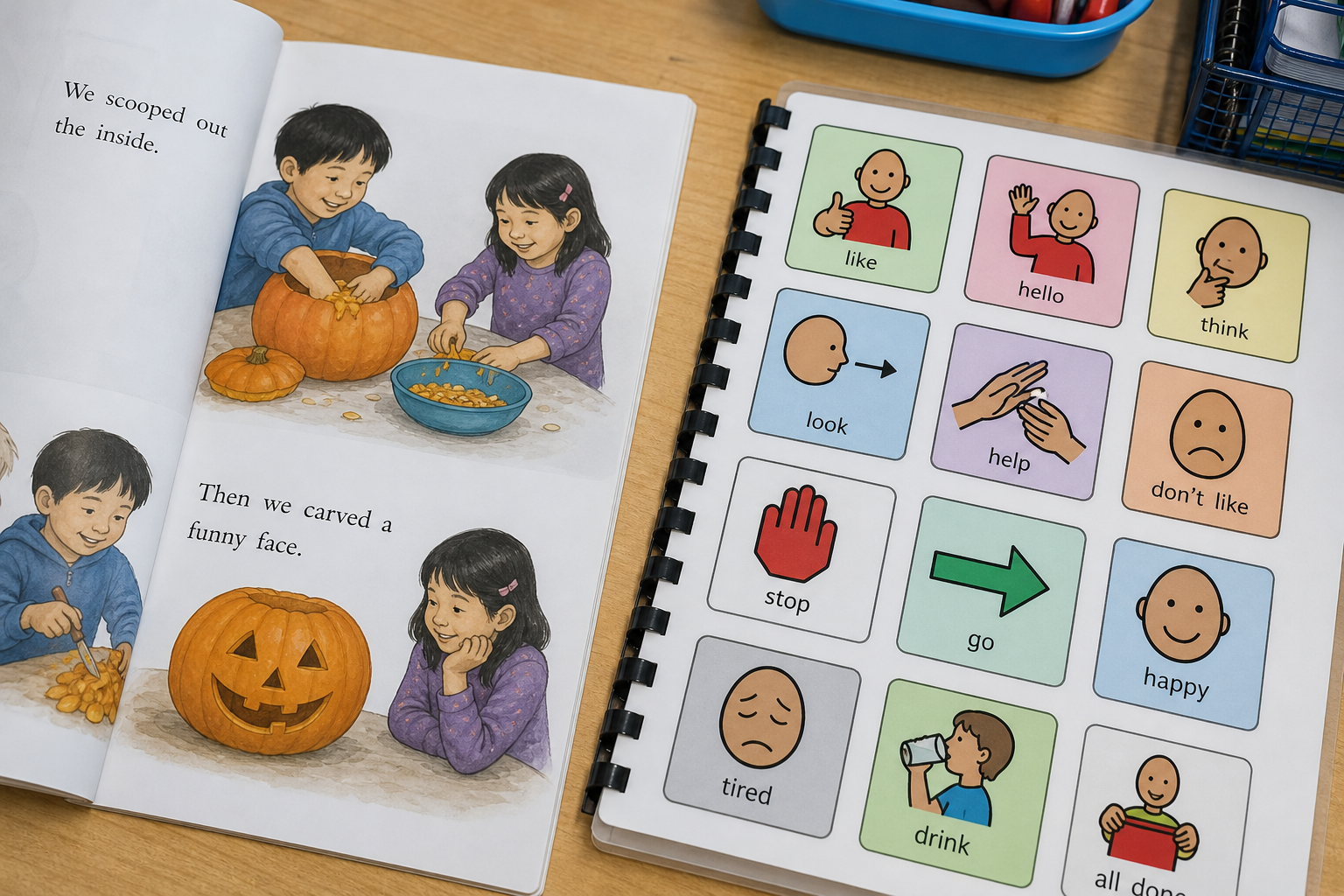
Core Stories pair naturally with a communication board during modeling.
Team Supports for Classroom and Home Carryover
Finally, Team Supports include core-word tip sheets and a planning calendar so a classroom team can model the same word a therapist is targeting that week. Similarly, families can follow the same calendar at home, which closes the loop between therapy, school, and daily routines. For a deeper look at keeping vocabulary consistent across settings, see what resources help SLPs carry core vocabulary from therapy into the classroom.
How to Choose Speech Therapy Lesson Plan Downloads
Choosing the right early communication lesson plan downloads doesn't need to be complicated. The following five steps outline a simple process many SLPs and teachers already follow when matching a resource to a goal.
- Identify the current goal. Check which core word or speech sound a child is currently working on in their plan before browsing any titles, so the download you pick actually targets the right skill.
- Match the story to that goal. Pick a Core Story for vocabulary work or a Sound Story for the specific articulation target the child needs practice with this week.
- Read and model. Share the story aloud in about five minutes, then model the word or sound using the child's own speech, sign, or AAC system consistently throughout the reading.
- Extend into play. Let the child lead a follow-up activity while the adult keeps modeling the same target naturally, without quizzing or demanding a verbal response.
- Share the plan. Use a tip sheet or planning calendar so teachers and family members model the exact same target that week, reinforcing it across every setting the child spends time in.
For more printable options to pair with this process, browse this roundup of printable speech and language resources for preschool SLPs.
What to Look for Before You Buy Early Communication Lesson Plan Downloads
Not every download labeled "speech therapy resource" is built the same way. Before spending caseload budget or personal funds, run through this short checklist so the early communication lesson plan downloads you choose actually hold up across a full school year.
- Single-target design: Does the story focus on one word or sound, or does it scatter attention across many targets at once?
- Modeling cues included: Are there explicit prompts telling the adult exactly when and how to model the target?
- AAC-friendly format: Can the target be modeled with speech, sign, and an AAC device equally well, without extra adaptation?
- Carryover tools: Does the bundle include a tip sheet or calendar that classroom teams and families can actually use?
- Realistic session length: Can the core activity reasonably be completed in five to ten minutes, matching a typical therapy slot?
Free Early Communication Lesson Plan Downloads to Try First
Before committing to a full bundle, free samples let a clinician test the format risk-free. Little Speech Corner currently offers the Apples for Anna Core Story focused on the word THERE, a vocabulary planning calendar with a sample story, and both SW and CH Sound Story samples. These can be downloaded through the Little Speech Corner resource library before purchasing anything larger on TPT.
Once a sample fits well, many SLPs move to the Core Stories Foundational 53-Pack, which connects a full year of core words to a suggested weekly sequence. However, it's worth confirming the current listing details, since pricing and included files can change over time. Educators looking for story-based language work beyond vocabulary alone may also enjoy this piece on literacy-based speech therapy activities for preschoolers.
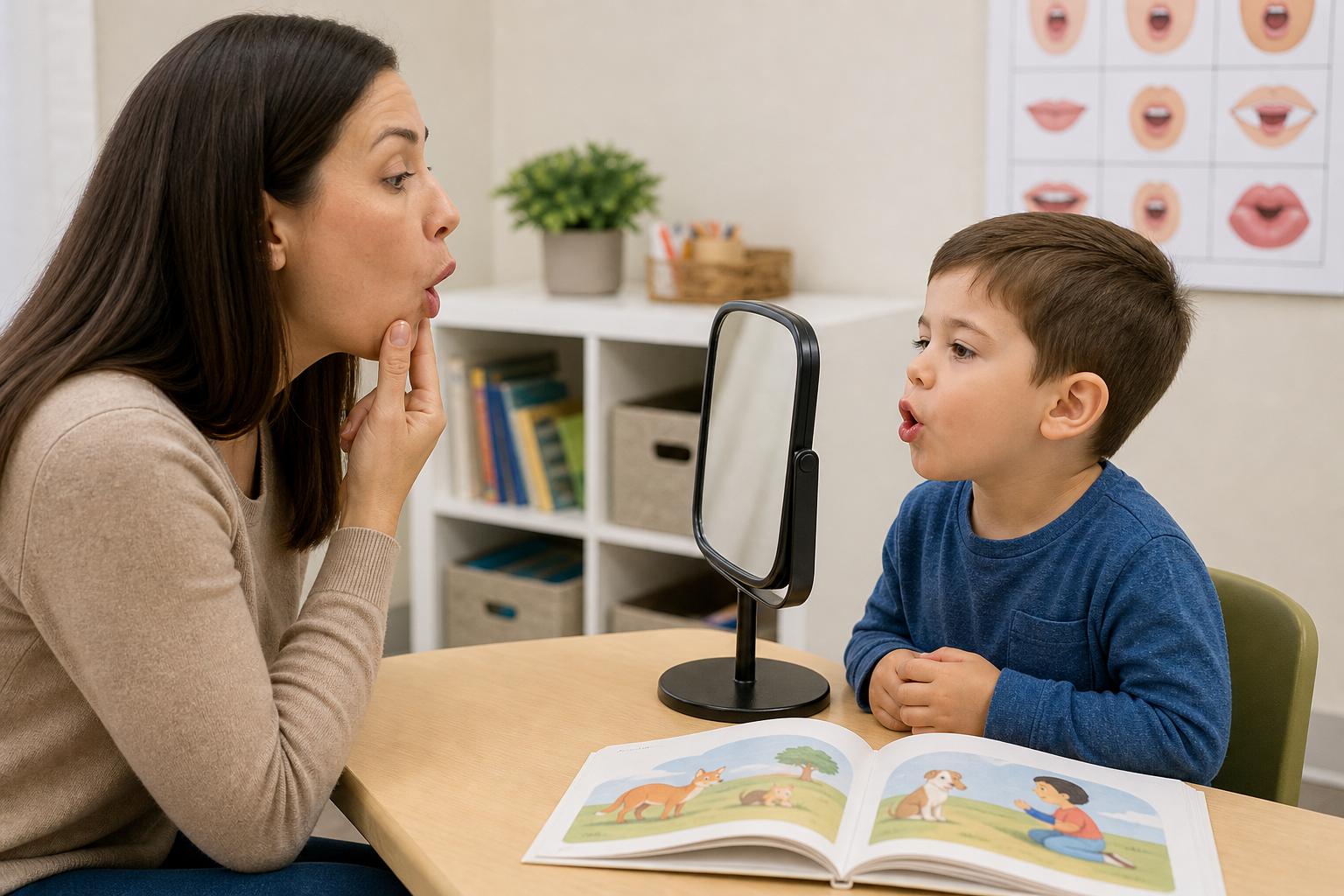
Sound Stories give children repeated, natural practice with a target speech sound.
Early Communication Lesson Plan Downloads vs. Building Materials From Scratch
It's worth asking whether ready-made downloads are actually better than DIY materials. In most cases, the answer comes down to time and consistency. Building an equivalent story, modeling script, and play extension from scratch typically takes an hour or more per target, whereas a ready-made download is usable in minutes.
In contrast, homemade materials often drift in quality and consistency across a busy caseload — one week's activity might be thorough, the next thrown together at the last minute. Because early communication lesson plan downloads follow one repeatable format, quality and structure stay consistent no matter how hectic the week gets. That consistency is exactly what supports the repetition young communicators need to generalize new words and sounds.
Using These Downloads in Mixed-Ability and AAC-Inclusive Classrooms
Classrooms rarely include children with identical communication profiles. Therefore, a strong early communication lesson plan download needs to flex across speech, sign, and AAC without requiring three separate lesson plans. Because Core Stories build modeling directly into the story rather than bolting it on afterward, one adult can run the same five-minute session for a small group with mixed communication needs.
For example, while reading a Core Story aloud, the adult might speak the target word, sign it simultaneously, and activate it on a child's AAC device — all within the same sentence. Consequently, every child in the group hears and sees the target modeled in their own communication mode, without anyone being singled out or excluded from the activity.
Frequently Asked Questions About Early Communication Lesson Plan Downloads
What are early communication lesson plan downloads?
Early communication lesson plan downloads are printable or digital, story-based resources that SLPs, educators, and families use to model core vocabulary and speech sounds with young children. They typically include a short story, modeling cues, and follow-up activities ready to use in a session or classroom.
How do Core Stories work inside a lesson plan?
Core Stories center on one core word and pair a short illustrated story with modeling prompts. An adult reads the story in about five minutes, models the target word using the child's communication supports, then moves into related play.
What is the Read, Model, Play approach?
Read, Model, Play is a three-part routine: share a brief Core Story, model the target vocabulary, then follow the child's lead into play that reinforces the word. The structure keeps sessions predictable without feeling rigid.
How long does each lesson take to complete?
Most Core Story sessions take roughly five minutes for the shared reading and modeling portion, though total time varies with the child and the play that follows. This is a general guideline, not a guaranteed outcome for every learner.
Who can use these early communication lesson plan downloads?
School-based and private-practice SLPs, early childhood special educators, classroom teams, and families can all use these downloads. They are designed primarily for adults supporting children between roughly ages 2 and 7.
What age range do these resources support?
The materials are designed primarily for young communicators between about 2 and 7 years old. Specific stories and sound targets can be matched to a child's current vocabulary or articulation goals.
How are Sound Stories different from Core Stories?
Core Stories focus on one functional vocabulary word, while Sound Stories are illustrated narratives loaded with a specific speech sound, like SW or CH, for articulation practice. A clinician selects the sound target before using the story.
Are free samples available before buying a bundle?
Yes. Free samples include the Apples for Anna Core Story focused on the word THERE, a vocabulary planning calendar with a sample story, and SW and CH Sound Story samples. These let you try the format before purchasing a larger set.
What does the Core Stories Foundational 53-Pack include?
The 53-Pack is a bundle of foundational Core Stories connected to a suggested Core Word of the Week sequence and planning calendar. Pricing, file formats, and licensing terms should be confirmed on the current TPT listing before purchase.
How do these downloads support AAC users?
Core Stories are built for flexible modeling, so an adult can model the target word with speech, sign, or an AAC device during the same story. This keeps the activity accessible regardless of how a child communicates.
What mistakes should educators avoid when using these downloads?
A common mistake is skipping the modeling step and moving straight to drills, which reduces natural language exposure. Another is choosing too many new words at once instead of focusing on one core word across several contexts.
How do you carry core vocabulary from therapy into the classroom?
Team Supports, such as core-word tip sheets and a shared planning calendar, help therapists and teachers model the same word across settings during the same week. Consistent exposure at home, in therapy, and in the classroom supports carryover.
Where can you purchase or download these resources?
Little Speech Corner's Core Stories, Sound Stories, and bundles are sold and distributed through the Teachers Pay Teachers (TPT) store. Free samples can also be downloaded there before committing to a paid set.
How do these downloads compare to building lesson plans from scratch?
Ready-made early communication lesson plan downloads save prep time because the story, vocabulary focus, and activity ideas are already organized. Building equivalent materials from scratch each week takes considerably longer for a busy caseload.
Can early communication lesson plan downloads be used in teletherapy sessions?
Yes. Because each story is short and screen-shareable, a clinician can read and model on a video call while a caregiver supports modeling in person. The same Read, Model, Play structure works whether the session happens in a clinic room or over teletherapy.
Do these downloads align with IEP goals and data collection?
Because each Core Story or Sound Story targets a single, clearly defined word or sound, it's straightforward to tie a session directly to an existing IEP objective and note whether the child imitated, initiated, or needed a full model that day.
Is a TPT account required to access the free samples?
A free account on Teachers Pay Teachers is generally needed to download any file, including no-cost samples. Creating an account takes only a minute and does not require a payment method for free resources.
What best practices help SLPs get the most from these downloads?
Match the story's core word or sound target to current goals, model consistently rather than quizzing, and loop in classroom teams using the planning calendar. Repetition across short, predictable sessions tends to support stronger carryover.
Final Thoughts on Choosing Early Communication Lesson Plan Downloads
In summary, early communication lesson plan downloads work best when they're matched to a specific vocabulary or sound goal rather than chosen at random. Core Stories support flexible modeling and AAC use, Sound Stories give focused articulation practice, and Team Supports keep classrooms and families aligned on the same weekly target. Above all, starting with a free sample is a practical, low-risk way to see whether the Read, Model, Play format fits a particular caseload before exploring the full catalog on TPT.
