
Speech Sound Practice Stories for Clinicians: A Guide
Speech sound practice stories for clinicians pair sound-loaded narratives with articulation drills. Preview free samples and shop Sound Stories now.

Speech sound practice stories for clinicians give speech-language pathologists a story-based way to target articulation goals without turning a session into a flashcard drill. Instead of isolated word lists, these sound-loaded narratives let a clinician choose a target sound, read a short illustrated story, and build in repeated practice opportunities inside a meaningful context. For SLPs working with young children, this approach pairs clinical precision with the kind of engagement that keeps a session moving forward.
In particular, this guide looks at how story-based articulation practice works, how to use it step by step, and where clinicians can find both free samples and a growing catalog of sound-targeted resources, including the Sound Stories collection from Little Speech Corner.
What Are Speech Sound Practice Stories for Clinicians?
Speech sound practice stories for clinicians are illustrated narratives built around a single articulation target, where sound-loaded vocabulary appears repeatedly inside the plot. A clinician reads the short story, pauses on target-sound words, and prompts the child to produce the sound in that moment rather than afterward.
Consequently, the story becomes both the warm-up and the practice material. Instead of flipping through disconnected picture cards, the child hears the target sound modeled in context and then gets a chance to imitate or spontaneously produce it before the page turns. This structure works for individual sessions, small groups, and even short home carryover activities when a caregiver rereads the same story.
Why Story-Based Articulation Practice Works
Speech sound disorders are common enough that most caseloads include multiple children working on articulation goals at the same time. According to the National Institute on Deafness and Other Communication Disorders, speech sound disorders affect an estimated 8 to 9 percent of young children, which means most SLPs need practice formats that hold attention across many repetitions.
Story-based articulation practice helps here because it gives drill-level repetition a narrative reason to exist. In contrast to a plain word list, a story offers characters, pictures, and a reason to keep listening. Above all, that engagement matters for young children, since attention is often the limiting factor in how many accurate productions a session can collect.
A clinician reading a sound-loaded story aloud before pausing on target words for practice.
How Sound-Loaded Narratives Support Clinician-Selected Practice
Sound-loaded narratives work because the clinician, not the author, decides which sound matters most for a given child. For example, one story can serve a dozen different students across a week, each clinician pausing on different pages to match a different articulation goal.
The Read, Model, Play Approach in Practice
Little Speech Corner's signature Read, Model, Play approach was originally built around core vocabulary, and the same basic rhythm transfers naturally to sound-based practice. A short story is read in about five minutes, the adult models the target language using the child's communication supports, and interaction or play follows. Therefore, a clinician can borrow this same shape for sound stories: read first, model the target sound clearly, then move into play that reinforces the same words.
Similarly, clinicians who already use story-based resources for other goals, such as the ideas described in this guide to play-based language activities for speech therapy, will find the transition to sound-focused stories straightforward since the session structure stays familiar.
Step-by-Step: Using Speech Sound Practice Stories in Sessions
Although every caseload is different, the same basic sequence applies across most articulation goals. The steps below outline one practical way to structure a session around a sound-loaded story.
- Choose a clinician-selected target sound. Start by selecting the articulation target that matches the child's current goal, such as a specific consonant sound in the initial, medial, or final word position.
- Preview the story vocabulary and visuals. Scan the illustrated story ahead of time to identify sound-loaded words and visuals, which helps plan where to pause for production practice during reading.
- Read the story and highlight target words. Read the story aloud with natural expression, slowing down and emphasizing target-sound words so the child hears a clear model before attempting production.
- Practice the sound with structured repetition. Pause on sound-loaded words to prompt the child's own production, using cueing or shaping strategies as needed for several repetitions across the story.
- Extend practice into play and carryover. Carry the target sound into related play or a take-home activity so the child practices the same words outside the initial reading context.
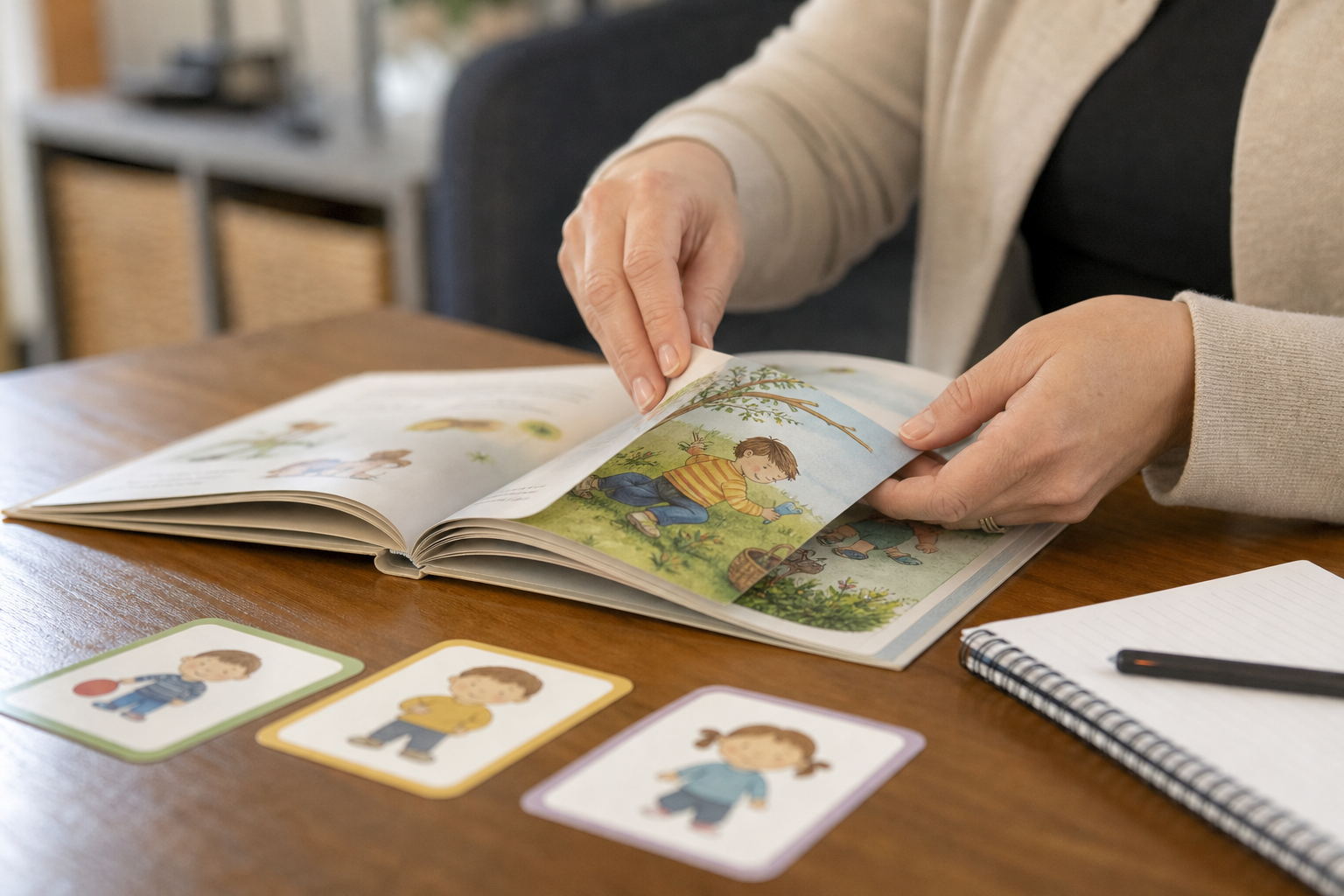
Sound-loaded story pages paired with articulation cards for a structured practice session.
Choosing the Right Sound Stories for Your Caseload
Not every target sound develops on the same timeline, so it helps to think about typical development alongside a child's individual needs. The American Speech-Language-Hearing Association notes that sounds like /p/, /m/, and /b/ tend to develop earlier, while sounds like /r/, /s/, and consonant blends often develop later and account for a large share of referrals.
| Development Stage | Example Sounds | Common Use Case |
|---|---|---|
| Early-developing | p, m, b, n | Early intervention and preschool caseloads |
| Middle-developing | k, g, f, v | Preschool through early elementary |
| Later-developing | s, r, ch, blends | Elementary caseloads and persistent errors |
As a result, clinicians often build a small rotation of sound stories covering a few different development stages rather than relying on a single title. For additional ideas on sequencing printable story-based materials, the overview on printable articulation stories for speech therapy wins covers related planning strategies.
Free Samples and Where to Find These Resources
Clinicians who want to test the format before committing to a full collection can start with free samples. Little Speech Corner currently offers free SW and CH Sound Story samples, which give a clear preview of how target-word visuals, sound patterns, and shared reading come together in one short narrative.
Beyond the free samples, the full Sound Stories catalog is available through the Little Speech Corner Teachers Pay Teachers store, where clinicians can browse additional targets. In addition, the broader resource overview on story-based speech therapy resources for young children places Sound Stories alongside other available materials for context. Clinicians can also visit Little Speech Corner directly to preview the full approach before purchasing.
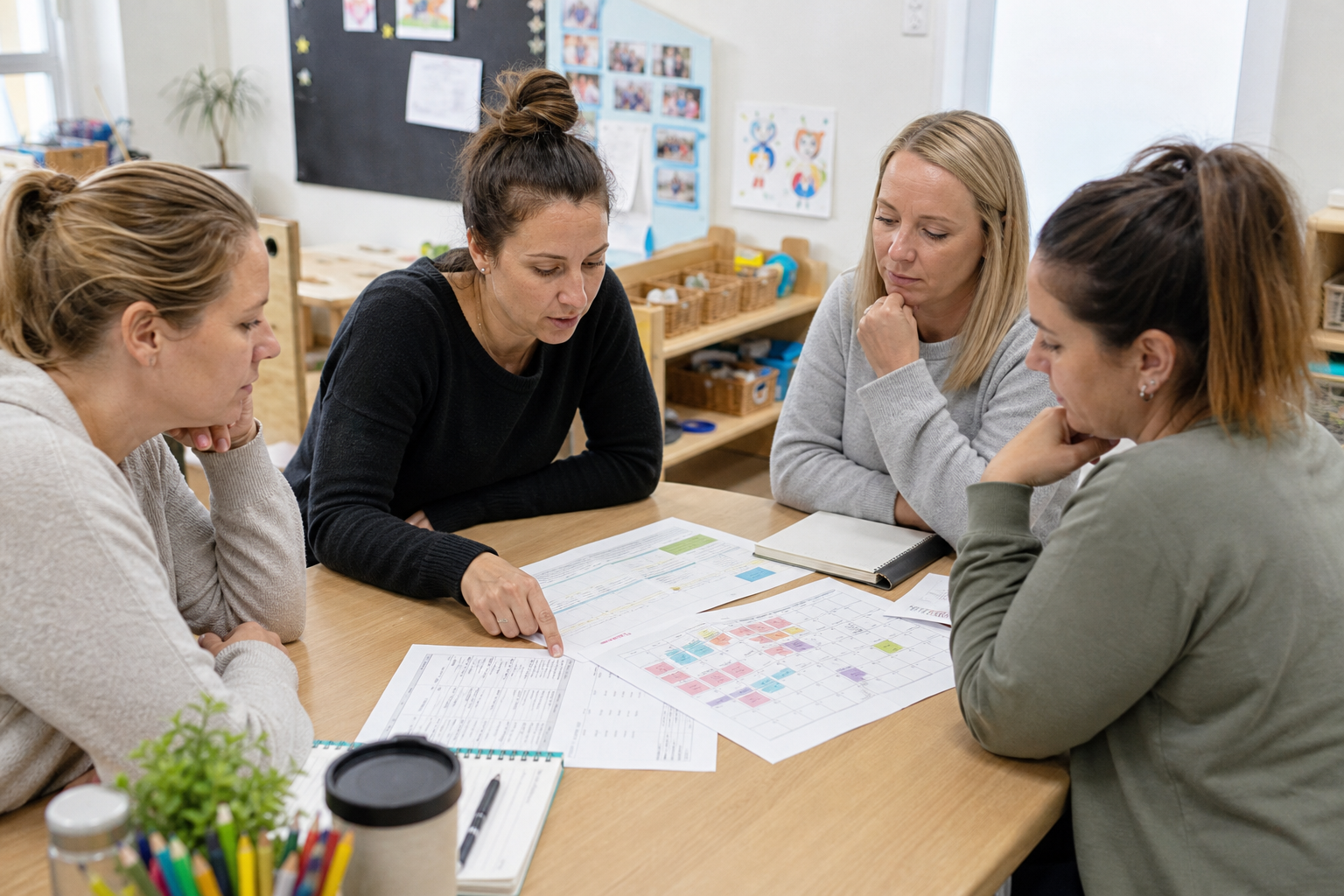
A classroom team reviewing a planning calendar that supports consistent speech sound practice across settings.
Common Mistakes to Avoid With Sound-Loaded Stories
One frequent mistake is reading straight through a story without pausing for production, which turns a practice tool into a passive listening activity. Instead, clinicians should slow down at sound-loaded words and expect an actual attempt before turning the page.
Another common issue is selecting a story with too many competing targets, which can dilute focus on the primary sound goal. Likewise, skipping the play or carryover step after reading reduces the chance that practice generalizes beyond the session. For more supporting ideas on pairing literacy with therapy goals, see this guide to literacy-based speech therapy activities for preschoolers.
Frequently Asked Questions About Speech Sound Practice Stories for Clinicians
What are speech sound practice stories for clinicians?
Speech sound practice stories for clinicians are illustrated narratives that embed a clinician-selected target sound into repeated, naturally occurring opportunities for practice. Rather than drilling isolated words, the clinician reads the story and pauses on sound-loaded vocabulary to prompt production.
How do sound-loaded narratives differ from traditional drill lists?
Traditional drill lists present target words in isolation, while sound-loaded narratives place those same words inside a meaningful story context. As a result, children often stay engaged longer and practice the sound within connected language rather than disconnected repetition.
Which speech sounds do Sound Stories currently target?
Sound Stories are organized by clinician-selected articulation targets, with free samples currently available for the SW and CH sounds. Clinicians should check the current Sound Stories catalog for the full list of available targets.
How long does a typical sound-loaded story session take?
A single read-through generally takes a few minutes, leaving the remainder of the session for follow-up drill and carryover activities. The exact timing varies based on the child's attention and the number of practice repetitions built in.
Can these story-based materials support phonological awareness goals too?
Because sound stories highlight target-sound words through repeated reading, they can reinforce early sound awareness alongside articulation goals. However, they are designed primarily as articulation and speech-sound practice tools rather than a standalone phonological awareness curriculum.
Are speech sound practice stories appropriate for group therapy?
Yes, a shared story can work well in small groups when children are practicing the same or similar target sounds. In that setting, the clinician can rotate turns for production while the rest of the group follows along with the narrative.
What age range benefits most from story-based speech sound practice?
This approach is commonly used with young children, roughly ages 2 through 7, who are building early speech sound skills. Older children with persistent articulation errors can also benefit when the story content is matched to their interests.
What is the Read, Model, Play approach used alongside these stories?
Read, Model, Play is a short shared-reading sequence, roughly five minutes, followed by adult modeling and child-led interaction. It was originally built around core vocabulary, and the same structure can frame how a sound story is introduced before drill practice begins.
How much do Sound Stories typically cost?
Pricing and bundle sizes vary by listing, so clinicians should confirm current details directly on the Sound Stories catalog page. Free SW and CH samples are also available for clinicians who want to preview the format first.
What common mistakes should clinicians avoid when using sound stories?
A frequent mistake is reading the story straight through without pausing for production practice on target words. Another is choosing a story with too many competing goals, which can dilute focus on the selected sound.
Where can clinicians find free samples of speech sound practice stories?
Free SW and CH Sound Story samples are available for preview before purchase, giving clinicians a chance to test the format with their own caseload. These samples are typically accessed through the Sound Stories resource page and the TPT store.
Can families use these stories for home carryover practice?
Yes, once a clinician introduces a sound story in session, families can reread it at home to reinforce the same target sound. This extends practice beyond the therapy room without requiring new clinical training for caregivers.
Final Thoughts
In summary, speech sound practice stories for clinicians offer a practical middle ground between rigid drill work and open-ended play. By choosing a clinician-selected target, reading a short illustrated story, and building in repeated production opportunities, SLPs can keep sessions engaging without losing clinical focus. Whether starting with a free SW or CH sample or browsing the full Sound Stories catalog, this story-based format gives clinicians one more flexible tool for building consistent speech sound practice into everyday sessions.
