
Story-Based Core Vocabulary Resources for Early Childhood
Explore story-based core vocabulary resources for early childhood using Read, Model, Play. Browse Core Stories, Sound Stories, and free samples.

Story-based core vocabulary resources turn a single high-frequency word into a short, illustrated story that speech-language pathologists, teachers, and families can use again and again. Instead of drilling a word list in isolation, a shared story gives children several natural, meaningful chances to hear and attempt the same word. As a result, practice feels like story time rather than a formal lesson — and children are far more likely to carry the word into play, routines, and conversation. This guide explains exactly what story-based core vocabulary resources look like, why core vocabulary matters so much for early communicators, what the research says, and how the Read, Model, Play approach puts these stories to work in therapy rooms, classrooms, and living rooms alike.
Quick answer: Story-based core vocabulary resources are illustrated stories built around one core word — "go," "more," or "stop," for example — rather than a theme or character alone. Each story gives adults a built-in script for modeling that word before, during, and after reading, then carrying it into play and daily routines. Because the same word repeats across the story and beyond, children encounter it often enough to start using it themselves, often faster than with traditional vocabulary drills.
Story-based core vocabulary resources pair one word with an entire shared reading experience.
What Are Story-Based Core Vocabulary Resources?
Story-based core vocabulary resources are short, illustrated stories organized around one core word rather than a theme or character alone. A core word is a high-frequency word, such as "go," "want," or "more," that a child can reuse across countless settings and situations. Because these words show up constantly in daily life, speech-language pathologists and educators often build entire sessions around them instead of around topic vocabulary that only applies once, such as "dinosaur" or "birthday."
In practice, a story-based resource looks like a short picture book or digital storybook that repeats the target word on nearly every page. For example, Little Speech Corner's Core Stories use exactly this format: a single core word drives the plot, the pictures, and the adult's language modeling. The approach draws on augmentative and alternative communication (AAC), a term for tools and strategies that support children who communicate with speech, signs, pictures, or speech-generating devices. According to the American Speech-Language-Hearing Association, functional vocabulary instruction works best when words are practiced across multiple, meaningful contexts rather than drilled in isolation. In addition, a browse through the Core Words guide shows how a single word can anchor an entire week of planning across home, classroom, and therapy settings.
Why Core Vocabulary Matters for Early Communicators
Core vocabulary matters because a small set of words accounts for a large share of everyday communication. Research summarized in the augmentative and alternative communication literature suggests that as few as 200 to 400 words make up roughly 80 percent of what children and adults say across a typical day. Consequently, focusing early practice on these high-utility words gives children far more opportunities to generalize new language outside of a single lesson, rather than memorizing a word they may only use once.
In addition, core words tend to be remarkably flexible. Unlike fringe vocabulary, which names specific objects, core words like "go," "stop," "more," and "all done" apply across play, mealtimes, and transitions. Similarly, teachers can reinforce the same word during circle time, snack, and outdoor play, which supports carryover far beyond the therapy room. For a closer look at how this plays out in real routines, this guide to teaching core vocabulary during play-based speech therapy offers several practical examples worth borrowing.
The Research and Evidence Behind Story-Based Vocabulary Instruction
Shared reading is one of the most studied contexts for early language growth, and story-based core vocabulary resources build directly on that evidence base. According to the CDC's developmental milestones guidance, many children begin combining words into short phrases between ages two and three — precisely the window when repeated core-word modeling can have an outsized impact on expressive language. Therefore, choosing a story format that repeats one word dozens of times in a single sitting lines up neatly with that developmental timeline instead of working against it.
Furthermore, the National Institute on Deafness and Other Communication Disorders notes that AAC systems and strategies work best when paired with consistent, everyday language models from the people around a child — not isolated clinical drills. Story-based resources are built to satisfy that exact requirement, because the same script a clinician models in a session is just as easy for a parent or paraeducator to repeat at home or in the classroom.
The Read, Model, Play Approach to Shared Stories
The Read, Model, Play approach offers one concrete way to put story-based core vocabulary resources into daily practice. First, an adult reads a short Core Story aloud, a process that usually takes about five minutes, modeling the target word with speech, sign, or AAC supports as needed. This is a flexible, realistic chunk of time rather than a fixed promise, so it fits neatly into a session or a classroom block without disrupting the schedule.
After the story, the adult pauses to invite the child into the conversation. For instance, a child might reach for a page, make a sound, or select a symbol on a communication device to request "more." Then, the adult follows the child's lead into play, continuing to model the same core word in a brand-new context. Because the pattern stays consistent story after story, children start to recognize the routine itself, which can make them more willing to participate each time. Teams that want a visual reminder of this pattern often turn to tip sheets and a planning calendar, both part of Team Supports, to keep adults modeling consistent vocabulary across every setting a child moves through during the day.
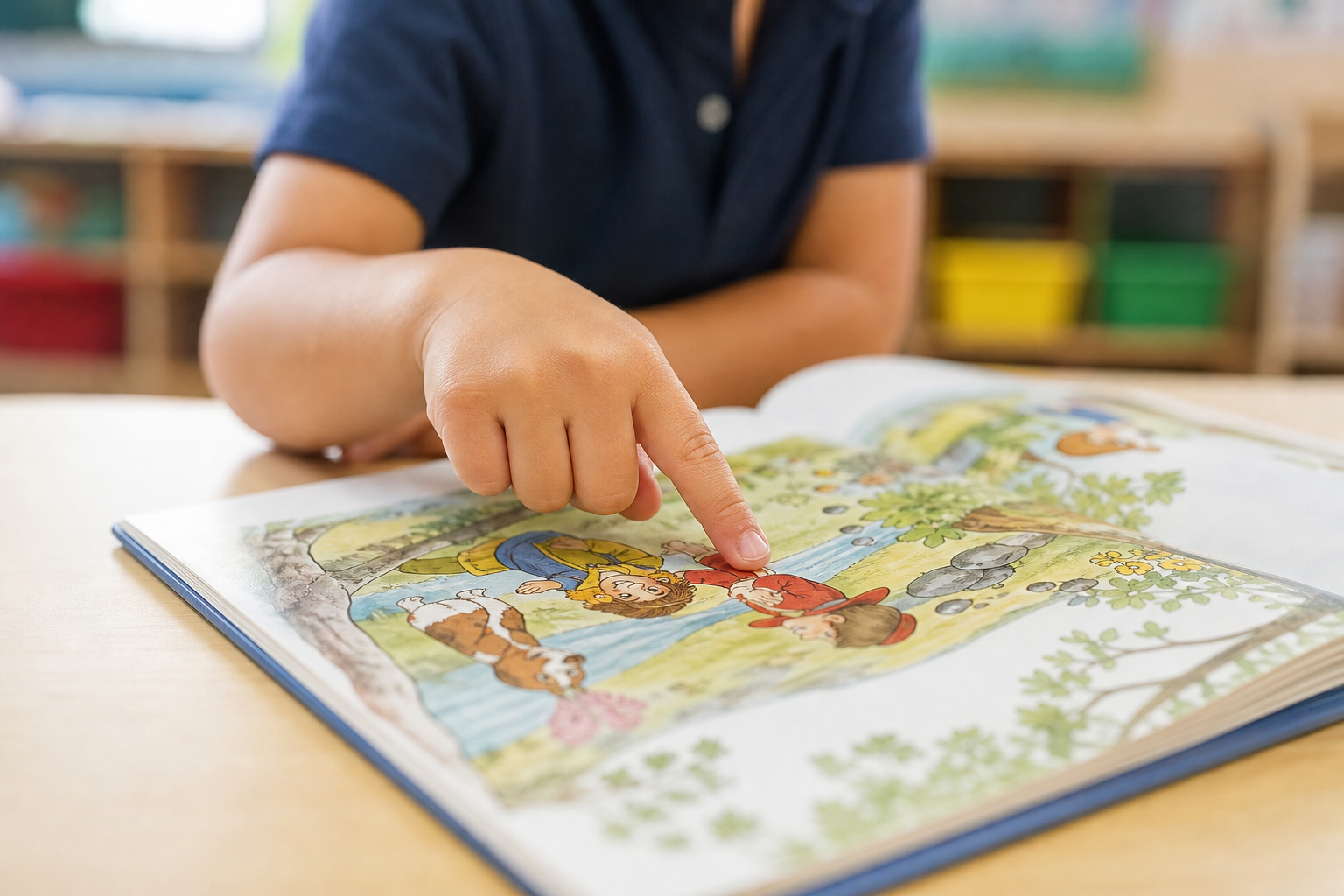
Pausing after a story gives children a natural chance to use the core word themselves.
Types of Story-Based Vocabulary Tools for Young Communicators
Several resource types fall under the story-based core vocabulary resources category, though each serves a slightly different purpose. The table below summarizes the main options so you can match a format to a specific goal.
| Resource | Primary Focus | Best For |
|---|---|---|
| Core Stories | One core word per story | Daily vocabulary modeling, AAC use |
| Sound Stories | Clinician-selected speech sounds | Articulation and phonology practice |
| Core Stories Foundational 53-Pack | 53 stories with a weekly sequence | Year-long planning across a classroom or caseload |
| Team Supports | Tip sheets, planning calendar | Classroom and family carryover |
Each format works well on its own, yet many speech-language pathologists mix and match them across a caseload. For example, a kindergarten classroom team might pair a Core Story with a tip sheet so a paraeducator can reinforce the same word during centers. Meanwhile, a private-practice SLP might alternate Core Stories with Sound Stories to address both language and articulation goals within the same block. Readers looking for a wider comparison of options can review this roundup of the best story-based speech therapy resources for young children, which places story formats side by side. For background on how illustrated books support language goals more broadly, this guide to speech therapy story books for SLPs and parents covers additional considerations such as book selection and session pacing.
Story-Based Core Vocabulary Resources vs. Traditional Word Lists
A traditional core vocabulary list is simply a printed set of words, often organized by part of speech, with no built-in context for practice. In contrast, story-based core vocabulary resources embed the same word inside a narrative, illustrations, and a natural pause-and-model routine. Therefore, an adult never has to invent a context on the spot — the story already supplies one.
Above all, this matters for engagement. A word list asks a child to repeat a word out of context, which can feel repetitive and unmotivating. A story, however, gives the same word a reason to exist on every page — a character wants to "go," a friend asks for "more," a game comes to a "stop." Specifically, that narrative hook is what keeps young children invested long enough to actually practice the word multiple times in one sitting, rather than disengaging after the third repetition.
How to Start Using Story-Based Core Vocabulary Resources in Therapy or Classroom Routines
Getting started does not require a full curriculum overhaul. Instead, most teams ease in with one word and one story, then expand from there. The steps below outline a simple starting sequence.
- Select a single core word, such as "go" or "more," and choose a Core Story built around that word so every page naturally repeats the same target vocabulary.
- Read the story in about five minutes, modeling the word with speech, sign, or AAC supports throughout the shared reading rather than saving modeling for the end.
- Pause after the story for interaction, inviting the child to use the word through gestures, single words, or AAC selections before moving into child-led play.
- Extend the same core word into play and daily routines, using a tip sheet or planning calendar so the word shows up at home, in the classroom, and in therapy sessions.
Once this cycle feels familiar, many teams add a second core word the following week, following a planned sequence rather than guessing at random. For a simpler entry point built specifically for preschool caseloads, this walkthrough on building a simple core vocabulary routine for preschool speech sessions breaks the process down even further.
Free Samples to Preview Core Vocabulary Stories
Before purchasing a full bundle, many speech-language pathologists like to preview the format firsthand. Little Speech Corner offers a few free samples, including the Apples for Anna Core Story built around the word "there," a planning calendar with a sample Core Story, and two Sound Story samples targeting the /s/ and /ch/ sounds. These samples give a realistic sense of the illustration style, the core word repetition, and the modeling suggestions included with every resource. Visiting the Little Speech Corner website directly is the simplest way to find current links to these free downloads alongside the full resource catalog.
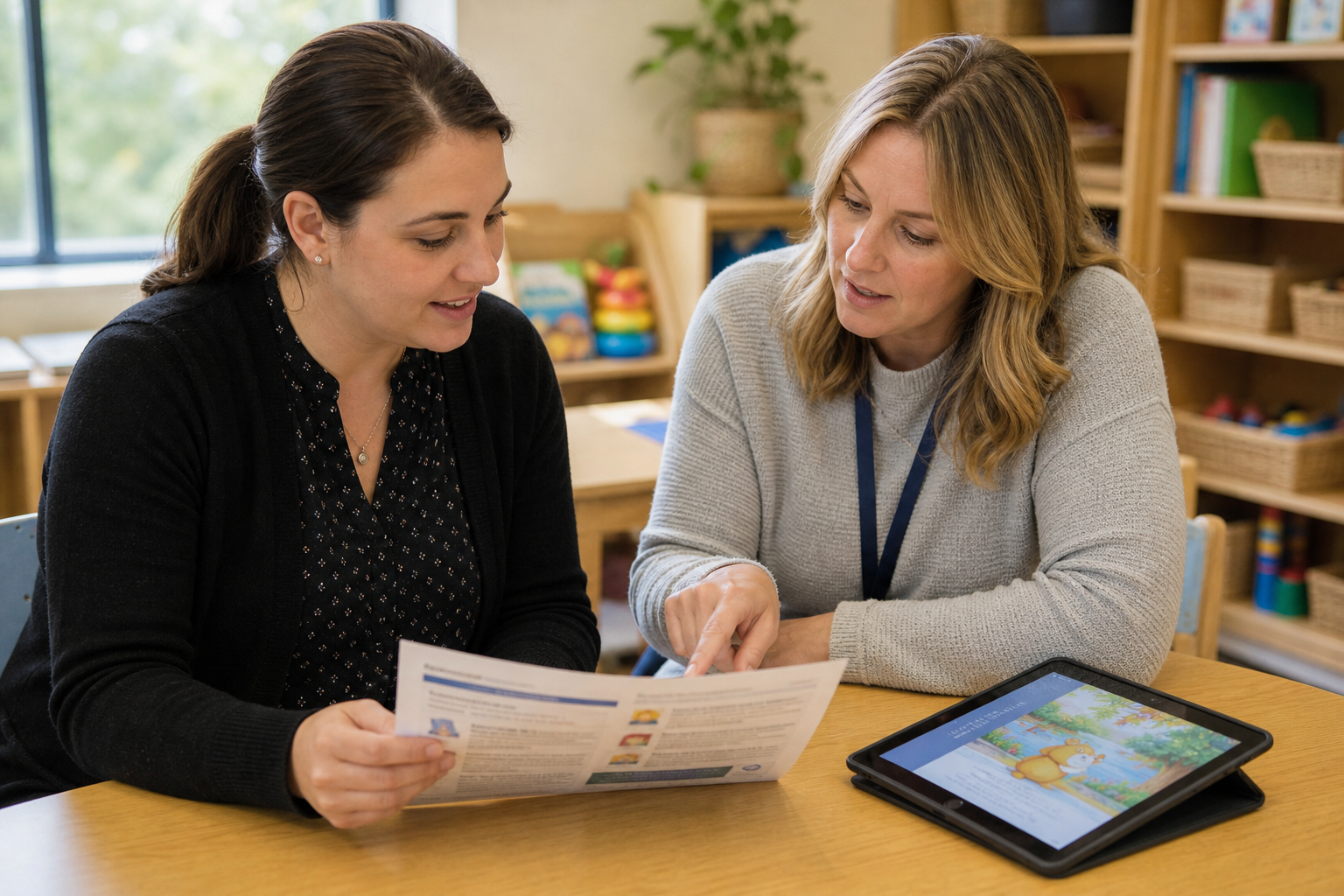
Team Supports help classroom staff and families keep modeling the same core word.
Choosing the Right Early Childhood Core Vocabulary Resource for Your Learners
Choosing among these options comes down to each learner's goals. If the priority is building functional, everyday language, Core Stories paired with the Read, Model, Play approach usually make the most sense. If a child also needs articulation support, a Sound Story can layer speech-sound practice into the same shared reading. For a classroom or caseload that needs a full year of planning, the Core Stories Foundational 53-Pack offers a ready-made sequence rather than requiring a team to build one from scratch.
It also helps to loop in other adults early. Team Supports, including the core-word tip sheets and planning calendar, keep paraeducators, classroom teachers, and family members modeling the same word a child is practicing in therapy. Because consistency across settings tends to support faster generalization, even a simple shared tip sheet can make a meaningful difference. For a deeper look at exactly which supports help this carryover happen, this overview of resources that help SLPs carry core vocabulary from therapy into the classroom is worth reading alongside this guide. Similarly, families and teachers who want a printable starting point can review these core vocabulary handouts for teachers and parents before choosing a bundle. Teams still deciding between formats may find it useful to preview samples directly before committing to a purchase.
Frequently Asked Questions About Story-Based Core Vocabulary Resources
What are story-based core vocabulary resources for early childhood?
Story-based core vocabulary resources are illustrated stories built around one high-frequency word, designed to give adults a simple script for modeling language before, during, and after shared reading. They pair naturally with the Read, Model, Play approach used across therapy, classroom, and home settings.
How is a Core Story different from a regular picture book?
A Core Story repeats a single target word on nearly every page, while a typical picture book usually introduces many new words tied to its plot. This repetition gives children more chances to hear and attempt the same core word in one short reading.
What age range do these resources support?
Little Speech Corner's resources are designed primarily for children ages two through seven. That said, older learners who are building early core vocabulary or AAC skills can also benefit from the same story formats.
Can story-based core vocabulary resources be used with AAC?
Yes, Core Stories are built to support flexible language modeling, including augmentative and alternative communication. An adult can model the target core word using speech, sign, or a child's AAC system while reading.
How long does a Read, Model, Play session typically take?
A Core Story usually takes about five minutes to share, though this is a general estimate rather than a guaranteed outcome. The interaction and play that follow can extend well beyond that initial reading time.
What is the Core Stories Foundational 53-Pack?
The Core Stories Foundational 53-Pack is a bundle of 53 Core Stories sold through Teachers Pay Teachers, organized around a suggested weekly core-word sequence. It gives teams a ready-made starting point rather than requiring them to plan each week from scratch.
How do Sound Stories differ from Core Stories?
Sound Stories are illustrated narratives loaded with a clinician-selected speech sound, designed for articulation and speech-sound practice. Core Stories, in contrast, center on a single core vocabulary word rather than a specific sound pattern.
Are free samples available before buying a full resource?
Yes, free samples include the Apples for Anna Core Story, a planning calendar with a sample story, and SW and CH Sound Story samples. These let a speech-language pathologist or teacher try the format before choosing a full bundle.
Where can I purchase these story-based core vocabulary resources?
All digital purchases and free downloads happen through the Little Speech Corner store on Teachers Pay Teachers. Visiting littlespeechcorner.com first can help narrow down which resource fits a specific learner before heading to the store listing.
How much do story-based core vocabulary resources for early childhood cost?
Pricing varies by individual listing and bundle, so it is best to check the current Teachers Pay Teachers listing for exact pricing, formats, and licensing details. Individual Core Stories and the larger Foundational 53-Pack are typically priced differently based on scope.
How many core words should a session target at once?
Most teams start with just one core word per story or session to keep modeling consistent. As a child becomes familiar with the routine, additional words can be layered in gradually, often following a weekly sequence.
Can classroom teachers use these resources without an SLP present?
Yes, Team Supports such as tip sheets and planning calendars are designed specifically so classroom teachers, paraeducators, and family members can model the same core word independently. This helps extend practice well beyond scheduled therapy sessions.
What is a common mistake when introducing core vocabulary to young children?
A common mistake is introducing too many new words at once instead of repeating a single word across several contexts. Story-based core vocabulary resources help avoid this by anchoring each story to just one target word.
How do story-based core vocabulary resources support bilingual or multilingual learners?
Story-based core vocabulary resources support bilingual learners by letting an adult model the same core word in more than one language across repeated readings. Because the story structure and routine stay predictable, a child can map new vocabulary onto a familiar pattern instead of relearning the whole activity each time the spoken language changes.
What is the difference between core vocabulary and fringe vocabulary in story-based resources?
Core vocabulary refers to a small set of high-frequency, flexible words — such as "go," "more," or "stop" — that apply across many contexts, while fringe vocabulary names specific objects or topics tied to one activity, like "dinosaur" or "pancake." Story-based resources primarily target core words because they generalize faster, though some stories still include fringe words as supporting detail.
In summary, story-based core vocabulary resources offer a practical, repeatable way to build functional language skills without turning every session into a formal drill. By pairing a single core word with a short story and the Read, Model, Play approach, speech-language pathologists, educators, and families can model the same vocabulary across therapy, classroom, and home routines. Whether the starting point is a free sample like Apples for Anna or a full Core Stories Foundational 53-Pack, the goal stays the same: more natural, repeated opportunities for young communicators to use the words that matter most. For a closer look at the full catalog and current free samples, visiting littlespeechcorner.com remains the most direct next step.
