
AAC Story Activities for Young Communicators in Therapy
Explore AAC story activities that pair shared reading with core-word modeling and play. Try free samples and SLP-made resources from Little Speech Corner.

AAC story activities pair short, illustrated stories with core-word modeling so children who use augmentative and alternative communication (AAC) — tools like communication boards or speech-generating devices — can practice real language in a natural, playful context. For speech-language pathologists, early childhood educators, and families supporting learners ages two through seven, this approach turns a few minutes of shared reading into a launchpad for interaction and play. Mrs. Gwen, M.A., CCC-SLP of Little Speech Corner built her Read, Model, Play method around exactly this idea: a brief Core Story opens the door, and real language growth happens in the conversation that follows.
In short: AAC story activities are short, story-based routines that model core vocabulary through shared reading and follow-up play, giving AAC users structured but natural chances to see and use language in context.
What Are AAC Story Activities?
AAC story activities are brief, intentional routines built around a story, a target core word, and follow-up play. Specifically, an adult reads a short illustrated story while pointing out and modeling one high-frequency word on the child's own communication system, then follows the child into interaction and play where that same word keeps coming up naturally.
This differs from simply reading a book aloud. Because the goal is communication practice rather than comprehension alone, the adult pauses deliberately to model, and the story itself is often shorter and more repetitive than a typical picture book. As a result, children get many low-pressure chances to see a word used correctly before they are ever asked to use it themselves.
AAC story activities bring shared reading and core-word modeling together in just a few minutes.
Why AAC Story Activities Support Core Vocabulary Growth
Core vocabulary refers to a small set of high-frequency words, such as go, more, stop, and help, that can be used across countless situations throughout the day. Research summarized by the American Speech-Language-Hearing Association notes that early AAC intervention benefits from repeated, meaningful modeling rather than isolated drill practice. Therefore, embedding these words inside a story gives children a natural, memorable context for each one.
In addition, stories provide built-in repetition. A core word that appears several times across one short narrative gives a child multiple chances to notice it, see it modeled, and eventually attempt it themselves. Similarly, pairing the word with a picture and a simple plot helps children connect meaning to symbol, which supports both comprehension and later expressive use.
Consequently, many SLPs and classroom teams build entire weekly plans around a single core word introduced through a story, then reinforced across routines, songs, and play for the rest of the week.
The Read, Model, Play Approach to AAC Story Activities
Read, Model, Play is the signature framework behind Little Speech Corner's AAC story activities. First, an adult shares a Core Story that takes about five minutes to read, though pacing can vary by learner. Next, the adult models the story's target core word directly on the child's own AAC system, whether that is a paper board, a picture exchange system, or a speech-generating device.
Finally, the adult follows the child into open-ended, child-led play that naturally revisits the same word. For example, a story about a ball rolling "there" might lead into a rolling-ball game where the adult keeps modeling "there" as the ball moves. This sequence keeps language modeling connected, purposeful, and genuinely fun rather than feeling like a drill.
For a deeper look at how core vocabulary ties into this framework, the guide to teaching core vocabulary through stories walks through planning considerations for clinicians and teams.
How to Run AAC Story Activities in Session or Classroom
The following sequence outlines a simple way to structure an AAC story activity from start to finish:
- Choose a Core Story and target word. Pick a short, illustrated story built around one high-frequency core word that matches the child's current goals and communication system.
- Preview the AAC vocabulary. Locate the target word on the child's communication board or device before reading so modeling moments happen smoothly and quickly.
- Share the story in about five minutes. Read at a relaxed pace, pointing to pictures and pausing briefly so the child can anticipate the repeated language.
- Model the core word on the child's AAC system. Say the word aloud while pointing to or activating it on the child's own board or device, repeating this several times.
- Extend into child-led play. Follow the child's lead into a related play activity, continuing to model the same core word naturally as chances arise.
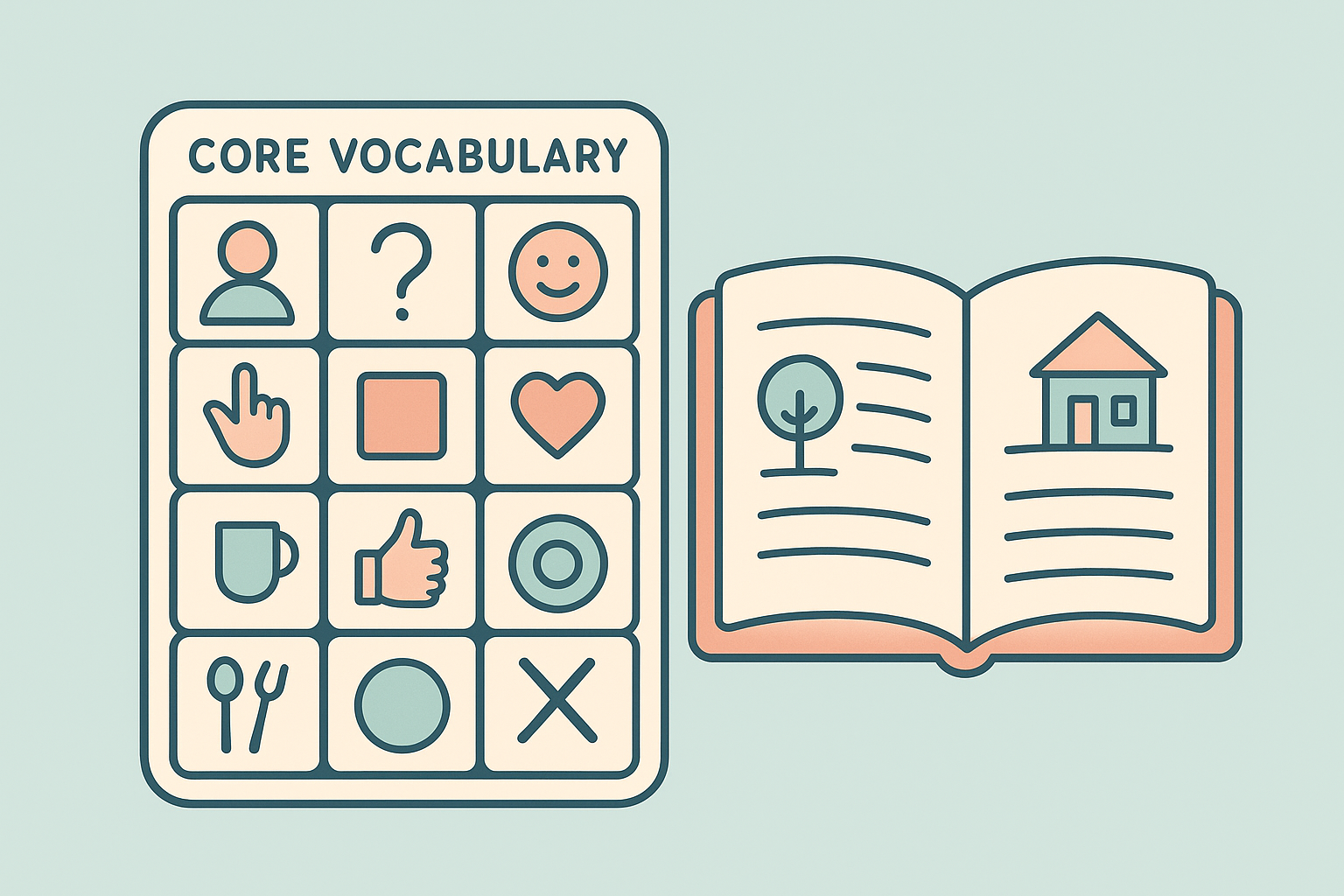
Pairing a core word board with a story page keeps AAC story activities visual and predictable.
AAC Story Activities for Different Settings
AAC storytime activities work across several environments, though the setup looks slightly different in each one. In a therapy session, a clinician usually selects the story and core word deliberately to match a specific IEP goal, then measures how many times the child imitates or initiates the word during play.
In a classroom, a teaching team often follows a shared weekly core-word plan so every adult, from the classroom teacher to the paraeducator, models the same word in different routines. A collection of story-based speech therapy activities for ages 2 to 7 can help teams coordinate this kind of consistent modeling throughout the day.
At home, families generally benefit from simplicity. A single short story read at bedtime or snack time, with the target word modeled once or twice, is often more sustainable than an elaborate lesson plan. Above all, consistency across settings matters more than perfection in any one of them.
Common Mistakes to Avoid With AAC Story Activities
Even well-intentioned AAC story activities can fall short if a few common pitfalls creep in. First, modeling too many words in one sitting can overwhelm a new AAC user who is still learning to recognize a single symbol. Instead, most clinicians focus on just one core word per story.
Second, some adults skip the play portion entirely, treating the story as the whole activity. However, research-informed AAC practice, including guidance from ASHA's overview of augmentative and alternative communication, consistently emphasizes that functional, real-world practice matters as much as direct instruction.
Third, choosing a story that is too long or too complex can lose a young child's attention before modeling even begins. Shorter, repetitive stories tend to hold attention better and leave more time for the play that follows.
Free AAC Story Activity Samples to Try
For anyone who wants to try this format before committing to a full resource set, free samples are a practical starting point. Little Speech Corner offers a free Core Story called Apples for Anna, built around the word "there," along with a core-vocabulary planning calendar that includes a sample story.
These samples, along with SW and CH Sound Story previews for articulation practice, are available through the Little Speech Corner Teachers Pay Teachers store. For a broader comparison of story-based options, the roundup of story-based speech therapy resources for young children is a useful next stop. You can also explore the full approach directly on Little Speech Corner's website, and learn more about AAC-specific planning on the site's dedicated AAC resource hub.
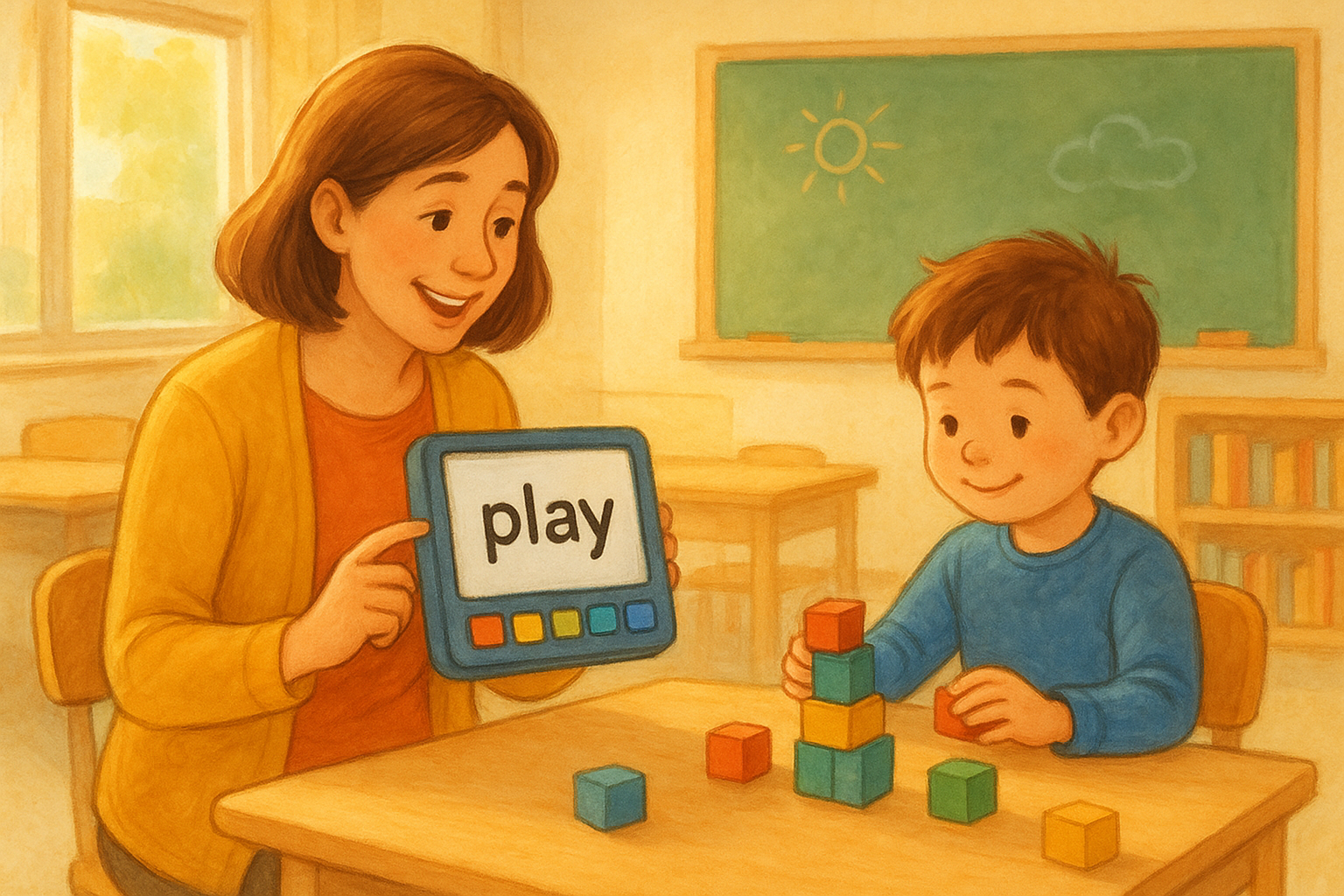
Play that follows the story is where AAC story activities often lead to the most spontaneous communication.
A Quick Note on Evidence and Expectations
It helps to set realistic expectations around timing and outcomes. The five-minute story length is a design target for keeping attention manageable, not a guaranteed outcome for every child or every session. Progress with AAC typically unfolds gradually, with repeated exposure across many sessions and settings rather than a single activity.
For general background on language milestones in young children, the CDC's developmental milestones resource offers useful context for families and educators tracking a child's broader communication growth alongside AAC-specific goals.
Frequently Asked Questions About AAC Story Activities
What are AAC story activities?
AAC story activities are short, illustrated story routines paired with core-word modeling so children using augmentative and alternative communication can see and practice language in context. They typically combine a brief shared reading moment with follow-up interaction and play.
How do AAC story activities support language development?
They give children repeated, low-pressure exposure to a target core word across reading, conversation, and play. This repetition in varied contexts helps children understand and eventually use the word independently on their own communication system.
What is the Read, Model, Play approach?
Read, Model, Play is a three-part routine where an adult shares a short Core Story, models a target core word using the child's AAC system, then follows the child into open-ended play. It was developed by Mrs. Gwen, a licensed SLP with over 20 years of experience.
How long should an AAC story activity session last?
A Core Story itself is designed to take about five minutes to read aloud, though this is not a guaranteed outcome for every learner. The modeling and play that follow can extend as long as the child's interest allows.
Can AAC story activities work with any communication device or board?
Yes, AAC story activities are designed to be flexible across communication supports, including low-tech core boards, picture symbols, and speech-generating devices. The adult simply models the target word using whichever system the child already uses.
What age range benefits most from AAC story activities?
Most AAC story activities are built for young communicators roughly ages two through seven, including preschool and early elementary learners. This range covers early AAC users just learning core words through children combining words into short phrases.
How do AAC story activities differ from traditional storytime?
Traditional storytime often focuses on listening and comprehension alone, while AAC story activities intentionally build in modeling moments for a specific core word. The story becomes a launchpad for communication practice rather than the entire goal.
What core vocabulary words work best in AAC story activities?
High-frequency, flexible words like go, more, there, stop, and help tend to work well because they can be used across many situations. Clinicians usually choose one core word per story so modeling stays focused and repeatable.
How much do AAC story resources typically cost?
Pricing varies by product and bundle, so it is best to check the current listing details on the Little Speech Corner Teachers Pay Teachers store before purchasing. Free samples are also available for anyone who wants to try the format first.
What mistakes should I avoid when using AAC story activities?
A common mistake is modeling too many words at once, which can overwhelm a new AAC user. Another is skipping the play portion, since follow-up interaction is where much of the real language generalization happens.
How can classroom teams use AAC story activities consistently?
Teams can use a shared core-word tip sheet and planning calendar so every adult in a child's day models the same target word. This consistency across the SLP, teacher, and family helps the word carry over into daily routines.
Where can I find free AAC story activity samples?
Little Speech Corner offers free samples, including the Apples for Anna Core Story and a core-vocabulary calendar with a sample story, available through its Teachers Pay Teachers store. These let new users preview the Read, Model, Play format before buying a full set.
Bringing AAC Story Activities Into Daily Practice
AAC story activities work best when they feel repeatable rather than elaborate. A single short story, one clear core word, and a few minutes of follow-up play can accomplish more over time than an occasional, complicated lesson. Because the approach fits into therapy sessions, classrooms, and home routines alike, it travels well across the adults who support a young communicator throughout the day.
In conclusion, AAC story activities offer a simple, evidence-informed way to combine shared reading, core-word modeling, and play so AAC users get natural, repeated chances to build language. Whether you are a speech-language pathologist planning a weekly core word, a teacher coordinating a classroom team, or a family member trying a free sample for the first time, starting small and staying consistent is what makes this approach work over time.