
Early Childhood Special Education Language Tools Guide
Explore early childhood special education language tools: core vocabulary stories, AAC modeling, and sound practice. See how to choose and use them.

Choosing early childhood special education language tools can feel overwhelming when every shelf and storefront promises something new. The best tools are simple, flexible, and respectful of how each child communicates. This guide from Little Speech Corner helps busy SLPs and educators sort through toys, books, apps, printables, and AAC supports. It also shows how to use them in short, child-led routines.
Quick answer: Early childhood special education language tools are materials and routines that help adults model words and support communication for young learners. Look for tools that are short, picture-supported, flexible for AAC, and easy for the whole team to share.
What Are Early Childhood Special Education Language Tools?
Early childhood special education language tools are resources that support speech, language, and communication in children, mainly ages 2 to 7, who receive special education services. They include picture stories, vocabulary tip sheets, planning calendars, and sound practice texts. Some support spoken language. Others support augmentative and alternative communication (AAC), which means gestures, picture boards, or devices that help a child communicate.
Importantly, these tools support adults. The adult models language, and the child responds in any way that works.
Types of Language Tools for Young Learners
Many different materials can serve as language tools. Below is a quick map of the main categories, with what each is best at. Mixing a few is usually more useful than relying on one.
Books and Story Resources
Short, picture-supported stories give adults a predictable script for modeling. Interactive books, where pieces move on and off the page, add movement and choice-making.
Toys and Open-Ended Play Materials
Play kitchens, farm sets, trains, puppets, and play dough all create natural reasons to talk. Open-ended items work well because the child can lead. Cause-and-effect toys also give early communicators a clear reason to request more or go.
Printables, Visuals, and Concept Pages
Printable scenes, category sorts, and basic concept pages (such as in, on, big, and little) are handy for no-prep sessions. Developmental milestone handouts also help families understand what to expect at each age.
Apps and Digital Resources
Scene-building and sticker apps can support vocabulary, following directions, and turn-taking. However, screens work best as one option among many. Keep an adult in the interaction and keep the child's full communication system available.
Professional Learning and Parent Resources
Podcasts, research summaries, and parent-friendly websites help teams stay current. In addition, simple caregiver handouts make it easier to share one word or one idea at home.
Why Story-Based Language Resources Work Well
Short stories give children a predictable, shared moment. Pictures anchor the words, and repeated phrases give adults many natural chances to model. As a result, a story can fit into circle time, a therapy session, or a quiet moment at home.
For more ideas, see this roundup of story-based speech resources for young children.
Shared reading is a simple way to put early childhood special education language tools into daily routines.
Why Play Belongs in Language Support
Young children learn language through play. Therefore, good tools leave room for the child to lead. Follow what the child picks up, then add a few words to match. For example, if a child pushes a toy train, you might say, "Go, train, go."
Open-ended items, such as blocks, puppets, and play dough, let you target many words without a script. For more on setting this up, read about creating a language-rich environment.
Core Vocabulary and AAC Supports
What is core vocabulary?
Core vocabulary is a small group of common words, like go, more, and help, that appear in much of daily talk. Because these words work in many settings, they are a practical focus for young communicators.
Aided language modeling in practice
Aided language modeling means the adult points to or selects words on the child's AAC system while speaking. For example, while reading about a bus, you might touch go and say, "The bus can go." The child keeps access to the full vocabulary at all times. Nothing is restricted or required.
Related reading: core vocabulary printables for AAC classroom use and preschool AAC activity ideas.
Language Targets You Can Support With Everyday Tools
One tool can touch many skills. Here are common areas teams explore, with simple modeling ideas. An SLP should choose actual targets for each child.
- Vocabulary: name and describe items during play, using a few repeated words.
- Following directions: pair a short phrase with a gesture or picture.
- Prepositions and basic concepts: model in, on, and under as toys move.
- Questions: model simple wh- questions, then wait and accept any response mode.
- Turn-taking and social play: pass a toy back and forth and narrate each turn.
- Sentence building: expand a child's message by one word, such as "ball" to "big ball."
These resources provide educational support and do not replace individualized assessment, clinical judgment, or speech-language therapy. An SLP should select speech targets and cues for each child.
How to Use Language Resources for Special Education: Read, Model, Play
Mrs. Gwen's Read, Model, Play approach pairs a short Core Story of about five minutes with interaction and child-led play. The time is a routine length, not a promised outcome. Try these steps:
- Choose one Core Word that fits the learner and the day.
- Read the story together, pausing for the child to look, point, vocalize, or use AAC.
- Model the word on the child's communication supports. Do not require repetition.
- Move into child-led play and model the word again in natural moments.
- Share the word with teachers, aides, and family for carryover.
Sound Stories for Articulation Practice
Sound Stories are illustrated, sound-loaded narratives. They give repeated chances to hear selected speech sounds in connected language. Free SW and CH samples are available so you can preview the style first. An SLP should choose the target speech sounds and cues for each child.
Team Supports for School and Home Carryover
Language grows when many adults use the same words. Core Word Tip Sheets and a planning calendar help teams focus on one word at a time. The Core Stories Foundational 53-Pack follows a suggested Core Word of the Week sequence. It is a collection of stories, not a complete individualized program. Please confirm current listing details on Teachers Pay Teachers (TPT) before you buy, including licensing for staff sharing.
Sharing Language Goals With Families
Keep home ideas short. One word, one routine, and one tip is plenty. Families can model the word at snack time, bath time, or while walking outside, and any communication mode counts.
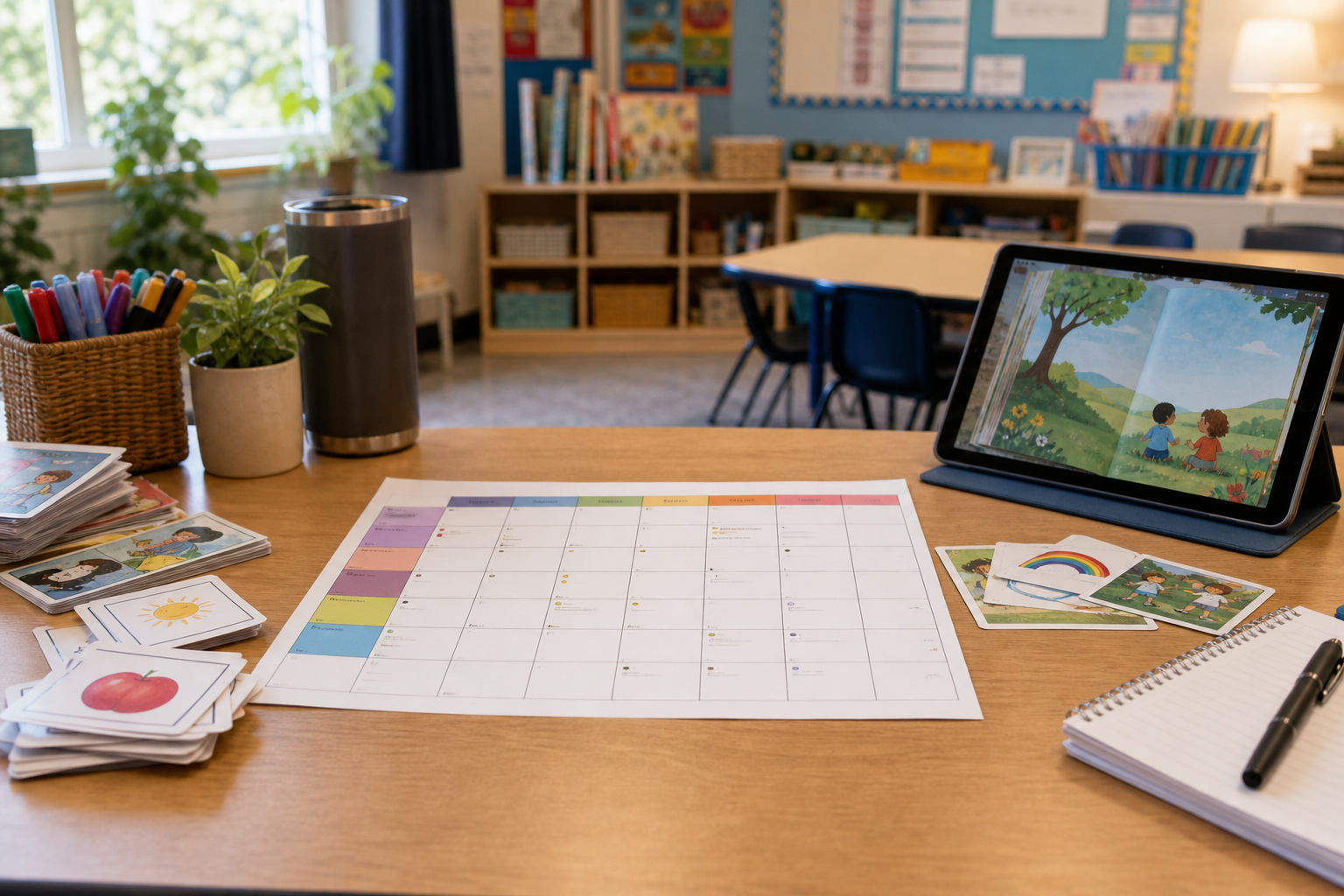
A shared planning calendar helps the whole team model the same word.
How to Choose the Right Tools for Your Learners
- Is it short enough for a busy day?
- Does it work with each child's AAC and other communication modes?
- Can the SLP choose words and targets?
- Can you preview it first?
- Does it leave room for child-led play?
- Are licensing terms clear for sharing with your team?
Also see printable resources for preschool SLPs. For professional background on AAC, visit ASHA or read about AAC on Wikipedia.
About Little Speech Corner
Little Speech Corner was created by Gwen Swire, M.A., CCC-SLP, who has more than 20 years of experience. Her credentials describe her background, not an endorsement of any product. Individual Core Stories, the Foundational 53-Pack, Sound Stories, and free samples are available through TPT. Storytime Stories and Story Builders are still in development.
Frequently Asked Questions
What are early childhood special education language tools?
They are materials and routines that help adults support communication in young children with special education needs. Examples include picture stories, core word tip sheets, AAC supports, and sound practice texts.
Who uses these tools?
SLPs, special educators, classroom teams, paraprofessionals, and caregivers use them, mainly with children ages 2 to 7.
What is core vocabulary?
Core vocabulary is a small set of common words, such as more, go, and help, that make up much of what people say every day. They work across many settings and activities.
What does AAC mean?
AAC stands for augmentative and alternative communication. It includes gestures, picture boards, and speech-generating devices that support or replace speech.
Why use stories to teach language?
Stories give repeated, meaningful exposure to words in context. Pictures and predictable text also give adults natural moments to model language.
How long should a story routine take?
A Read, Model, Play routine uses a story of about five minutes, followed by interaction and play. The time is a routine length, not a promised outcome.
Should children repeat the words back?
No. Repetition should not be required. Adults model words, and children can respond in any mode they use.
How do I choose a Core Word?
Start with a word that is useful in the child's day and easy to model across activities. An SLP can help select words that fit each learner's goals.
Can these tools replace speech therapy?
No. They provide educational support and do not replace individualized assessment, clinical judgment, or speech-language therapy.
How do sound-loaded stories fit in?
They offer repeated chances to hear selected speech sounds in connected language. An SLP should choose the target sounds and cues for each child.
How can teams carry words across settings?
Share one core word at a time through tip sheets or a planning calendar. Then every adult can model it in class, therapy, and at home.
Where can I try a free sample?
Free samples, including the THERE Core Story and SW and CH Sound Stories, are available through the Little Speech Corner TPT store.
Conclusion
The most useful early childhood special education language tools are short, visual, flexible, and easy to share across a team. Stories, play materials, printables, and AAC modeling all help adults model language while children lead the way. Start small with one word and one story, then try a free sample from Little Speech Corner to see how it fits your learners.
