
Play-Based Language Activities for Early Childhood Ideas
Try play-based language activities for early childhood that build core vocabulary through child-led play. Get practical examples and a free sample.
Play-based language activities for early childhood are simple, child-led play routines where adults model words and phrases in the moment. Instead of drilling, you join the child's play and add language that fits. Here is how to do it with confidence, whether you are an SLP, a teacher, or a caregiver.
Quick answer: Pick one core word, share a short story, then follow the child's lead in play. Use the word naturally on the child's communication system, and never require repetition.
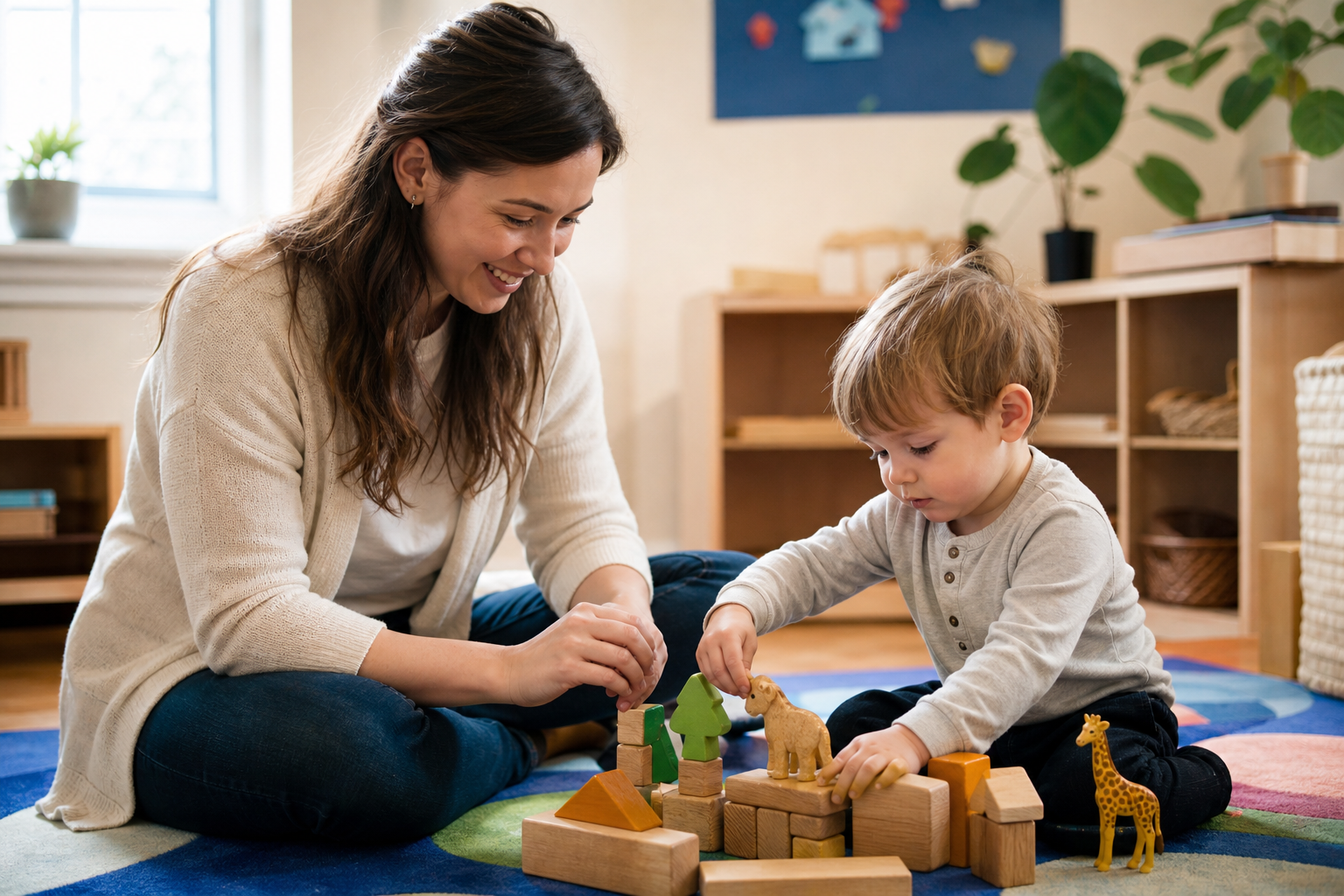
Shared play on the floor is a natural place for play-based language activities for early childhood.
What Are Play-Based Language Activities for Early Childhood?
They are routines where language grows out of play. The child chooses the toy or game. The adult comments, models key words, and waits.
This approach respects all communication modes. Gestures, sounds, pictures, and words all count. For more ideas, see these play-based language activities for speech therapy.
Why Child-Led Play Works for Language
Children pay attention to what interests them. As a result, words heard during a favorite game are tied to real actions and objects. In addition, play removes the pressure to perform.
Child-led play also gives you natural repetition. A car can "go" fifty times in a few minutes, and each time is a chance to model the word.
Start With Core Vocabulary
Core vocabulary is a small group of high-use words, such as go, more, stop, help, and open. They work in almost any activity. Therefore, they are ideal for play.
Augmentative and alternative communication (AAC) means any tool that supports or replaces speech, from picture boards to speech-generating devices. When you model on the child's AAC, you show how the words work. Keep the child's full vocabulary available at all times. Learn more in this guide to teaching core vocabulary during play.
Five Play Ideas to Try This Week
| Play activity | Core words to model |
|---|---|
| Cars and ramps | go, stop, fast, more |
| Play food and a toy kitchen | eat, more, all done, want |
| Bubbles | pop, again, up, look |
| Block towers | put, on, down, my turn |
| Treasure box with small items | open, in, find, help |
Choose only one or two words per session. For example, during block play you might say "Put on," then pause. Your pause invites the child to respond in any way.
A Simple Read, Model, Play Routine
Read, Model, Play is the approach used at Little Speech Corner. A short Core Story takes about five minutes. Then you model the word and move into play. Five minutes is a manageable format, not a promised outcome.

A short shared reading sets up the word you will model during play.
Steps to follow
- Pick one core word that fits the child's interests and communication supports.
- Read a short story for about five minutes, modeling the word as you go.
- Set out a few toys related to the story.
- Let the child lead, and use the word naturally in short phrases.
- Tell the team which word you used so others can model it too.
Want to try it? The Little Speech Corner free THERE Core Story, Apples for Anna, is a gentle place to begin through Teachers Pay Teachers (TPT).
Early Learning Language Play in the Classroom and at Home
Carryover matters. Language grows when many adults use the same words in different places. Consequently, a weekly Core Word of the Week helps teachers, aides, and families stay aligned.
At school, model during centers, snack, and outdoor time. At home, use the word during bath, meals, and floor play. If you need quick ideas, try these five-minute activities for preschoolers or these AAC activities for preschool.
The Core Stories Foundational 53-Pack on TPT pairs with a suggested weekly sequence for this kind of team modeling. Check the current listing for included files and licensing before sharing across staff. See also this overview of play-based speech activities.
Common Mistakes to Avoid
- Asking the child to repeat words on demand.
- Limiting AAC to a few "approved" words.
- Modeling too many new words at once.
- Taking over the play instead of following the child.
A Note on Clinical Use
These resources provide educational support and do not replace individualized assessment, clinical judgment, or speech-language therapy. An SLP should select speech targets and cues for each child.
Further background on the field is available from the American Speech-Language-Hearing Association and on AAC on Wikipedia.
Frequently Asked Questions
What are play-based language activities for early childhood?
They are everyday play routines where adults model words and phrases while the child leads. Language is built into the play instead of drilled.
Why does play support language development?
Play is motivating and gives repeated, meaningful chances to hear words in context. Children are often more engaged when they choose the activity.
What age group are these activities for?
They suit young communicators, especially ages 2 to 7. Adjust the words and expectations to each child.
How long should a play-based language activity last?
A short story of about five minutes plus play is a manageable start. Follow the child's interest and stop when engagement fades.
What is core vocabulary?
Core vocabulary is a small set of common words, like more, go, and stop, that are used across many situations. They are useful in nearly any play routine.
Can I use these activities with AAC?
Yes. AAC includes tools like picture boards and speech-generating devices. Model words on the child's system and keep the full vocabulary available.
Should I ask the child to repeat words?
No. Modeling does not require repetition or speaking on demand. Accept gestures, sounds, AAC, or words as communication.
What toys work best?
Simple, open-ended toys work well, such as blocks, animals, cars, and play food. Choose items the child already enjoys.
How can teachers use play-based language activities in a classroom?
Pick a weekly core word and model it during centers, snack, and outdoor play. Share the word with the whole team for consistency.
How can families carry activities over at home?
Use the same word during bath, meals, and floor play. Short, relaxed moments are enough.
Do these activities replace speech therapy?
No. They provide educational support and do not replace individualized assessment or therapy. An SLP should select speech targets and cues for each child.
Where can I try a free sample?
Little Speech Corner offers free samples, including the Apples for Anna (THERE) Core Story, through its Teachers Pay Teachers store.
Conclusion
Play-based language activities for early childhood work best when they are short, joyful, and led by the child. Choose one core word, model it on the child's communication system, and share it with everyone on the team. Start small, stay curious, and let play do the heavy lifting.
