
SLP Printable Resources for Language Development Guide
Learn how to choose SLP printable resources for language development, from core vocabulary stories to sound practice. Preview a free sample today.
SLP printable resources for language development are downloadable stories, tip sheets, and planning tools that help speech-language pathologists (SLPs) and teams model words and language with young children. The best ones are short, flexible, and easy to use in therapy, classrooms, and at home. Here is how to choose them and use them well.
Quick answer: Look for printable resources that give you one clear language target, a story or routine you can use in about five minutes, and room to follow the child's lead. Pair them with your own clinical judgment.
What Are SLP Printable Resources for Language Development?
They are digital materials you download and print or display. Common types include illustrated stories, core word tip sheets, calendars, and picture supports. They give adults a ready-made way to model vocabulary in context.
At Little Speech Corner, Mrs. Gwen (Gwen Swire, M.A., CCC-SLP) creates story-based resources for SLPs, special educators, and classroom teams. They are designed mainly for children ages 2 to 7.
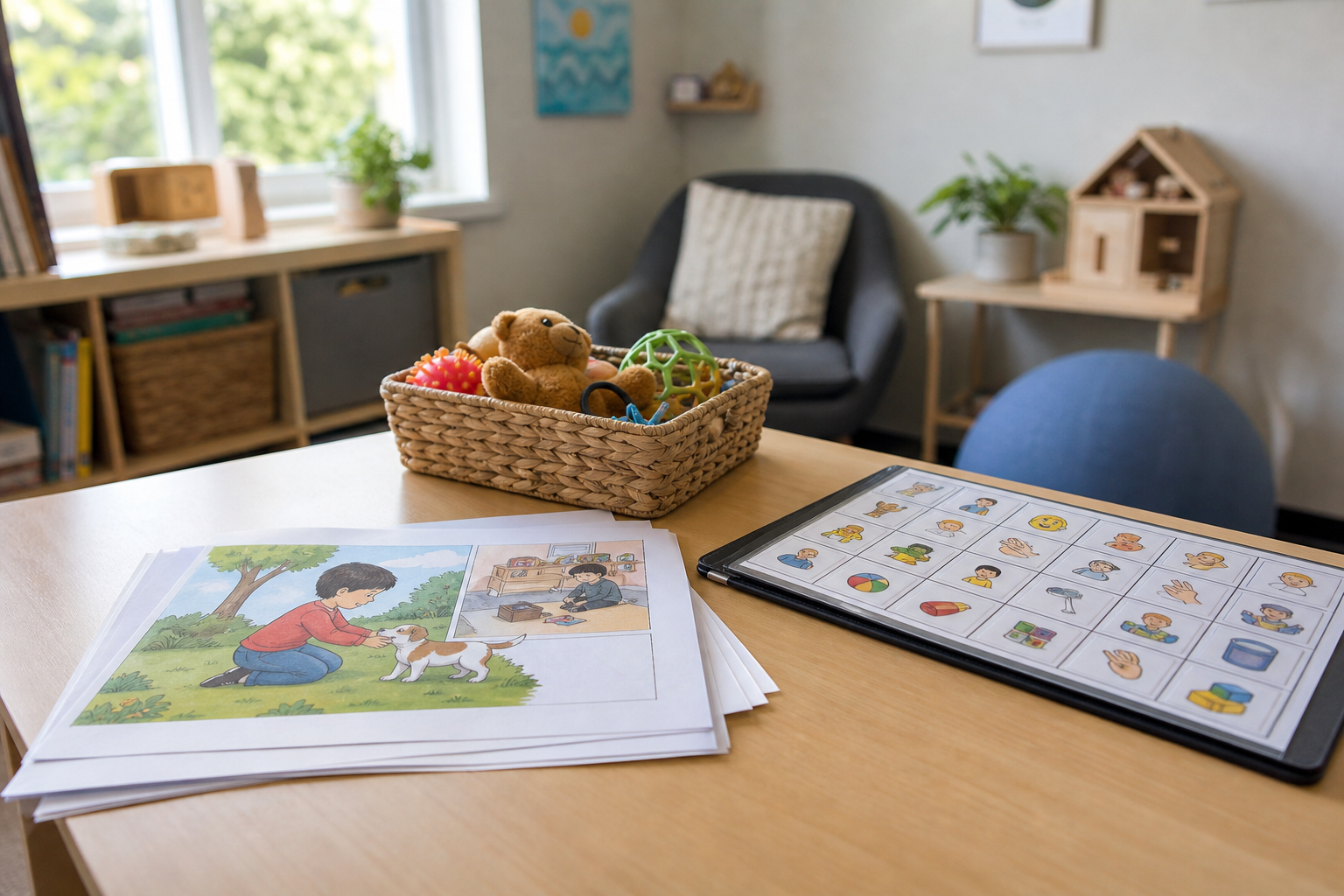
Printed stories and simple toys set up for a language modeling session.
Why Stories Work for Early Language Modeling
Stories give words a setting. A child sees a picture, hears a word, and connects it to an action. As a result, adults can model language naturally instead of drilling it.
Stories also repeat well. Therefore, a single word can appear several times without feeling forced. For related ideas, see this guide to printable speech and language resources for preschool SLPs.
Core Vocabulary and AAC Support
What is core vocabulary?
Core vocabulary is the small group of common words, like "go," "more," and "stop," that people use across many settings. Because these words appear everywhere, they are useful to model often.
How AAC fits in
Augmentative and alternative communication (AAC) covers tools and strategies that support or replace speech, such as picture boards or speech-generating devices. In aided language modeling, an adult points to or selects words on the child's system while talking. The child's full vocabulary stays available at all times.
The American Speech-Language-Hearing Association explains AAC on its official website. You can also read more in our post on core vocabulary printables for AAC classroom use.
How to Use a Printable Story Step by Step
The Read, Model, Play routine pairs a short Core Story with interaction. The five minutes describes the reading time, not a promised result.
- Choose one target word that fits the learner, ideally with input from the child's SLP.
- Read the story together for about five minutes, pausing to point and comment.
- Model the word on the child's communication system, such as AAC, with no pressure to respond.
- Move into child-led play and use the word naturally when it fits.
- Share the word and an example with teachers and caregivers for school and home carryover.

Shared reading leads naturally into child-led play.
Printable Language Tools for Different Goals
| Resource type | Best for |
|---|---|
| Individual Core Stories | Modeling one core word, including with AAC |
| Core Stories Foundational 53-Pack | A suggested Core Word of the Week sequence |
| Sound Stories | Clinician-selected articulation practice in connected stories |
| Team Supports and Core Word Tip Sheets | Helping adults model shared vocabulary across settings |
For sound work, see these printable articulation stories. For busy caseloads, this roundup of speech therapy resources for school-based SLPs may help.
How to Choose the Right Printable Resource
Consider these questions before you download:
- Does it fit the learner's age, interests, and communication mode?
- Is there one clear target, rather than many at once?
- Can the team use it across therapy, class, and home?
- Is there a preview or free sample you can try first?
- Do the listing's licensing terms match how you plan to share it?
Families may also find this overview of language delay challenges useful as background.
Please note: These resources provide educational support and do not replace individualized assessment, clinical judgment, or speech-language therapy. An SLP should select speech targets and cues for each child.
Try a Free Sample First
Previewing is the easiest way to see if a style fits your learners. Free examples include Apples for Anna (THERE), a calendar with a sample Core Story, and SW and CH Sound Story samples. All downloads are completed through the Little Speech Corner Teachers Pay Teachers (TPT) store. Please confirm listing details there before relying on formats or licensing.
Storytime Stories and Story Builders, which focus on oral language and story understanding, are still in development and are not yet available.
Frequently Asked Questions
What are SLP printable resources for language development?
They are downloadable materials, such as illustrated stories, tip sheets, and calendars, that help SLPs and teams model vocabulary and language. They support, but do not replace, individualized assessment and therapy.
Who uses printable language resources?
School-based and private-practice SLPs, early childhood special educators, classroom teams, and caregivers use them. Little Speech Corner resources are designed mainly for learners ages 2 to 7.
What is core vocabulary?
Core vocabulary is the small set of common words, such as more, go, and stop, that people use across many situations. These words make up a large share of everyday talk.
What is AAC?
Augmentative and alternative communication (AAC) includes tools and strategies, such as picture boards and speech-generating devices, that support or replace speech. All communication modes are valid.
What does Read, Model, Play mean?
It is a three-part routine: read a short Core Story, model the target core word, then move into child-led play. The story takes about five minutes, but that time is not a promised outcome.
How do printable stories differ from worksheets?
Stories give language a shared, meaningful context. Worksheets often isolate a skill, while a story lets adults model words in connected language and then carry them into play.
Do I need to ask a child to repeat words?
No. Modeling does not require repetition or a response. Adults show the word and let the child join in however they choose.
Can printable stories help with articulation practice?
Sound-loaded stories can provide repeated chances to hear and practice selected speech sounds in connected language. An SLP should choose the target sounds and cues for each child.
How do I choose a resource for my caseload?
Start with the learner's goal, age, and communication mode. Then preview the resource, check it fits your setting, and confirm the current listing details.
Are there free samples to try?
Yes. Free examples include Apples for Anna (THERE), a calendar with a sample Core Story, and SW and CH Sound Story samples through the Little Speech Corner TPT store.
Where do I download the resources?
Purchases and free downloads are completed through the Little Speech Corner Teachers Pay Teachers (TPT) store. Check each listing for current details.
Can I share a resource with my whole school?
Check the current TPT licensing on the listing before sharing with other staff or schoolwide. Licensing terms can differ by product.
What is a common mistake when using printable resources?
A common mistake is treating the resource as the whole plan. Printable materials work best as one tool within individualized goals chosen by an SLP.
Conclusion
Good SLP printable resources for language development are simple, flexible, and respectful of every communication mode. Choose one clear target, read and model without pressure, follow the child's lead in play, and share the word with the team. To see the approach in action, explore the free samples and resource guides at Little Speech Corner and preview what fits your learners.
