
Speech Therapy Interactive Stories: A Practical Guide
Learn how speech therapy interactive stories support core vocabulary, AAC modeling, and child-led play. Explore practical ideas and try a free sample.

Speech therapy interactive stories turn a short read into real language practice. An adult reads, pauses, models a word, and then follows the child into play. At Little Speech Corner, we build this routine around core vocabulary, AAC modeling, and child-led play. This guide shows SLPs, teachers, and families how to use it.
Quick answer: An interactive story invites the child to take part, not just listen. The adult pauses, comments, and models one target word with the child's communication supports. Then everyone moves into child-led play.
What Are Speech Therapy Interactive Stories?
Speech therapy interactive stories are short, illustrated stories made for shared reading and language modeling. They are not for quiet, passive listening. Instead, the adult points, comments, waits, and gives the child room to respond in any way they can.
A response may be a look, a gesture, a sound, a spoken word, or a selection on an AAC system. Augmentative and alternative communication (AAC) means tools and strategies, such as picture boards or speech-generating devices, that support communication. All of these responses count.
Shared reading gives young children a calm, predictable setting for language.
Interactive Stories vs. Story Worksheets and Question Packs
Many free story resources are comprehension sets. They pair a short passage with WH questions (who, what, where, when, why, how), sequencing pictures, or inference prompts. Those are useful for older students who work on retelling and answering questions.
Interactive stories have a different job. For young communicators, the focus is on the shared moment, not a quiz. Therefore, the adult models language first. Questions, if any, stay light and optional.
- Comprehension sets: best for answering questions, retelling, and inferencing.
- Sequencing stories: best for ordering events and building sentences.
- Interactive stories: best for modeling core words, AAC use, and play-based language.
- Sound-loaded stories: best for hearing target speech sounds in connected language.
Why Story-Based Language Practice Works Well
Stories offer repetition without drilling. A familiar picture, a repeated phrase, and a predictable page turn give a child many chances to hear a word in context. As a result, the word feels like part of a moment, not a task.
In addition, stories fit many settings. An SLP can use one in a session, a teacher can use it at circle time, and a caregiver can read it at home. For more on this idea, see our guide to story-based speech therapy resources for young children.
The Read, Model, Play Approach
Read, Model, Play is the approach behind Mrs. Gwen's Core Stories. First, share a short story of about five minutes. Next, model a core word during the reading. Finally, move into interaction and child-led play. The five minutes is a planning guide, not a promised result.
Core vocabulary means the high-use words children need across many situations, such as go, more, stop, and there. You can learn how to teach these in our post on teaching core vocabulary through short stories.
How to Use an Interactive Story Step by Step
- Choose one core word that fits the learner, and decide how you will model it with their communication supports.
- Read the story together in about five minutes, pausing to point, comment, and wait.
- Model the word during reading with speech, gesture, or AAC. Do not ask the child to repeat it.
- Move into child-led play with toys or objects from the story, and model the same word naturally.
- Share the word with the team so teachers and family can model it during routines.
Try This: A Sample Modeling Script
Imagine a story about a ball that rolls away. On the page, you say, "The ball can go." Then you wait a few seconds. If the child looks, points, or smiles, you respond warmly: "Yes, go! Ball go." Next, roll a real ball and model go again.
Notice what is missing: no demands, no "say it." The child can join in whenever, and however, they choose.
Tips for Pausing and Waiting
- Count silently to five before you speak again.
- Use an expectant face and open hands to invite a response.
- Accept any mode of communication as a turn.
- Keep the page turns predictable so the child knows what comes next.
Using Stories With AAC and Aided Language Modeling
Aided language modeling means the adult points to or selects words on the child's AAC system while speaking. For example, while reading about a ball rolling away, you might say "go" and touch go on the device or board.
Keep the child's full vocabulary available at all times. A story word is a highlight, not a limit. Likewise, the American Speech-Language-Hearing Association offers helpful background on AAC at asha.org.
Sound Stories for Articulation Practice
Sound Stories are illustrated, sound-loaded narratives. They give repeated chances to hear selected speech sounds in connected language. A clinician chooses the target sounds and cues, and then follows up with practice that suits the child.
If you want printable options, read about printable articulation stories for speech therapy. Free SW and CH samples are available through our Teachers Pay Teachers (TPT) store.
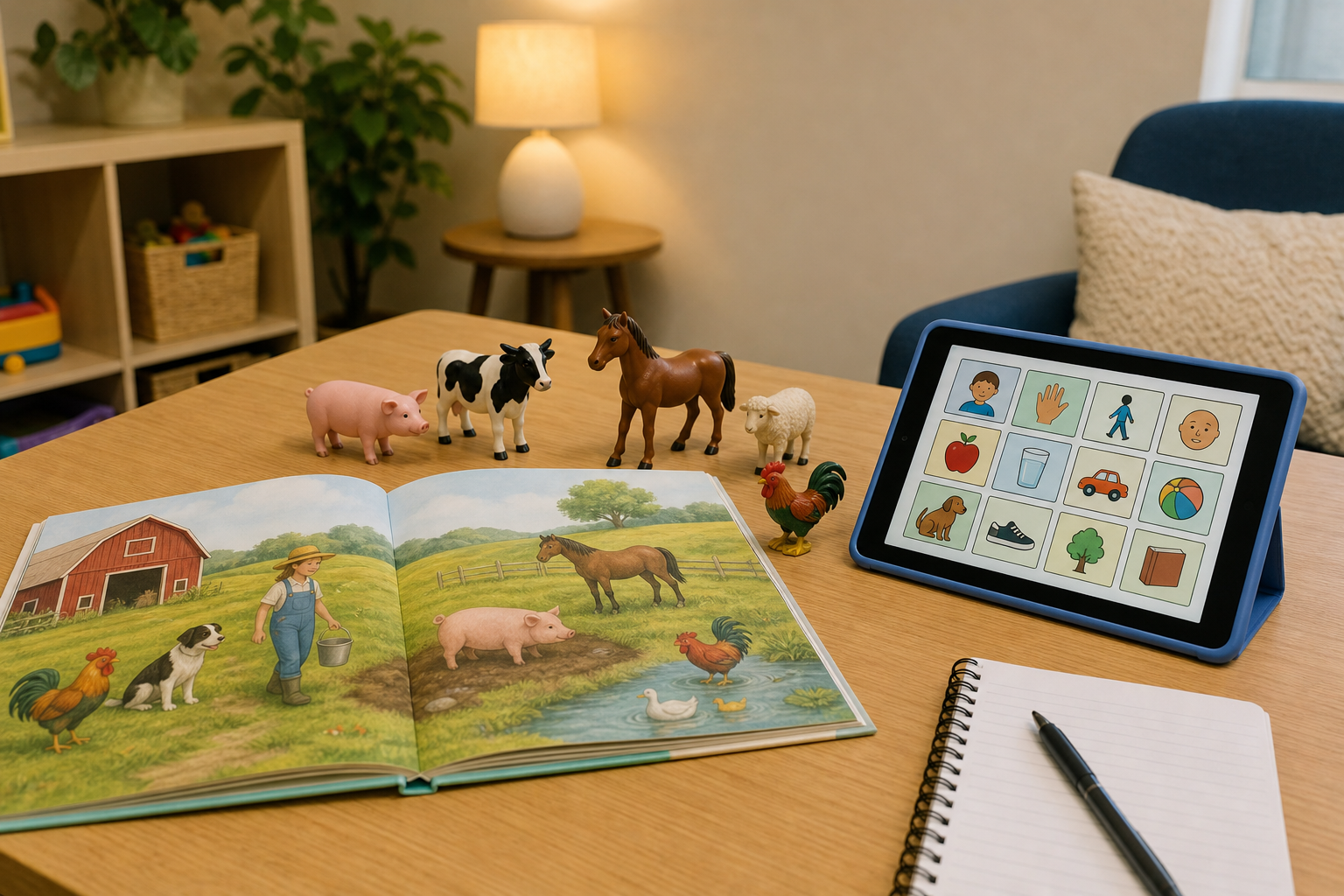
Books, toys, and communication supports make story time flexible.
Keeping Play Child-Led
After the story, follow the child. If they push the toy car, model go. If they stack blocks, you might model more. In short, the play shapes the language, not the other way around. Our list of play-based language activities offers more ideas.
These resources provide educational support and do not replace individualized assessment, clinical judgment, or speech-language therapy. An SLP should select speech targets and cues for each child.
Carrying Stories Into the Classroom and Home
Language grows when the same word shows up in many places. Therefore, tell the team which word you are modeling. A teacher can use more at snack. A caregiver can use it at bath time.
Team Supports, such as Core Word Tip Sheets, help adults share one word across settings. Before sharing files with staff or a school, check the current TPT licensing terms.
Choosing Resources and Trying a Free Sample
Little Speech Corner offers individual Core Stories, the Core Stories Foundational 53-Pack, Sound Stories, and Team Supports. Mrs. Gwen is Gwen Swire, M.A., CCC-SLP, with more than 20 years of SLP experience. Her background shapes the resources, but it is not an endorsement of any outcome.
To start gently, try the free Apples for Anna (THERE) Core Story. Browse everything at Little Speech Corner, and confirm listing details on TPT before buying. Meanwhile, Storytime Stories are still in development and are not yet available.
Frequently Asked Questions
What are speech therapy interactive stories?
Speech therapy interactive stories are short, illustrated stories that adults share with a child while pausing to model language, comment, and invite participation. They turn reading into a shared language moment.
Who can use interactive stories?
SLPs, special educators, classroom teams, and caregivers can use them. Little Speech Corner resources are designed mainly for young communicators ages 2 to 7.
How long should an interactive story take?
The Read, Model, Play approach uses a story of about five minutes, followed by interaction and play. The time is a planning guide, not a promised outcome.
Do interactive stories work with AAC?
Yes, stories can support aided language modeling, where adults point to or select words on the child's AAC system while talking. The child's full vocabulary should always stay available.
What is AAC?
Augmentative and alternative communication (AAC) includes tools and strategies such as pictures, gestures, and speech-generating devices that support communication alongside or instead of speech.
Should the child repeat the words during the story?
No. Repetition is not required. Adults model the words, and the child may respond with looks, gestures, sounds, AAC, or speech in their own way.
How are core vocabulary stories different from sound stories?
Core Stories focus on high-use words such as more, go, or there. Sound Stories repeat selected speech sounds in connected language for clinician-chosen articulation practice.
Can interactive stories replace speech therapy?
No. These resources provide educational support and do not replace individualized assessment, clinical judgment, or speech-language therapy. An SLP should select speech targets and cues for each child.
How do I choose the right story?
Start with the learner's interests and a core word that fits their communication goals. Previewing a listing or trying a free sample can help you decide.
Is there a free way to try these stories?
Yes. Free samples include the Apples for Anna (THERE) Core Story, a calendar with a sample story, and SW and CH Sound Story samples through Teachers Pay Teachers.
How can I carry the story into the classroom or home?
Share the core word with the team and model it during daily routines. Team Supports such as Core Word Tip Sheets can help adults use the same word across settings.
What mistakes should I avoid with speech therapy interactive stories?
Avoid pressuring the child to talk, limiting their AAC vocabulary, or packing in too many target words. One word, modeled warmly, is enough.
Conclusion
Speech therapy interactive stories bring together shared reading, core-vocabulary modeling, and child-led play in a short, friendly routine. Choose one word, read, model it with the child's supports, and follow their lead into play. Then share the word with the team, and invite a story into your next session.
