
AAC Core Vocabulary Activities for Early Communicators
Discover practical AAC core vocabulary activities using Read, Model, Play, plus free samples and SLP-designed Core Stories for young learners.

AAC core vocabulary activities are the everyday teaching moments that help augmentative and alternative communication (AAC) users build a flexible, reusable set of high-frequency words. These activities turn a device or paper-based board into a living part of daily conversation rather than a static tool. For speech-language pathologists (SLPs), special educators, and classroom teams, the goal is simple: model the same small set of powerful words, like "want," "go," and "more," across stories, play, and routines until they become automatic. This guide explains what core vocabulary means, why it matters for young AAC learners, and how a short, story-based routine can anchor daily practice.
Quick answer: AAC core vocabulary activities pair a short piece of shared reading or play with consistent modeling of one core word on the learner's own communication system. Repeating that single word across settings, people, and days helps the word become something the learner recognizes, understands, and eventually uses independently.
What Are AAC Core Vocabulary Activities?
AAC core vocabulary activities are structured but flexible routines that give AAC users repeated, meaningful practice with core words. Rather than teaching single nouns in isolation, these activities embed core words into real exchanges, like requesting, commenting, and protesting.
In particular, core vocabulary refers to a small set of words that work across many topics and settings. For example, the word "go" fits a story about a bus, a game about animals, or a snack-time routine. In contrast, fringe vocabulary, such as "dinosaur" or "birthday," only applies to one narrow topic. Specifically, many AAC programs organize teaching around core words first because of how often they show up in everyday language. According to information shared by the American Speech-Language-Hearing Association (ASHA), consistent, functional communication supports are central to effective AAC intervention, and core vocabulary is frequently used as that functional foundation.
A short shared-reading moment is one of the simplest AAC core vocabulary activities for modeling a single target word.
Why Core Word Practice Matters for AAC Learners
Core words matter because they give learners the most communicative power for the least learning effort. As a result, teams can spend less time teaching isolated labels and more time building words that transfer across the day. Research summarized in AAC literature often notes that a relatively small group of core words accounts for a large share of everyday spoken language, sometimes cited as up to 80 percent of common conversation. Therefore, prioritizing these words tends to produce a bigger communication payoff than focusing on topic-specific nouns alone.
Furthermore, young AAC users benefit from seeing core words used in many situations, not just one worksheet or one lesson. Similarly, families benefit when the same target word shows up at home, at school, and in therapy, because repetition across settings builds stronger recognition. The National Institute on Deafness and Other Communication Disorders (NIDCD) notes that AAC systems work best when paired with consistent support from the people around the learner, which is exactly what coordinated core vocabulary modeling aims to provide.
AAC Core Vocabulary Activities in Daily Practice
Above all, AAC core vocabulary activities work best when they are short, repeatable, and embedded in something the learner already enjoys. A five-minute story, a familiar song, or a simple play routine can all serve as the backdrop for modeling one core word again and again. For instance, a story about a child going to the park offers dozens of natural chances to model "go," "stop," and "want" without feeling like a drill.
In addition, these activities do not require a dedicated therapy block. Classroom teachers can fold core word modeling into circle time, and families can do the same during a bedtime story or snack routine. Consequently, the learner hears the same word modeled by multiple people across the week, which tends to support faster recognition and more confident use. Little Speech Corner's Core Words Guide walks through this kind of weekly planning in more detail for teams getting started.
Read, Model, Play: A Simple Framework for Practice
The Read, Model, Play approach offers one concrete way to structure AAC core vocabulary activities. A short Core Story provides about five minutes of shared reading and core-word modeling. Afterward, the adult shifts into open-ended interaction and child-led play, continuing to model the same target word in new sentences. This structure supports flexible language modeling, including learners who use AAC, because the adult can point to or select the word on the child's own system throughout the story and the play that follows.
Notably, the five-minute reading portion is not a promised outcome or a guarantee of progress; it simply describes the typical shared-reading window before the activity opens into play. For example, free samples like the "Apples for Anna" Core Story, built around the word "THERE," demonstrate how one short story can carry a single core word through a full activity. Teams exploring this approach can also browse related guidance on core vocabulary teaching materials for AAC language for additional planning ideas.
Step-by-Step: Building an AAC Core Vocabulary Activity
Below is a simple sequence many teams use when planning a new core word activity:
- Pick one core word and gather a short story. Choose a single functional word, such as "go," "want," or "more," and select a story or activity that naturally repeats that word throughout.
- Read the story aloud for about five minutes while modeling the core word on the learner's AAC system every time it appears in the text.
- Move into open-ended play related to the story and continue modeling the same core word in new, natural sentences during the activity.
- Create simple opportunities for the learner to use the word on their own device or board, offering another model right away if they do not respond independently.
- Share the target word with other team members and family so the learner hears and practices it consistently across settings for the week.
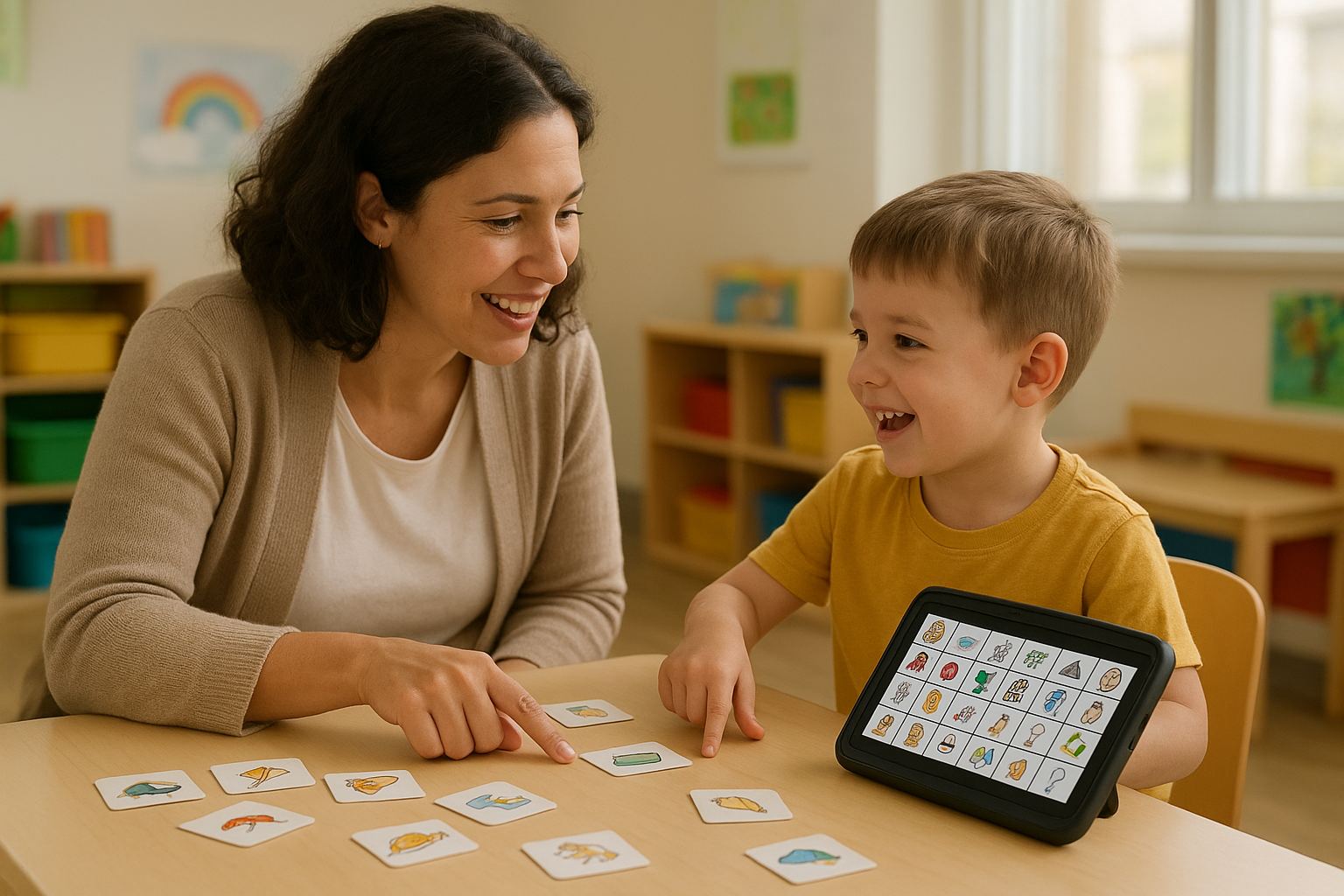
Open-ended play after a short story gives extra chances to repeat AAC core vocabulary activities throughout the session.
Classroom and Team Carryover Ideas
Consistency across adults is one of the biggest factors in how well core word modeling sticks. However, keeping an SLP, a classroom teacher, and a family all on the same target word can be challenging without a shared plan. A simple weekly calendar that names one core word, paired with a short tip sheet of modeling phrases, helps every adult use the same vocabulary in their own setting.
For example, a tip sheet might suggest modeling "stop" during transitions, clean-up time, and a stop-and-go game, giving teachers and families specific, low-effort ways to fold the word into routines they already run. Little Speech Corner's team supports are built around exactly this kind of shared planning. Similarly, the guide to core vocabulary books for SLPs and teachers offers additional ideas for pairing printed stories with classroom-wide modeling.
Free and Ready-Made AAC Core Vocabulary Resources
Teams who want to try AAC core vocabulary activities before building their own often start with free samples. A free Core Story built around the word "THERE," a sample core-vocabulary calendar, and SW and CH Sound Story samples are all available as low-risk ways to preview the Read, Model, Play structure. Therefore, teams can test the approach with their own students before committing to a full resource set.
For a more complete weekly plan, the Core Stories Foundational 53-Pack offers 53 ready-made stories connected to a suggested Core Word of the Week sequence and an annual planning calendar. It is best described as a starting framework for a year of modeling, not a complete, individualized therapy program on its own. Current pricing, file formats, and licensing are listed on the product's Teachers Pay Teachers page, so it is worth checking that listing directly before purchase. Visitors can browse the full catalog and preview individual titles at littlespeechcorner.com.
Frequently Asked Questions About AAC Core Vocabulary Activities
What are AAC core vocabulary activities?
AAC core vocabulary activities are routines, such as shared reading, modeling, and play, that give AAC users repeated practice with a small set of high-frequency words. These words, like "go," "more," and "want," work across many situations instead of naming just one object.
How do I choose which core words to target first?
Start with a few highly functional words the learner can use across home, therapy, and classroom routines. Words like "go," "stop," "want," and "more" are common starting points because they fit into nearly any activity.
How long should a core vocabulary activity take?
Many short activities run about five minutes of shared reading or modeling, followed by open-ended play and interaction. The exact length can flex based on the learner's attention and the setting.
What is the difference between core words and fringe words?
Core words are reusable across many contexts, such as "go," "more," or "help," while fringe words are specific nouns tied to one topic, like "dinosaur" or "birthday." Core vocabulary builds flexible, everyday communication, while fringe vocabulary supports specific themes or lessons.
Can AAC core vocabulary activities work for non-verbal and minimally verbal students?
Yes, these activities are designed for learners who use devices, picture boards, or other AAC supports instead of speech. The adult models the core word on the learner's system while reading or playing, which gives the student a clear, repeated example to follow.
How often should core vocabulary be modeled?
Frequent, short exposures throughout the day tend to work better than one long session. Teams often pick one core word per week and model it consistently across therapy, classroom, and home routines.
What age range benefits most from core vocabulary practice?
Core vocabulary modeling is commonly used with young communicators from about 2 to 7 years old. However, the underlying strategy can be adapted for older AAC users who are still building core word fluency.
What common mistakes should teams avoid with core vocabulary modeling?
A common mistake is modeling only nouns or waiting for the student to initiate before modeling at all. Instead, adults should model core words proactively, even without expecting an immediate response.
How much does the Core Stories Foundational 53-Pack cost?
Pricing, included files, and licensing for the Core Stories Foundational 53-Pack are listed on its Teachers Pay Teachers page. Check the current listing before purchase since details can change.
Do I need a specific AAC device to use these activities?
No, core vocabulary modeling works with high-tech devices, low-tech boards, or a mix of both. The activity structure stays the same; only the tool used to model the word changes.
How can classroom teams stay consistent with core vocabulary across settings?
Shared planning tools, like a core-word calendar or tip sheet, help therapists, teachers, and families model the same target word in the same week. Consistency across settings gives the learner more repeated, meaningful exposure.
Where can I find free AAC core vocabulary activity samples?
Free samples, including a Core Story built around the word "THERE" and a sample core-vocabulary calendar, are available for download. These samples let teams preview the Read, Model, Play approach before choosing a full resource.
What is aided language modeling and how does it relate to core vocabulary?
Aided language modeling means the adult points to or selects words on the learner's own AAC system while talking, rather than only speaking aloud. It pairs naturally with core vocabulary activities because the adult models the exact words the student needs on the student's own device.
How do Sound Stories differ from Core Stories?
Core Stories focus on modeling one flexible core word for language and AAC growth, while Sound Stories are illustrated narratives built around a specific speech sound for articulation practice. Both use short, repeated story-based exposure, but they target different skill areas.
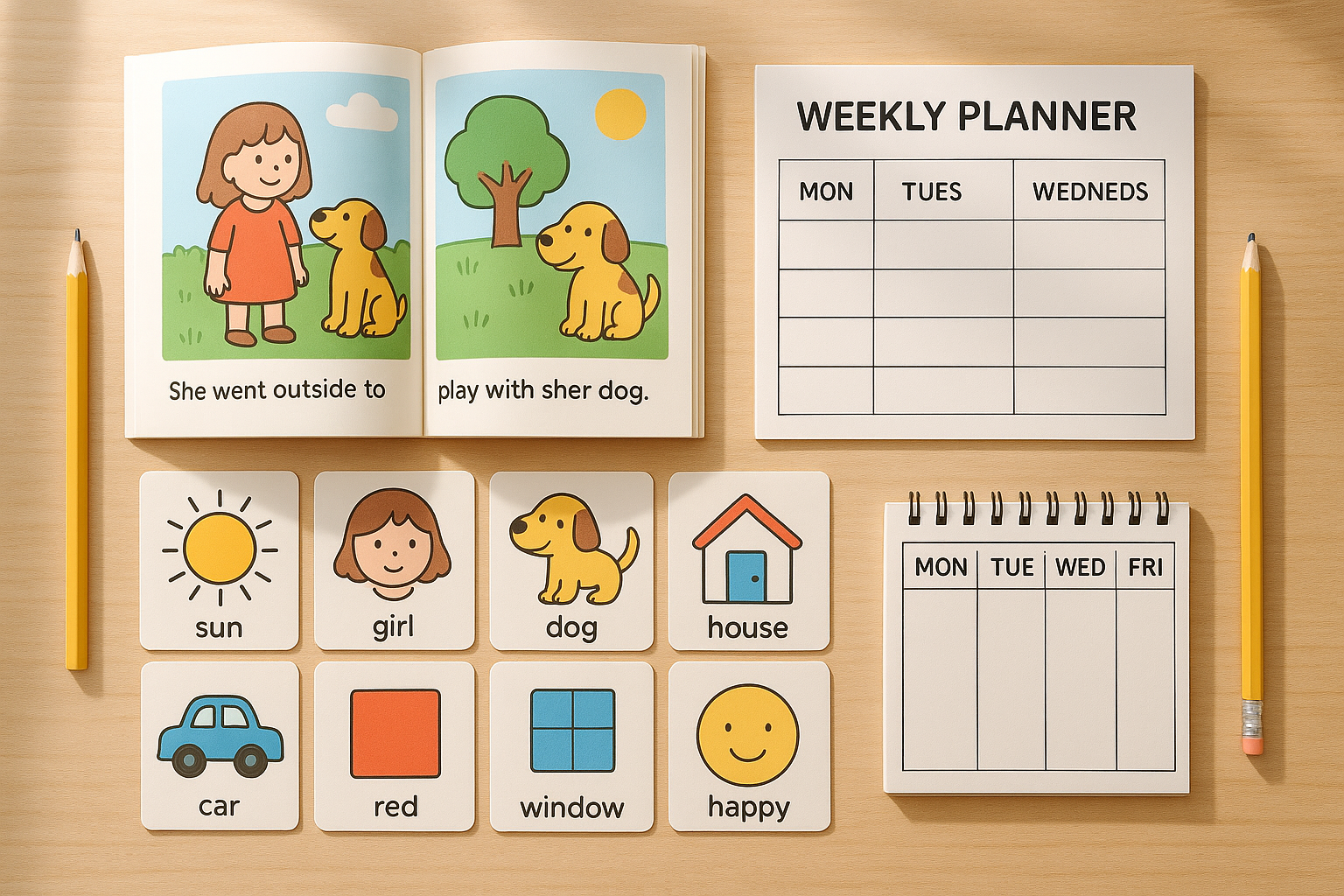
A simple weekly calendar helps teams coordinate AAC core vocabulary activities across therapy, classroom, and home.
Bringing It All Together
In the end, AAC core vocabulary activities work best when they stay simple, repeatable, and shared across the people in a learner's day. A short story, a few minutes of modeling, and some open-ended play can carry one core word a long way, especially when that same word gets reinforced at home and in the classroom. Specifically, pairing a predictable framework like Read, Model, Play with a shared weekly plan helps SLPs, teachers, and families stay aligned without extra prep time. Whether a team starts with a free sample or moves into a full-year bundle, the underlying goal stays the same: give young AAC users frequent, meaningful practice with the words that matter most across their whole day.