
Core Vocabulary Intervention Guides for SLPs and Teachers
Explore core vocabulary intervention guides from Little Speech Corner, with Read, Model, Play tips, free samples, and TPT resources for SLPs and teachers.

Core vocabulary intervention guides give speech-language pathologists (SLPs), special educators, and classroom teams a clear, repeatable plan for teaching the words that matter most across a child's day. Specifically, at Little Speech Corner, these guides take shape through Read, Model, Play, a simple routine built around short Core Stories and child-led interaction. Because core vocabulary includes a small set of high-frequency words used across nearly every setting, having a dependable plan makes modeling far easier for busy teams. In this guide, you'll find what these resources include, how to put them into practice, how core vocabulary differs from fringe vocabulary, how to choose target words, how to track progress responsibly, and where to find a free sample before committing to a larger bundle.
Quick answer: Core vocabulary intervention guides pair a short story or activity with one core word, model that word through speech, sign, or AAC (augmentative and alternative communication, tools and strategies that support or replace spoken language), and then extend practice into play, classroom routines, and home carryover. They organize planning for adults; they never script what a child must say.
What Are Core Vocabulary Intervention Guides?
Core vocabulary intervention guides are structured resources that help adults plan, model, and track core-word teaching across sessions, classrooms, and homes. Rather than scripting exactly what a child must say, a good guide suggests a target word, a few modeling phrases, and some play-based follow-up ideas. In other words, the guide supports the adult's language modeling, not the child's performance.
Core vocabulary itself refers to a relatively small set of high-frequency words, such as go, more, stop, want, and help, that show up across many everyday situations. Research on augmentative and alternative communication (AAC) suggests that a core vocabulary of roughly 200 to 400 words can account for a large share of what people say in daily conversation, across ages and settings. The National Institute on Deafness and Other Communication Disorders describes AAC as including both unaided methods, like gestures and sign, and aided methods, like communication boards or speech-generating devices. For a broader clinical overview of AAC strategies, the American Speech-Language-Hearing Association's AAC overview is a helpful general reference, separate from any single resource or program.
At Little Speech Corner, this idea shapes the Core Stories collection and the Core Stories Foundational 53-Pack, which organizes a year of suggested core words into a core vocabulary planning calendar. Each story is designed to be read in a few minutes, then followed by modeling and child-led play.
Shared reading is a common starting point for core vocabulary intervention guides.
Core Vocabulary vs. Fringe Vocabulary: Why the Distinction Matters
Before choosing materials, it helps to understand a distinction that sits underneath most core vocabulary intervention guides: core versus fringe vocabulary. Core words are the small, flexible set, like go, more, or stop, that generalize across almost any activity. Fringe vocabulary, in contrast, covers more specific words tied to a single topic, such as "dinosaur," "birthday," or "pizza." These words are important too, but they only apply in narrower contexts.
Because core words reappear constantly, many teams prioritize them first when planning intervention. As a result, a child gets repeated, natural exposure to the same handful of words across play, snack time, and classroom transitions. Fringe vocabulary then layers on top, shaped by each child's interests, dinosaurs for one learner, trains for another. A well-built core vocabulary intervention guide typically focuses on the core layer while leaving room for an individual child's fringe words to grow alongside it.
Why Core Vocabulary Support Matters for Young Communicators
Core words matter because they travel well. Unlike many fringe or topic-specific words, a word like more or go can be used across play, mealtime, and classroom routines. Consequently, when a team repeatedly models the same core word across different activities, children have many natural chances to see and hear it in context.
This approach fits naturally with aided language modeling, a strategy where an adult points to or selects words on a child's AAC system while talking, rather than only expecting the child to use it. Because core vocabulary intervention guides often suggest a single target word, adults do not need to search a full AAC vocabulary for the right button during a busy session. Instead, they can plan one modeling target ahead of time, then adjust it to fit the moment.
It is worth noting that these guides are meant to support, not replace, a child's full communication system. Respecting a learner's own communication mode, whether that is speech, sign, gestures, or AAC, remains part of responsible practice. A short Core Story is simply one entry point among many, and adults should stay responsive to however a child chooses to communicate.
How to Choose Core Words for an Intervention Plan
Not every core word fits every learner on the same day. Therefore, teams often weigh a few practical criteria before settling on a target:
- Frequency: Does the word show up across many parts of the day, not just one activity?
- Flexibility: Can the word be used in play, snack time, transitions, and the classroom alike?
- Grammatical balance: A well-rounded plan mixes pronouns (he, it), verbs (go, want), descriptors (big, more), prepositions (in, on), and negation terms (no, stop) rather than only nouns.
- Motivation: Is the word connected to something the child already finds engaging during child-led play?
- Developmental fit: Does the word match where the learner currently communicates, whether that's single words, combinations, or AAC selections?
Because every caseload looks different, these criteria are starting points rather than fixed rules. An SLP or educator remains best positioned to weigh them against an individual child's needs, and a core vocabulary intervention guide simply organizes the options so that decision is easier to make in the moment.
Building a Core Vocabulary Intervention Guide Plan with Read, Model, Play
Little Speech Corner's Read, Model, Play routine offers one practical way to put a core vocabulary intervention guide into action. The routine has three general steps, though pacing and cueing should always be adjusted to the child in front of you.
- Read the Core Story. Share a short, illustrated story built around one core word, such as go or want. A single read-through typically takes about five minutes, though this is simply a general guideline rather than a required outcome.
- Model the word across communication modes. As you read, model the target word using speech, sign, or the child's AAC system, following aided language modeling practices. The goal is exposure and demonstration, not requiring the child to repeat the word.
- Extend into child-led play. After the story, follow the child's interests during play, continuing to model the same core word naturally as opportunities arise. This keeps practice connected to the child's own choices rather than a fixed script.
Because SLPs select targets based on each learner's needs, no single routine works identically for every child. These resources provide educational support and do not replace individualized assessment, clinical judgment, or speech-language therapy. An SLP should select speech targets and cues for each child.
Core Vocabulary Resources from Little Speech Corner
Little Speech Corner, created by Gwen Swire, M.A., CCC-SLP (known to many as Mrs. Gwen), offers several types of digital resources built around this planning approach. Gwen brings more than 20 years of experience across early intervention, preschool, elementary, and family settings into the way each resource is organized. That background shapes the structure of each guide, though using any resource still does not replace individualized assessment or the judgment of a certified SLP.
- Individual Core Stories focus on one Core Word at a time, with modeling ideas and activity suggestions attached.
- The Core Stories Foundational 53-Pack bundles 53 stories into a suggested weekly sequence, often called the Core Word of the Week.
- Sound Stories are sound-loaded narratives built around clinician-selected target speech sounds, useful for articulation practice in connected language rather than isolated drills.
- Team Supports, including Core Word Tip Sheets, help classroom staff and families model the same word consistently.
For a closer look at how these pieces fit together for AAC learners specifically, the guide to core vocabulary teaching materials for AAC and language walks through practical examples. All current resources are available as digital downloads through Teachers Pay Teachers (TPT); specific pricing, file formats, and licensing terms should always be confirmed on the current TPT listing before purchase or classroom distribution.
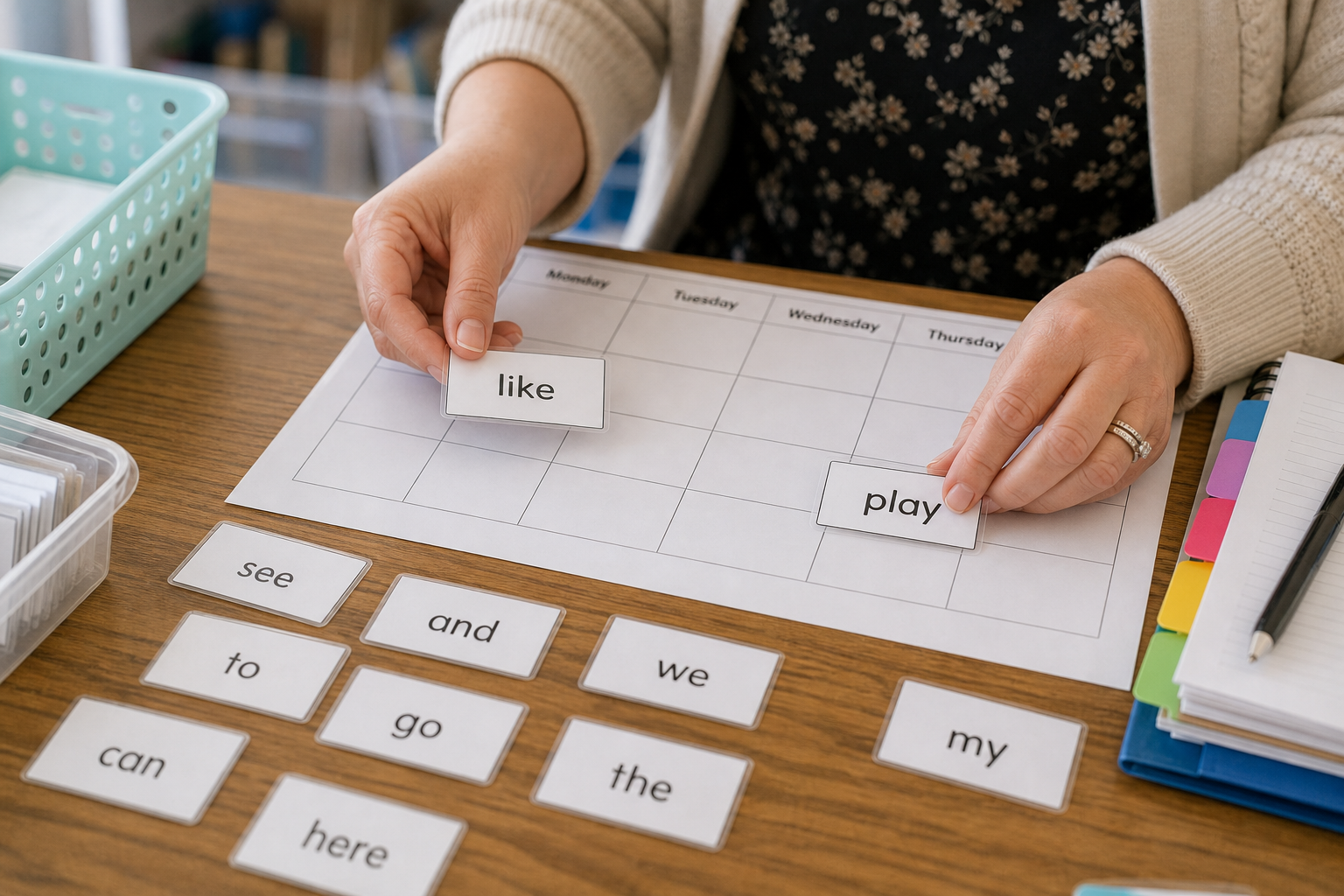
Planning tools help teams keep core word modeling consistent across the week.
Tracking Progress with a Core Vocabulary Intervention Guide
Many teams like to see whether modeling is making a difference, so simple tracking tools often pair well with a core vocabulary intervention guide. For example, a brief weekly tally sheet can note how many times a core word was modeled across settings, or whether a child showed interest, attention, or an attempt to use it. This kind of informal data collection, meaning the ongoing recording of small observations, helps a team notice patterns over time without turning every session into formal testing.
That said, what counts as meaningful progress looks different for every learner. Therefore, an SLP should decide which data points matter most for an individual child and how often to collect them. These resources provide educational support and do not replace individualized assessment, clinical judgment, or speech-language therapy. An SLP should select speech targets and cues for each child.
Core-Vocabulary Modeling Across School and Home
A core vocabulary intervention guide works best when more than one adult uses it. For example, if a classroom teacher, a paraprofessional, and a family member all model the same core word during the same week, the child has far more chances to notice and use it. Therefore, school and home carryover is often treated as a central goal rather than an afterthought.
Simple tools can support this kind of teamwork. The core vocabulary tip sheets offer short, visual reminders that classroom staff and caregivers can glance at during a busy day. Similarly, a core vocabulary planning calendar lays out a suggested word sequence across the year, which helps teams stay organized without reinventing a plan each week.
It helps to remember that modeling, not drilling, is the goal. Adults are encouraged to narrate their own actions and choices using the target word, rather than repeatedly prompting the child to say it on command. Over time, this consistent, low-pressure exposure tends to fit naturally into daily routines like snack time, transitions, and play, without singling out any one child's communication attempts.
Choosing Core Vocabulary Teaching Materials for AAC Learners
Not every classroom or caseload needs the same materials, so it helps to compare a few formats before choosing one. Printed books, digital stories, and handouts each offer slightly different strengths depending on the setting and the child's communication system.
For teams weighing printed options, the guide to core vocabulary books for SLPs and teachers compares several formats side by side. Meanwhile, the roundup of core vocabulary handouts for teachers and parents focuses on quick-reference tools that travel well between school and home.
Whichever materials a team chooses, it is worth keeping the child's full AAC vocabulary available during every activity. A core vocabulary intervention guide highlights one word to focus modeling on, but it should never limit which words or symbols a child can access on their own device or board. Full access supports the child's autonomy and allows communication to happen on their terms, even while an adult is modeling something specific.

Classroom story time offers another setting for core vocabulary intervention guides to support every communicator.
Using Core Vocabulary Intervention Guides Across Different Settings
A core vocabulary intervention guide does not need to stay confined to one room. In a therapy office, a clinician might read a Core Story one-on-one before moving into play. In a classroom, the same story could anchor a small-group activity, with a paraprofessional modeling the target word throughout the day. In contrast, a teletherapy session often relies on screen-sharing the story while the adult on the child's end handles hands-on modeling and play.
Regardless of setting, the underlying plan stays the same: pick one core word, model it across communication modes, and extend it into an activity the child already enjoys. In particular, this flexibility is part of what makes core vocabulary planning practical for busy, varied caseloads.
Getting Started with a Free Sample
For anyone curious about how this looks in practice, Little Speech Corner offers a few free samples, including the Apples for Anna story built around the core word there, a sample page from the core vocabulary calendar, and SW and CH Sound Story samples for articulation practice. These previews are available alongside the full resource catalog on the Little Speech Corner website, which also links out to the Teachers Pay Teachers store for purchases.
Trying a free sample first can help a busy SLP or teacher decide whether a particular story format fits their caseload before committing to a larger bundle like the Core Stories Foundational 53-Pack. Two in-development collections, Storytime Stories and Story Builders, are being built to support oral language and story understanding, though neither is available for purchase yet.
Frequently Asked Questions About Core Vocabulary Intervention Guides
What are core vocabulary intervention guides?
Core vocabulary intervention guides are structured resources that help SLPs, educators, and families plan which core words to model, how to model them, and how to extend practice into play and daily routines. They typically combine a short story or activity with modeling suggestions rather than a strict script.
How do SLPs use core vocabulary intervention guides in therapy sessions?
Many SLPs use a guide to choose one core word, read or present a related story, and then model that word through speech, sign, or AAC during the session. Afterward, they often extend the same word into play or a related activity to give the child more natural exposure.
Why is core vocabulary important for AAC users?
Core words tend to apply across many situations, which makes them useful building blocks for children who use AAC. Because a small set of core words can support communication across play, mealtime, and classroom routines, focusing on them often makes modeling more consistent and efficient for busy teams.
What's the difference between core vocabulary and fringe vocabulary?
Core vocabulary refers to a small set of high-frequency words, such as go, want, and more, that apply across nearly every activity and setting. Fringe vocabulary, in contrast, includes more specific words tied to a single topic, like dinosaur names or birthday party items. Because core words generalize so widely, many core vocabulary intervention guides prioritize them first, then layer in fringe vocabulary to match a child's individual interests.
How are core vocabulary intervention guides different from Sound Stories?
Core vocabulary guides focus on teaching and modeling specific words, such as go or more, across contexts. Sound Stories, on the other hand, are sound-loaded narratives built around clinician-selected target speech sounds for articulation practice, so the two resource types serve different, though sometimes overlapping, goals.
How much do core vocabulary resources cost?
Pricing for Little Speech Corner's core vocabulary resources, including individual Core Stories and the Core Stories Foundational 53-Pack, is listed directly on the Teachers Pay Teachers store. Because pricing, bundle contents, and licensing terms can change, it is best to check the current TPT listing before purchasing.
How long does a Read, Model, Play session take?
A single Core Story typically takes about five minutes to read aloud, though this is only a general guideline rather than a fixed rule. The modeling and play portions that follow can run longer, depending on the child's interest and the setting.
What mistakes should educators avoid when using core vocabulary guides?
One common mistake is treating the guide as a script that requires a child to repeat the target word on command. Another is limiting a child's AAC vocabulary to only the word being modeled, which can restrict their ability to communicate freely during the activity.
What are best practices for core-vocabulary modeling?
Effective modeling usually involves narrating the adult's own actions using the target word, rather than only prompting the child to say it. In addition, modeling the same word consistently across different activities and settings tends to give children more meaningful, low-pressure exposure.
Can core vocabulary intervention guides be used at home?
Yes, many families use simplified versions of these guides, such as Core Word Tip Sheets, to model the same vocabulary used at school. This kind of school and home carryover often helps a child encounter the same word in several everyday contexts.
Do core vocabulary intervention guides work with AAC devices?
Core vocabulary intervention guides are generally designed to support flexible language modeling, which can include AAC. However, specific device or app compatibility should always be checked directly, since every AAC system is organized a little differently.
What age group benefits most from core vocabulary intervention guides?
Little Speech Corner's resources are primarily designed for young communicators around ages 2 to 7, though individual SLPs and teachers may adapt materials for other ages as needed. An SLP or educator is best positioned to judge whether a particular resource fits an individual learner.
How can I track progress when using a core vocabulary intervention guide?
Many teams use simple tools, such as a frequency tally sheet or a short weekly note, to track how often a core word is modeled and how a child responds across settings. These resources provide educational support and do not replace individualized assessment, clinical judgment, or speech-language therapy. An SLP should select speech targets and cues for each child.
Where can I find free samples of core vocabulary resources?
Free samples, including the Apples for Anna Core Story, a sample page from the core vocabulary calendar, and SW and CH Sound Story samples, are available through the Little Speech Corner website and its Teachers Pay Teachers store. Trying a free sample is a low-pressure way to see whether the format fits a caseload or classroom.
Final Thoughts on Core Vocabulary Intervention Guides
In summary, core vocabulary intervention guides give SLPs, educators, and families a practical starting point for planning consistent, flexible language modeling. Rather than promising a specific outcome, a well-designed guide simply organizes which core word to focus on, how to model it across communication modes, and how to extend it into play and daily routines. Whether a team starts with a single free sample, works through the Core Stories Foundational 53-Pack, or simply borrows the Read, Model, Play framework, the goal stays the same: more natural, repeated opportunities for a child to see and hear meaningful words, on their own communication terms. As always, an SLP should guide the specific targets and cues used for each individual learner.
