
Core Vocabulary Teaching Tools for Special Educators
Core vocabulary teaching tools for special educators: stories, tip sheets, and calendars that fit AAC and play. Explore practical ways to start today.

Core vocabulary teaching tools are the stories, tip sheets, calendars, and visual supports that help adults model the most useful everyday words in a steady, low-pressure way. Core vocabulary is the small set of words people use all day, such as more, go, stop, and help. This guide shows special educators and SLPs what to look for, how to use each tool, and how to share it with the whole team.
Quick answer: Pick one core word. Put it in a predictable context, such as a short story. Then model it during child-led play, using the child's own communication supports.
What Are Core Vocabulary Teaching Tools?
Core words work in nearly every activity. A noun like "cookie" only gets you a cookie. In contrast, "more" works with snacks, bubbles, songs, and books. Teaching tools simply make it easier for adults to show those flexible words again and again, in natural moments.
These words matter a great deal for augmentative and alternative communication (AAC). AAC includes picture symbols, communication boards, and speech-generating devices. Importantly, access to words is not the same as learning them. Children need partners who show how the words work. For a closer look, see this guide to core vocabulary teaching materials for AAC language.
Types of Core Word Resources to Look For
Different tools do different jobs. The table compares common options and when each one fits best.
| Tool | Best use | Who benefits |
|---|---|---|
| Short illustrated stories | Modeling one word during shared reading | Learners and the adult reading |
| Tip sheets | Sharing example phrases | Staff and families |
| Planning calendars | Choosing a word focus across the year | Teams and SLPs |
| Visual supports | Pointing to words during routines | Learners who use AAC |
| Play-based modeling ideas | Using words during toys, snack, and clean-up | Everyone in the child's day |
Handouts and Tip Sheets for Carryover
Handouts are especially helpful for school and home carryover. A good one lists a single word, three or four example phrases, and moments when the word fits. This roundup of core vocabulary handouts for teachers and parents shows what to include.
Which Core Words Should You Start With?
Start with words that fit many situations and the child's own interests. Common early choices include the following. Your SLP can help match words to each learner.
- more: snack, bubbles, songs, books
- stop: tickle games, noisy toys, transitions
- go: cars, swings, starting any activity
- help: opening containers, tricky tasks
- all done: ending meals, clean-up, screen time
- want: before offering something of interest
- no / yes: choices, preferences, protests
- that: pointing, choosing, commenting
Words like these also build early word combinations. For example, "want" plus "more" or "go" plus "outside" gives a child flexible short messages. Notice that core words are not only for requests. Model them for comments, protests, greetings, and social turns too.
Why Special Educators Choose Story-Based Resources
Stories offer repetition without drilling. An adult can pause, point to a word, and keep reading. As a result, the child hears the same word in a friendly, predictable context.
Shared reading also invites looking, pointing, and joint attention. In addition, a story gives busy staff a ready-made script. For more on this approach, read the SLP guide to teaching core vocabulary through stories.
A shared story time gives adults a natural place to model one core word.
How to Teach a Core Word with Read, Model, Play
Read, Model, Play is the approach behind Little Speech Corner's Core Stories. A short story takes about five minutes. Then the adult moves into interaction and child-led play. The five minutes is a routine length, not a promised result.
- Pick one core word that fits the learner and your team's plan.
- Read the story and point to the word on the child's supports.
- Model the word with aided language modeling, without requiring a response.
- Follow the child's lead in play and use the word where it fits.
- Share with the team so classroom staff and family model the same word.
What Aided Language Modeling Looks Like
Aided language modeling means the adult points to symbols or device buttons while speaking. The child sees how the word works. For example, at snack you might say, "Do you want more?" while touching "more." You do not need to touch every word. Just model the key core words, and keep the pace relaxed.
Strategies That Make Modeling Stick
- Pause and wait. Give the child several quiet seconds to look, point, or respond in any mode.
- Add one word. If the child says or points to "go," you might model "go outside."
- Set up small chances. Keep a favorite toy in a clear container so "help" or "open" has a purpose. Step in quickly if the child gets upset.
- Model, don't quiz. Avoid "Can you press the word?" and show the word yourself instead.
Core Vocabulary Teaching Activities for Play and Routines
Tools work best when they connect to real moments. Pick two or three target words per activity, and keep sessions short. Here are simple ideas.
- Bubbles: model "more," "go," and "pop."
- Blocks: model "on," "more," and "uh oh" when the tower falls.
- Freeze dance: contrast "go" and "stop" with music.
- Clean-up: model "put in," "help," and "all done."
- Predictable books: pause before a repeated line and model "again."
For more, try these easy ways to teach core vocabulary during play.
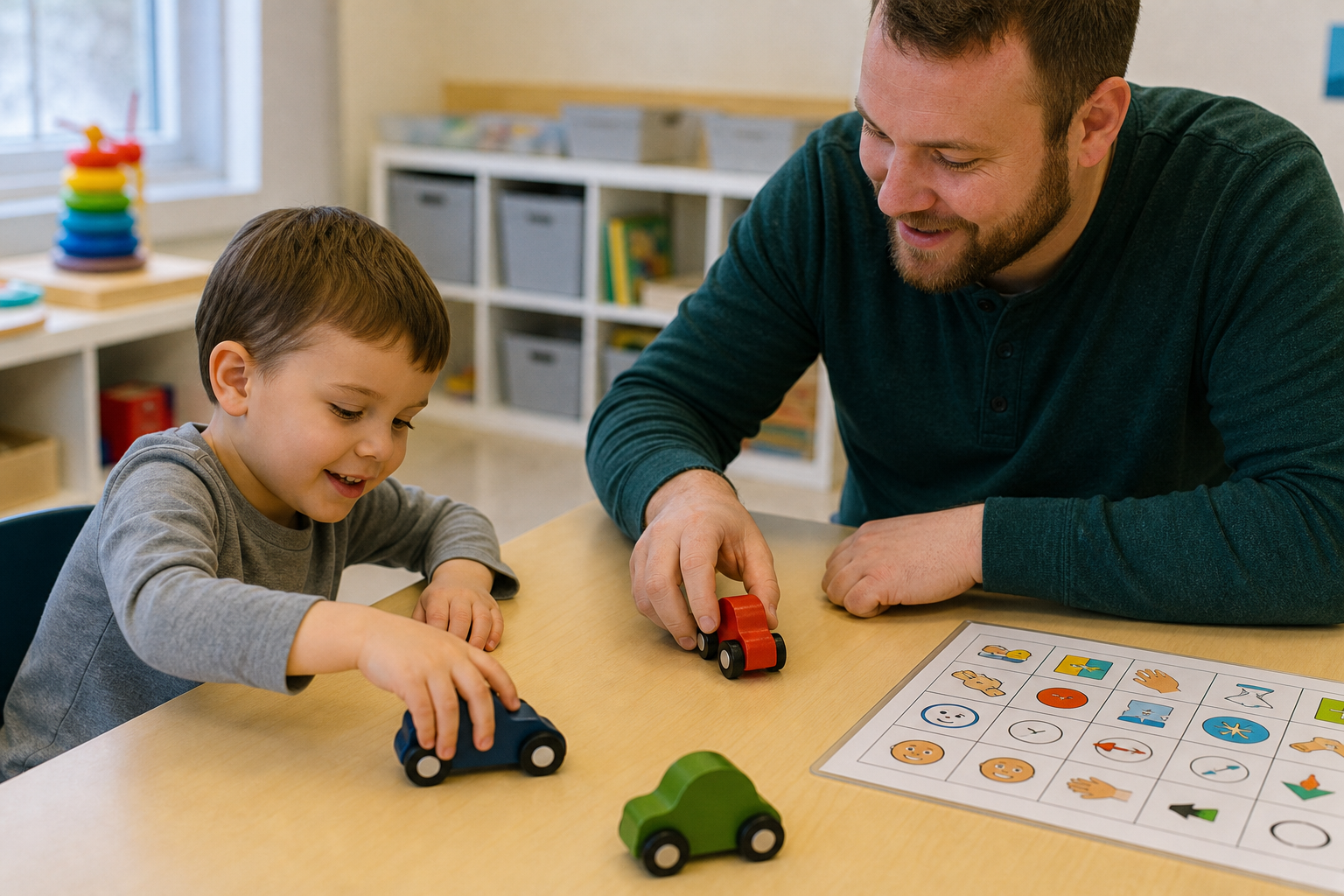
Child-led play gives core words many natural chances to appear.
Planning Core Words Across the Year
A simple plan keeps everyone on the same word. Many teams use a Core Word of the Week. A calendar makes that easy to share. See how to plan core words all year with a calendar.
The Core Stories Foundational 53-Pack on Teachers Pay Teachers (TPT) pairs 53 Core Stories with a suggested weekly sequence. It is a flexible planning aid, not a complete individualized program. Check the current TPT listing for included files and licensing before sharing materials with staff.
When to Add More Core Words
Adding words does not need to wait for "mastery." Keep the child's full vocabulary available, and focus your modeling on a few words at a time. Signs a team may be ready to model new words include:
- The child uses current words in several settings.
- The child reaches for words that are not available yet.
- The child starts combining words.
- A new routine, class, or setting brings new needs.
A quick weekly check helps. Note what the child tried to say, then adjust your next target word. Your SLP can guide these decisions.
Sharing Tools With Staff and Families
Consistency across settings helps a word feel useful. Share one word at a time, with a few example phrases and moments to try them. In addition, a short tip sheet keeps the message clear. Core vocabulary tip sheets are a simple way to support carryover without long trainings.
Respecting Every Communication Mode
Good tools invite participation; they never demand it. Do not force a child to speak or require repetition. Keep the child's full AAC vocabulary available at all times. Speech, gestures, symbols, and devices all count as communication.
These resources provide educational support and do not replace individualized assessment, clinical judgment, or speech-language therapy. An SLP should select speech targets and cues for each child.
Where Little Speech Corner Fits
Little Speech Corner creates downloadable, story-based resources for SLPs, special educators, and classroom teams supporting children ages 2–7. Gwen Swire, M.A., CCC-SLP, known as Mrs. Gwen, has more than 20 years of SLP experience. Her background shapes the materials, though it is not an endorsement or validation of any specific outcome.
Available resources include individual Core Stories, the Foundational 53-Pack, Sound Stories, Team Supports, and free samples such as the THERE Core Story. Purchases and downloads happen through the TPT store. You can preview a sample first and see whether the style suits your learners. Storytime Stories and Story Builders are still in development.
For background on AAC, the American Speech-Language-Hearing Association's AAC overview is a helpful starting point.
Frequently Asked Questions
What are core vocabulary teaching tools for special educators?
They are materials that help adults model common, flexible words across activities. Examples include short stories, tip sheets, visual supports, and planning calendars.
What is core vocabulary?
Core vocabulary is the small set of words people use most often, such as go, more, stop, and help. These words work across many topics and settings.
What is AAC?
Augmentative and alternative communication (AAC) includes any method that supports or replaces speech. Picture symbols, communication boards, and speech-generating devices are common examples.
How many core words should I teach at once?
Many teams focus on one word at a time, such as a Core Word of the Week. The right pace depends on the learner and should be guided by the SLP.
Why use stories to teach core words?
Stories give adults a predictable, engaging context to repeat a word naturally. Shared reading also invites pointing, looking, and joint attention.
How long should a core vocabulary activity take?
A short story routine can take about five minutes, followed by play. Five minutes is a planning guide, not a promised outcome.
Do children have to repeat the word?
No. Modeling invites participation without requiring repetition. Children may respond with speech, gestures, symbols, or a device.
How do I involve classroom staff and families?
Share one word at a time with a tip sheet and a few example phrases. Consistent modeling across settings helps the word feel useful.
Are story-based tools better than worksheets?
They serve different purposes. Stories and play offer natural context for modeling, while worksheets may suit other goals. Choose what fits the learner.
Can these tools replace speech therapy?
No. Educational resources support learning but do not replace individualized assessment, clinical judgment, or speech-language therapy. An SLP should select speech targets and cues for each child.
What common mistakes should I avoid?
Avoid pressuring a child to speak or limiting access to the full AAC vocabulary. Also avoid quizzing, switching words too quickly, or adding words without modeling them.
Where can I find free core vocabulary samples?
Little Speech Corner offers free samples, including a THERE Core Story, through its TPT store. Check the listing for current details.
Conclusion
The best core vocabulary teaching tools for special educators are simple, flexible, and easy to share. Pick one word, read a short story, model with the child's supports, and follow their lead in play. Keep every communication mode open, and let your SLP guide targets. When you are ready, try a free sample from Little Speech Corner and see how the routine fits your classroom.
