
Core Word of the Week Books: A Weekly Planning Guide
Core word of the week books help SLPs and teachers build AAC and language skills through weekly themes and repetition. See how to plan yours today.
Core word of the week books give speech-language pathologists (SLPs) and early childhood teachers a simple, repeatable structure for teaching the small set of high-frequency words that make up most of what young children say. Rather than introducing a brand-new theme every day, this weekly approach lets children hear, see, and practice one core word, such as "go," "more," or "stop," across multiple stories, routines, and activities. For teams supporting children ages 2 to 7, including those who use augmentative and alternative communication (AAC), this rotation builds the kind of deep, functional vocabulary knowledge that one-off lessons rarely achieve.
Throughout this guide, you will find a practical breakdown of what these books are, why the weekly format works, and how to build a planning calendar your team can actually stick to. Along the way, you will also find links to related core vocabulary guide resources for deeper reading.
What Are Core Word of the Week Books?
Core word of the week books are storybooks or book-based activity sets organized around a single core vocabulary word, used repeatedly across a five-day or weekly cycle. Each book pairs the target word with predictable story lines, modeling opportunities, and play-based extensions so children encounter the same word in varied, meaningful contexts. As a result, this repetition supports generalization, which is the ability to use a word across different settings instead of only inside one lesson.
Core vocabulary itself refers to a small bank of high-frequency words, like "want," "look," and "stop," that people use across nearly every conversation, regardless of topic. According to core vocabulary research widely cited in AAC literature and summarized by the American Speech-Language-Hearing Association (ASHA), a core set of roughly 300 to 400 words accounts for nearly 80 percent of what most speakers say in everyday conversation. Consequently, teaching these words deeply, rather than teaching hundreds of topic-specific "fringe" words shallowly, tends to produce more functional communication gains.
Direct answer: Core word of the week books are weekly-themed storybooks that repeat one high-frequency core word across a five-day cycle, giving children, including AAC users, enough exposure and practice to actually use the word on their own.
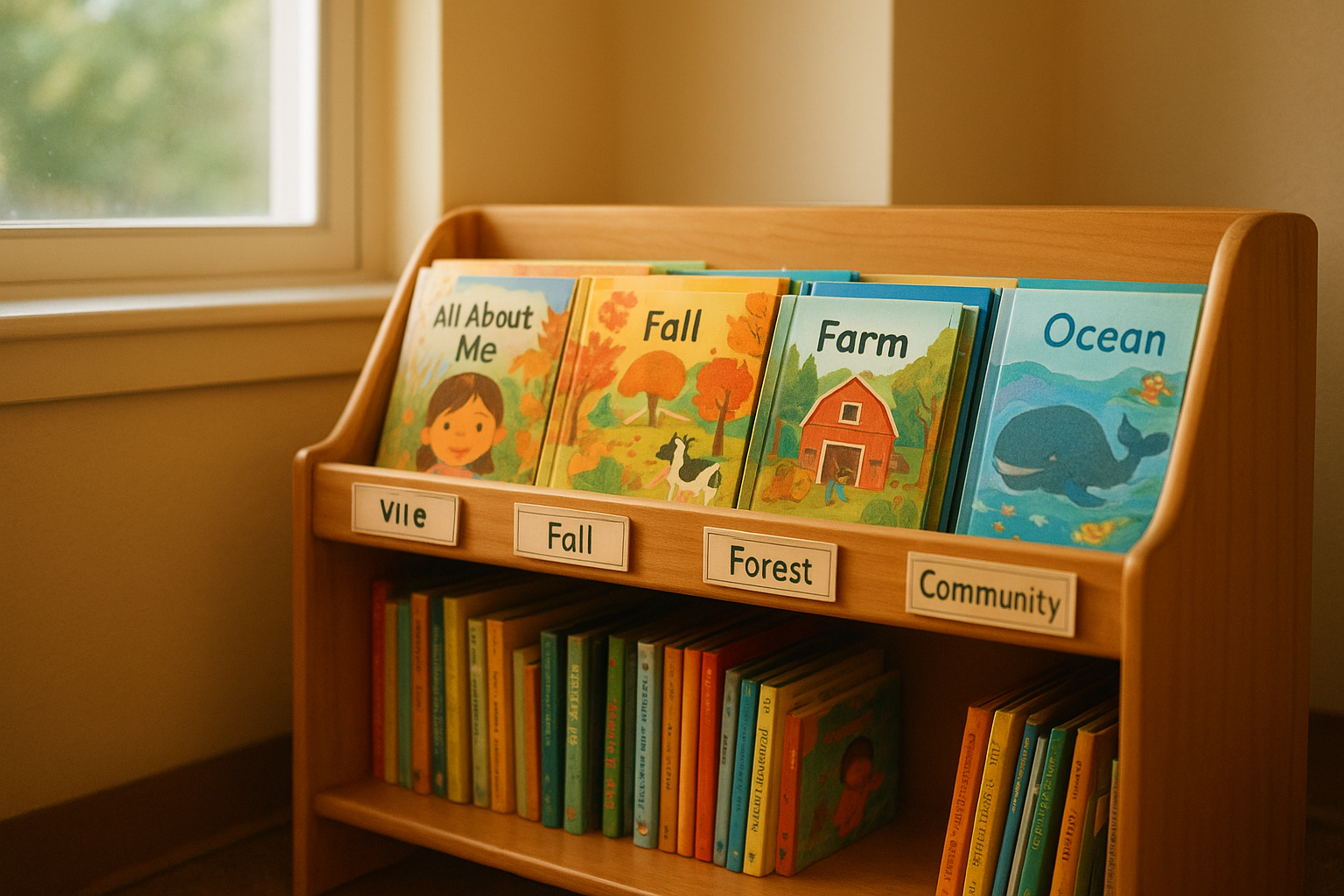
A simple rotating shelf makes it easy to introduce a new core word each week.
Why a Weekly Core Vocabulary Rotation Builds Stronger Communication Skills
Unlike daily theme changes, a weekly core vocabulary rotation gives children enough repeated exposure to move a word from recognition into independent use. In particular, young children and AAC learners typically need many meaningful exposures to a word before it becomes part of their spontaneous communication. A five-day cycle allows that repetition to happen naturally through stories, songs, play, and transitions, rather than through isolated drill.
Furthermore, because the same word reappears in slightly different sentences each day, children practice flexible use rather than memorizing a single phrase. For example, "go" might appear in "the dog will go," "I want to go," and "go fast" within one story cycle. As a result, children build a more generalized, usable understanding of the word rather than a single rote script.
This approach also supports classroom teams working alongside private-practice SLPs, since everyone can reference the same weekly word during circle time, centers, and transitions. In addition, caregivers benefit from a predictable schedule they can follow at home without needing to track multiple shifting themes.
How to Choose the Right Core Word Books for Your Caseload
Selecting the right core word books starts with matching the word to real, functional communication needs rather than an arbitrary list. Specifically, look for words already present on a child's AAC communication board or words that come up often during daily routines, such as "help," "in," or "all done." Prioritizing these words first increases the odds that practice will carry over into real life quickly.
Next, consider the story format itself. A strong core word book repeats the target word on nearly every page, uses predictable sentence patterns, and includes simple, clear illustrations that support comprehension without overwhelming detail. Books designed specifically for this purpose, such as Little Speech Corner's Core Stories, follow a "Read, Model, Play" structure that pairs the story with built-in modeling cues and extension activities.
For a deeper breakdown of book features to look for, this guide to core vocabulary books walks through specific criteria SLPs and teachers can use when evaluating new materials.
Building a Core-Word Weekly Planning Calendar
A core-word weekly planning calendar simply maps out which word a classroom or caseload will focus on each week across a term or school year. Typically, teams schedule 20 to 36 words across an academic calendar, leaving room to revisit high-priority words later for additional reinforcement. Mapping this out in advance prevents last-minute scrambling and keeps every adult, from the SLP to the classroom teacher to the parent, on the same page.
When building the calendar, it helps to group related words loosely by season or classroom theme without forcing an exact match every week. For instance, words like "cold" and "more" might pair naturally with winter activities, while words like "go" and "stop" fit well alongside movement-based units. Still, the core word always takes priority over the theme, since functional communication value matters more than topical relevance.
How to Set Up a Core Word of the Week System in 6 Steps
Setting up a sustainable core word of the week system does not require a complicated overhaul of an existing schedule. Instead, follow these six steps to build a routine your team can maintain all year.
- Select a target word. Choose one core word for the week based on IEP goals, classroom themes, or priority words on a child's AAC communication board.
- Choose a matching book. Gather or select a core word book that features the target word prominently and repeatedly throughout a predictable, easy-to-follow story line.
- Model the word aloud. Model the word using aided language input, such as pointing to it on an AAC device or visual, while reading the story at least once daily.
- Extend into play. Carry the word into play-based activities like sensory bins, art projects, or movement games so children practice it outside the pages of the book.
- Send a home tip sheet. Share a simple core-word tip sheet with caregivers so they can model the same word during daily routines like meals, bath time, or play at home.
- Review and rotate. Review each child's progress with the word at the end of the week, document spontaneous uses, and rotate to a new core word for the following week.
For additional ready-made activity ideas that pair naturally with each step, these story-based speech therapy activities for ages 2 to 7 offer a useful starting point.
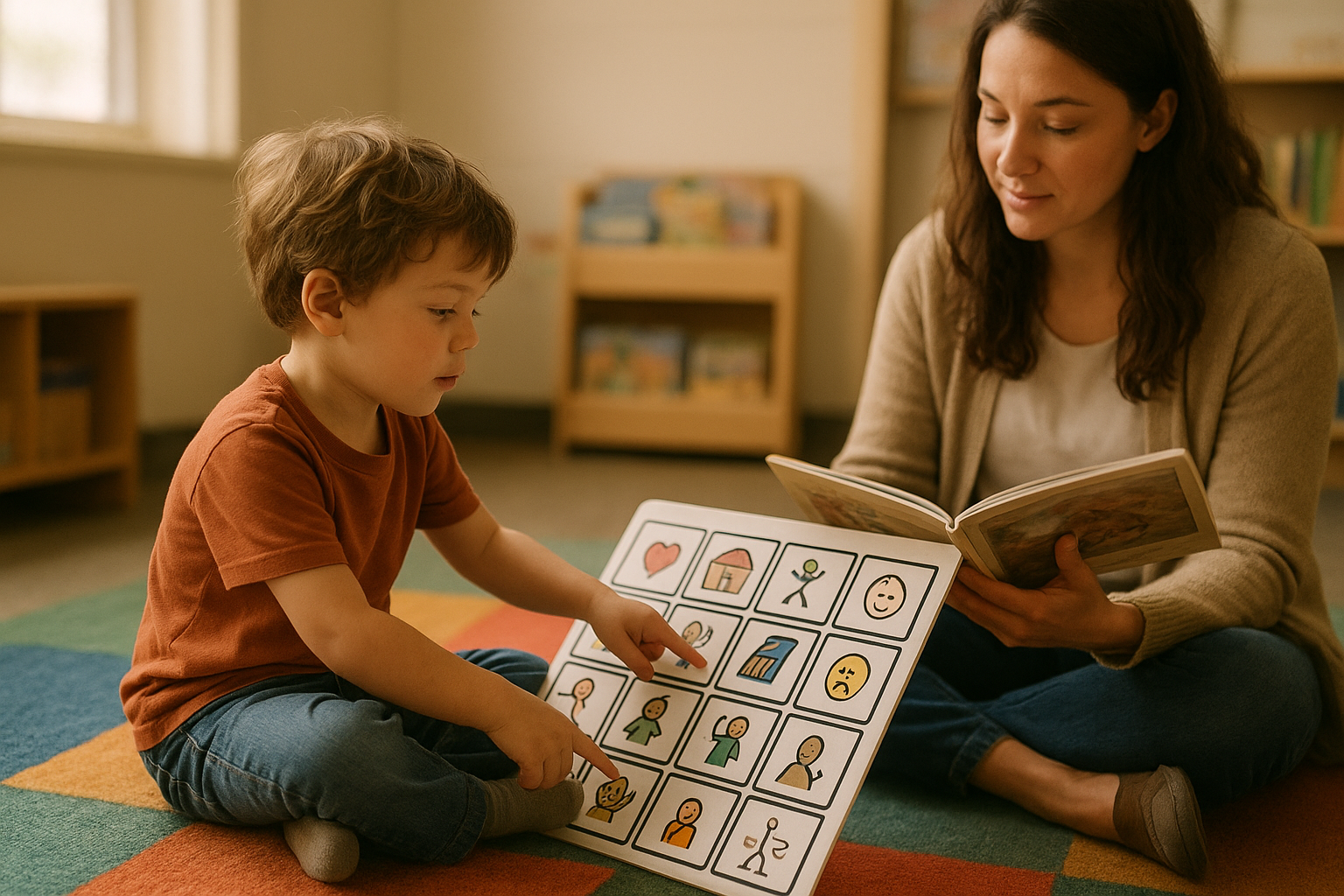
Pairing core word of the week books with AAC modeling helps children connect the printed word to their own communication system.
Sample Weekly Schedule Using Core Word Books
A typical five-day schedule might look like this:
- Monday: Introduce the word and read the core word book together as a whole group.
- Tuesday: Re-read the book, pausing to model the word with AAC or gestures on each page.
- Wednesday: Extend the word into a hands-on center or play-based activity.
- Thursday: Practice the word in small groups or individual therapy sessions.
- Friday: Review progress, send the tip sheet home, and preview next week's word.
Core Word Books vs. Traditional Vocabulary Themes
Traditional vocabulary books often introduce a cluster of new nouns tied to a single topic, such as farm animals or seasons, without built-in repetition of any one word. While this approach can build topic knowledge, it rarely gives children enough practice with any single word to use it functionally across settings.
In contrast, core word books repeat one functional, high-frequency word throughout the story in multiple sentence contexts. Therefore, instead of learning twenty topic-specific nouns shallowly, children learn one flexible, everyday word deeply enough to use it on their own. According to early literacy research summarized by Reading Rockets, repeated readings of the same text support both vocabulary retention and comprehension, which reinforces why the weekly repetition model tends to outperform constantly shifting themes for language-building goals.
Common Mistakes to Avoid When Starting a Core Word Program
One common mistake is rotating words too quickly, before children have had enough repeated exposure to generalize them into spontaneous use. Similarly, some teams focus only on isolated drill practice instead of embedding the word into stories, play, and daily routines, which limits carryover.
Another frequent issue is forgetting to loop caregivers in on the weekly word, which breaks the home-school consistency that drives faster progress. Finally, teams sometimes skip documenting spontaneous word use, making it harder to know when a child is ready to move on to a new word.
Understanding typical language development timelines can also help teams set realistic expectations. The CDC's early childhood developmental milestones offer a useful reference point for when certain communication skills typically emerge, which can inform how quickly a program rotates words for a given age group.
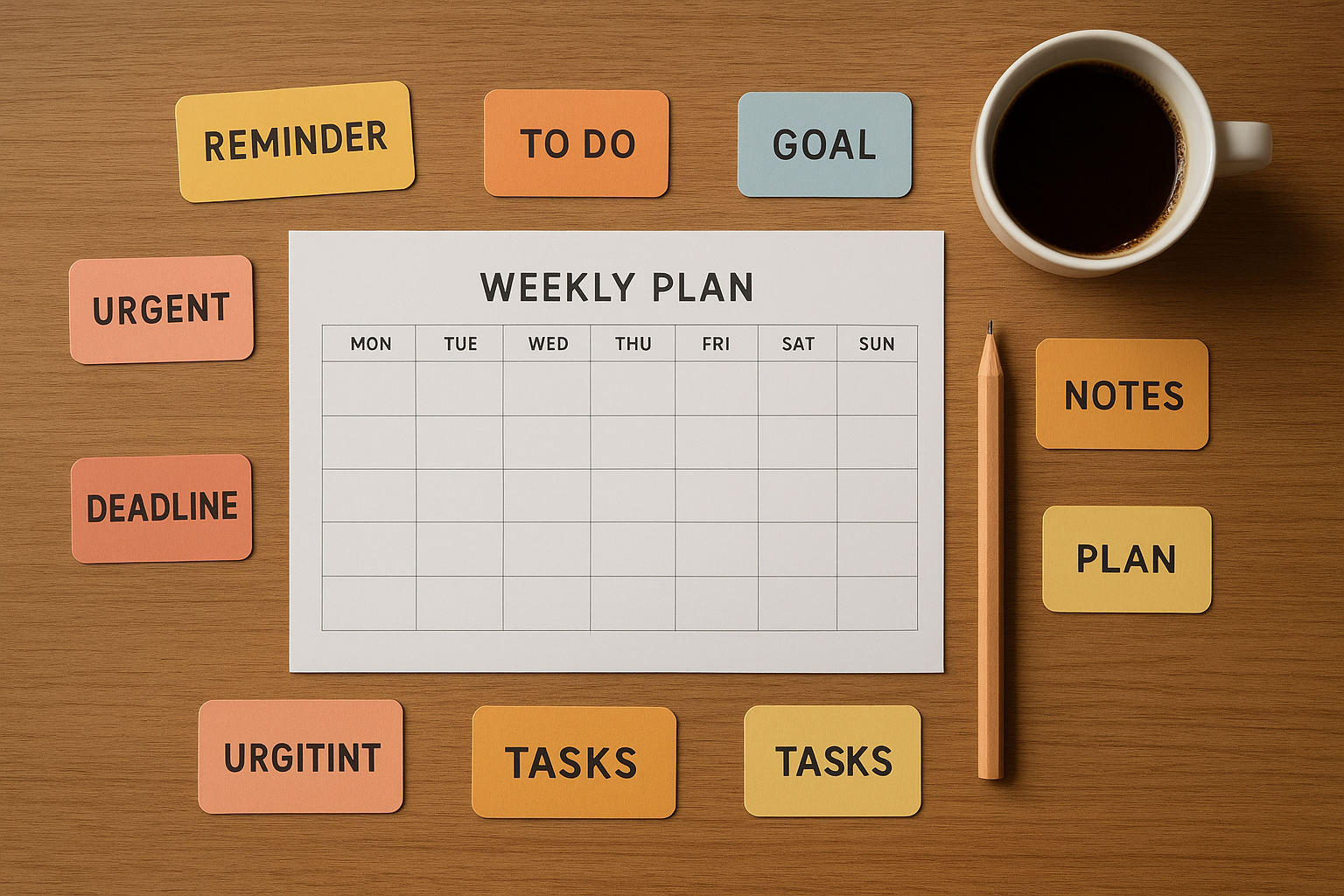
A simple planning calendar keeps core word of the week books organized across the school year.
Frequently Asked Questions
What exactly are core word of the week books?
Core word of the week books are storybooks built around one high-frequency core word that children see, hear, and practice repeatedly across a five-day cycle. The repeated exposure helps children generalize the word into their own spoken or AAC-based communication.
How do core word books support AAC users?
Core word books give AAC users repeated, predictable chances to see a word modeled on a communication board or device during a familiar story. This repetition builds the motor planning and recognition needed for spontaneous use.
Why use a weekly rotation instead of daily themes?
A weekly rotation gives children enough repeated exposure to actually learn and generalize a word, whereas daily theme changes rarely allow mastery. Most children need multiple meaningful exposures before a new word becomes usable.
How many core words should a caseload cover in a year?
Many SLPs rotate through 20 to 36 core words across a school year, often covering one word per week during the academic calendar. The exact number depends on student goals, session frequency, and whether words are revisited later.
What is the difference between core words and fringe words?
Core words are the small set of high-frequency words, like go, more, stop, and help, that appear across almost every conversation and setting. Fringe words are topic-specific, like dinosaur or birthday, and are used far less often outside their particular context.
How much do core word of the week book sets typically cost?
Digital core word book bundles sold through platforms like Teachers Pay Teachers typically range from a few dollars for a single story to larger bundle pricing for a full-year set covering dozens of core words. Bundled packs often cost less per word than purchasing stories individually.
How long does it take to see progress with a core word program?
Many teams notice increased spontaneous use of a target word within two to four weeks of consistent modeling across home and school settings. Progress varies by child, communication method, and how often the word is practiced outside formal sessions.
What common mistakes should teams avoid when starting a core word of the week program?
A common mistake is rotating words too quickly before children have had enough repeated exposure to generalize them. Another is focusing only on isolated drill instead of embedding the word into stories, play, and daily routines.
What age group benefits most from core word of the week books?
Children ages 2 to 7, including early AAC users and children with developmental language delays, tend to benefit most from this structured, repetitive approach. This age range aligns with the period when foundational core vocabulary skills are typically established.
Can parents use core word of the week books at home?
Yes, many core word programs include a simple tip sheet so caregivers can reinforce the same word during daily routines like mealtime, bath time, or play. This home-school alignment is one of the strongest predictors of carryover success.
What are some good first core words to teach?
Strong starting words include go, stop, more, help, in, out, and all done because they are usable across nearly every activity and setting. These words also tend to appear early in typical language development.
How do core word books differ from traditional vocabulary books?
Traditional vocabulary books often introduce many new nouns tied to a single theme, like farm animals or seasons, without built-in repetition. Core word books instead repeat one functional word throughout the story so children can practice it in multiple sentence contexts.
What best practices improve carryover of core words across settings?
Pairing the weekly book with play-based activities, visual supports, and a caregiver tip sheet gives children more natural opportunities to use the word outside the therapy room. Consistent modeling by every adult in a child's day also strengthens carryover significantly. For more AAC-focused planning resources, see these core vocabulary teaching materials for AAC.
Bringing It All Together
Ultimately, core word of the week books work because they slow down vocabulary instruction just enough for children to truly absorb and reuse each word. By choosing a word based on real communication needs, pairing it with a predictable story, and extending it through play and home practice, SLPs and teachers give children the repetition that generalization requires. As a result, this structure benefits a wide range of learners, from early AAC users to typically developing preschoolers building their first sentences.
If you are ready to build your own rotation, start small with a handful of high-priority words before mapping out a full-year calendar. For additional free samples and planning tools, visit Little Speech Corner's resource library to explore Core Stories built specifically around this weekly, repetition-based model.