
Play-Based AAC Intervention Materials: A Practical Guide
Learn how to choose and use play-based AAC intervention materials that support core vocabulary modeling. Explore practical tips and try a free sample.

Play-based AAC intervention materials are resources that help adults model augmentative and alternative communication (AAC) inside shared stories and child-led play. AAC includes picture boards, symbol books, and speech-generating devices that give children another way to communicate. This guide shows SLPs, educators, and families how to choose these materials and use them with warmth and flexibility.
Quick answer: Good play-based AAC materials pair a short story with core-word modeling and open-ended play. The adult models; the child leads and may respond in any mode.
Shared stories and play give adults natural moments to model AAC, using play-based AAC intervention materials.
What Are Play-Based AAC Intervention Materials?
They are stories, activity ideas, and planning tools built around play. Instead of drills, the adult models words on the child's AAC system while the two enjoy a book or toys together.
The focus is on core vocabulary: common words such as go, more, up, and there that work across many settings. Because these words appear everywhere, they fit naturally into play.
Why Play Works for Early Communicators
Play gives children a reason to communicate. Moreover, it removes the pressure of performing on demand. As a result, adults can model language many times in a relaxed way.
The American Speech-Language-Hearing Association (ASHA) describes AAC as an approach that can support communication for people with many different needs. Play simply offers a friendly place to use it. For more preschool-friendly ideas, see these AAC activities for preschool.
What to Look for in Materials
Not every resource fits every learner. Therefore, check a few features before you choose.
- Core-word focus: one clear word per story or activity.
- Short reading time: a story that fits a busy day.
- Flexible modeling: works with low-tech boards, symbol books, or devices.
- No required responses: the child is never forced to speak or repeat.
- Team supports: tip sheets so school and home can use the same words.
For a deeper look at printable options, read about core vocabulary printables for AAC classroom use.
The Read, Model, Play Approach
Mrs. Gwen (Gwen Swire, M.A., CCC-SLP) designed Little Speech Corner resources around Read, Model, Play. A short Core Story takes about five minutes to share. Then the adult models the core word and moves into child-led play. The five minutes is a practical planning guide, not a promised outcome.
Individual Core Stories, the Core Stories Foundational 53-Pack, and a Core Word of the Week sequence are available through the Little Speech Corner Teachers Pay Teachers store. Please confirm current listing details, including formats and licensing, before you buy or share files with a team.
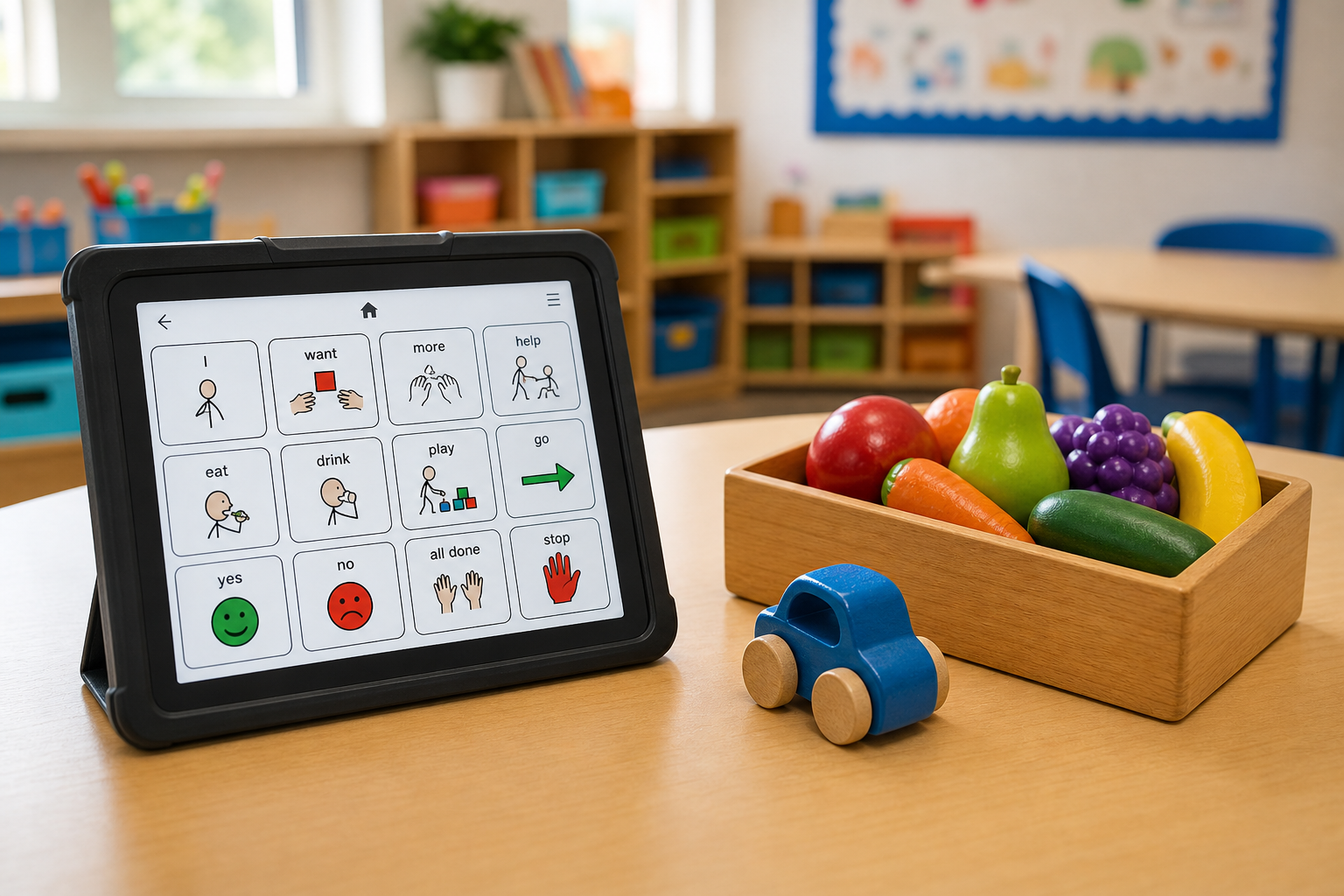
Toys, books, and an AAC system within easy reach make modeling feel natural.
How to Use Play-Based AAC Materials Step by Step
- Pick one core word that fits the learner and the materials. An SLP should select targets for each child.
- Set up the child's full AAC system within reach, with the word easy to find.
- Share the short story and point to the core word as it appears. Do not ask for repetition.
- Move into child-led play and model the word at natural moments.
- Pass the word and one modeling idea to teachers and caregivers for carryover.
Modeling Examples During Play
Specific examples make modeling easier. For instance, during a block tower you might model up as the tower grows. Similarly, when a toy car rolls away, you can model go or stop.
Keep the child's full vocabulary available at all times. In addition, accept every communication mode, including gestures, sounds, symbols, and speech. If you want more ideas, explore these AAC core vocabulary activities for early communicators.
Carryover at School and Home
Words become useful when many people model them. Core Word Tip Sheets and a planning calendar help classroom teams and families focus on the same vocabulary. Consequently, the child hears and sees that word in more places.
If you are comparing options, this overview of story-based speech resources for young children may help. You can also review core vocabulary teaching materials for AAC.
Please note: These resources provide educational support and do not replace individualized assessment, clinical judgment, or speech-language therapy. An SLP should select speech targets and cues for each child.
Frequently Asked Questions
What are play-based AAC intervention materials?
Play-based AAC intervention materials are resources that support augmentative and alternative communication within play and shared stories. They help adults model vocabulary while the child leads the interaction.
What does AAC stand for?
AAC stands for augmentative and alternative communication. It includes tools and strategies such as picture boards, symbols, and speech-generating devices that support communication.
Why use play for AAC intervention?
Play gives children a motivating, low-pressure reason to communicate. It also offers many natural chances for adults to model words.
What is aided language modeling?
Aided language modeling is when an adult points to or selects symbols on the child's AAC system while speaking. The child sees how the system is used in real moments.
What are core words?
Core words are common, flexible words such as go, more, up, and there. They are used across many activities and settings.
Do children have to repeat the words I model?
No. Modeling does not require repetition or a response. Children can respond in any communication mode they choose.
How long should a story-and-play session last?
Many adults begin with a short story of about five minutes, then continue into play for as long as the child is engaged. Five minutes is a planning guide, not a promised outcome.
What ages are these materials for?
Little Speech Corner designs its story-based resources mainly for young communicators ages 2 to 7. An SLP can help decide whether a resource fits a particular learner.
Can I use these materials at home?
Yes, many families use shared stories and play for carryover. It helps to coordinate with the child's SLP about words and supports.
How do I choose a core word to start with?
Choose a versatile word that fits the child's interests and current AAC system. An SLP can guide the selection for each child.
Do these materials replace speech therapy?
No. They provide educational support and do not replace individualized assessment, clinical judgment, or speech-language therapy.
Where can I try a free sample?
Free samples, including a THERE Core Story, are available through the Little Speech Corner Teachers Pay Teachers store. Check the listing for current details.
What mistakes should I avoid with AAC play?
Common mistakes include quizzing the child, limiting access to the full AAC vocabulary, and taking over the play. Following the child's lead works better.
Conclusion
Play-based AAC intervention materials work best when they keep things simple: one core word, a short shared story, the child's full AAC system within reach, and plenty of child-led play. Adults model, children choose how to respond, and teams share the same words across settings. When you are ready, preview a free sample on Little Speech Corner and see whether the Read, Model, Play approach fits your learners.
