
AAC Shared Reading Activities: Tips for SLPs & Teachers
Explore AAC shared reading activities that build core vocabulary and engagement, with practical tips, book picks, and free tools for SLPs and teachers.

AAC shared reading activities pair picture books with augmentative and alternative communication (AAC) — tools and strategies that give a voice to children with limited or unclear speech — so that storytime becomes a two-way conversation instead of a one-way read-aloud. For speech-language pathologists (SLPs), early childhood teachers, and caregivers of children ages 2 to 7, this simple pairing of a book and a communication device or core-word board turns ordinary story time into one of the richest language and literacy opportunities available. Whether a child uses a speech-generating device, a paper-based core board, or picture symbols, AAC shared reading activities give every learner a real way to participate in the story rather than just listen to it.
Quick answer: AAC shared reading activities are storytime routines in which an adult models core vocabulary on a child's AAC system while reading a book, pausing often so the child can comment, request, protest, or answer using the same words. Unlike a typical read-aloud, the goal is not to finish the text — it is to build the child's expressive language, early literacy skills, and confidence one page at a time.
What Are AAC Shared Reading Activities?
AAC shared reading activities are, at their core, a way of reading books together that gives every child a voice, regardless of how clearly they speak. According to Wikipedia's overview of augmentative and alternative communication, AAC covers everything from simple picture boards to sophisticated speech-generating devices, and shared reading is one of the most natural settings in which to use any of them. Instead of the adult reading straight through the text, the adult models language on the child's AAC system, points to symbols, and leaves space for the child to respond.
In practice, this might look like a teacher tapping "go" on a tablet-based AAC app every time a character runs, or a parent pointing to "more" on a paper core board when a child wants another page. As a result, the book becomes less about listening and more about doing — requesting, commenting, and answering together. This is also exactly why AAC shared reading activities sit at the center of any serious literacy plan for a child with complex communication needs.
AAC shared reading activities let children use core vocabulary symbols while a story unfolds.
Where AAC Shared Reading Fits Into a Full Literacy Plan
Shared reading is powerful, but it works best as one piece of a bigger picture. Comprehensive literacy instruction for AAC learners generally includes four connected components working together: shared reading, independent reading or book exploration, structured writing, and word study or phonological awareness. In other words, a child does not just need someone to read to them — they also need chances to "read" a familiar book on their own, to compose simple messages, and to notice sounds and letters.
Specifically, each piece reinforces the others. For example, a core word modeled during shared reading can reappear during independent book exploration, then show up again when the child composes a short message with their AAC system, and finally get connected to its first letter during a brief word-study moment. Consequently, AAC shared reading activities should rarely stand completely alone; instead, think of them as the anchor around which the other three components rotate throughout the week.
In contrast, programs that treat shared reading as an isolated activity — read once, move on — tend to see slower vocabulary growth, because the child never gets a second or third exposure to the same words in a new context. Above all, repetition across multiple literacy activities, not just multiple reads of one book, is what moves a word from "recognized" to "used independently."
Emergent Literacy vs. Conventional Literacy for AAC Learners
It helps to separate two stages of literacy development. Emergent literacy describes the early behaviors that come before conventional reading and writing — things like holding a book right-side up, "pretend reading" familiar pages from memory, recognizing environmental print, and associating pictures with words. According to Wikipedia's overview of emergent literacy, these behaviors typically develop well before a child can decode text independently, and they are just as achievable for AAC users as for speaking peers, provided they get enough exposure.
Conventional literacy, meanwhile, refers to the more traditional skills of decoding words, reading fluently, and writing original sentences. Many children who use AAC are fully capable of reaching conventional literacy; however, they often need more structured, more frequent practice to get there, since they cannot casually "sound things out loud" the way a speaking child might while playing. Therefore, AAC shared reading activities that deliberately build both emergent skills (prediction, picture-word association, story structure) and the groundwork for conventional skills (letter sounds, print awareness) give a child the strongest possible foundation.
Why Shared Reading With AAC Supports Language and Literacy Growth
Shared reading with AAC works because it repeats a small set of words in a meaningful, predictable context, which is exactly how young children learn language naturally. The American Speech-Language-Hearing Association (ASHA) notes that AAC supports millions of children and adults who have complex communication needs, and consistent, repeated modeling is a key part of building their expressive language. In addition, early literacy research has long pointed to the importance of language exposure: one frequently cited estimate from Hart and Risley's 1995 study found that children from lower-language-input homes could hear as many as 30 million fewer words by age three than their peers.
For a child who relies on AAC, that gap can be even wider without deliberate modeling, since spoken language alone does not show them how to use their own system. Therefore, pairing storytime with intentional AAC modeling helps close that gap by giving the child hundreds of repeated exposures to the same core words across many books and many days. Above all, shared reading also builds joint attention, turn-taking, and social connection — skills that carry over directly into everyday conversation. If you want a deeper look at how these routines connect to broader communication goals, Little Speech Corner's AAC resource hub offers additional strategies and tools.
Furthermore, shared reading supports literacy specifically, not just spoken communication. A child who regularly sees core words modeled on both a book page and an AAC system starts to connect the symbol, the spoken word, and the printed word all at once. Similarly, this triple exposure — symbol, speech, print — is one reason researchers in augmentative communication consistently recommend shared reading as a cornerstone activity rather than an occasional treat.
How to Plan an AAC Shared Reading Session (Step-by-Step)
Planning a session does not need to be complicated. In fact, a short, well-prepared routine often works better than a long, unstructured one. Here is a simple process many SLPs and teachers follow:
- Pick a predictable, core-vocabulary-rich book. Choose a repetitive picture book with simple, repeated language so the child can predict what happens next and reuse the same core words across multiple pages.
- Prepare the AAC system before reading. Highlight or bookmark the core words you plan to model, such as go, look, more, and stop, so you can find them quickly while reading aloud.
- Model language without demanding a response. Use aided language input by pointing to or activating words on the AAC system as you narrate, showing the child how it works without requiring an answer.
- Pause and wait for the child to take a turn. Stop at predictable moments and wait several seconds, giving the child time to comment, request, or protest before you continue reading.
- Repeat the same story across several sessions. Read the same book multiple times over the week so familiarity with the story and vocabulary helps new words become automatic faster.
- Bridge the book to independent reading and writing time. Set out the same book during free-choice time and invite the child to retell it on their AAC system, then let them compose one short message about it in a writing activity.
For more structured session ideas that pair well with this process, our guide to story-based speech therapy activities for ages 2 to 7 walks through additional planning tips for this age range.
Choosing the Best Books for AAC-Supported Storytime
Not every book works equally well for AAC-supported storytime. Books with too much text on each page can overwhelm a beginning communicator, while books with clear, simple illustrations and repeated phrases tend to hold attention longer. Specifically, look for stories built around a handful of core words — go, stop, more, help, look — since these words appear in nearly every context a child will encounter throughout the day.
Board books, wordless picture books, and predictable "pattern" books, where the same sentence structure repeats with small changes, are especially useful. Similarly, seasonal or thematic books can be rotated throughout the year to keep sessions fresh without changing the core vocabulary focus. Little Speech Corner's Storytime Stories collection was designed with exactly this kind of repetition in mind, and the site's guide to core vocabulary books for SLPs and teachers offers a longer list of titles worth trying.
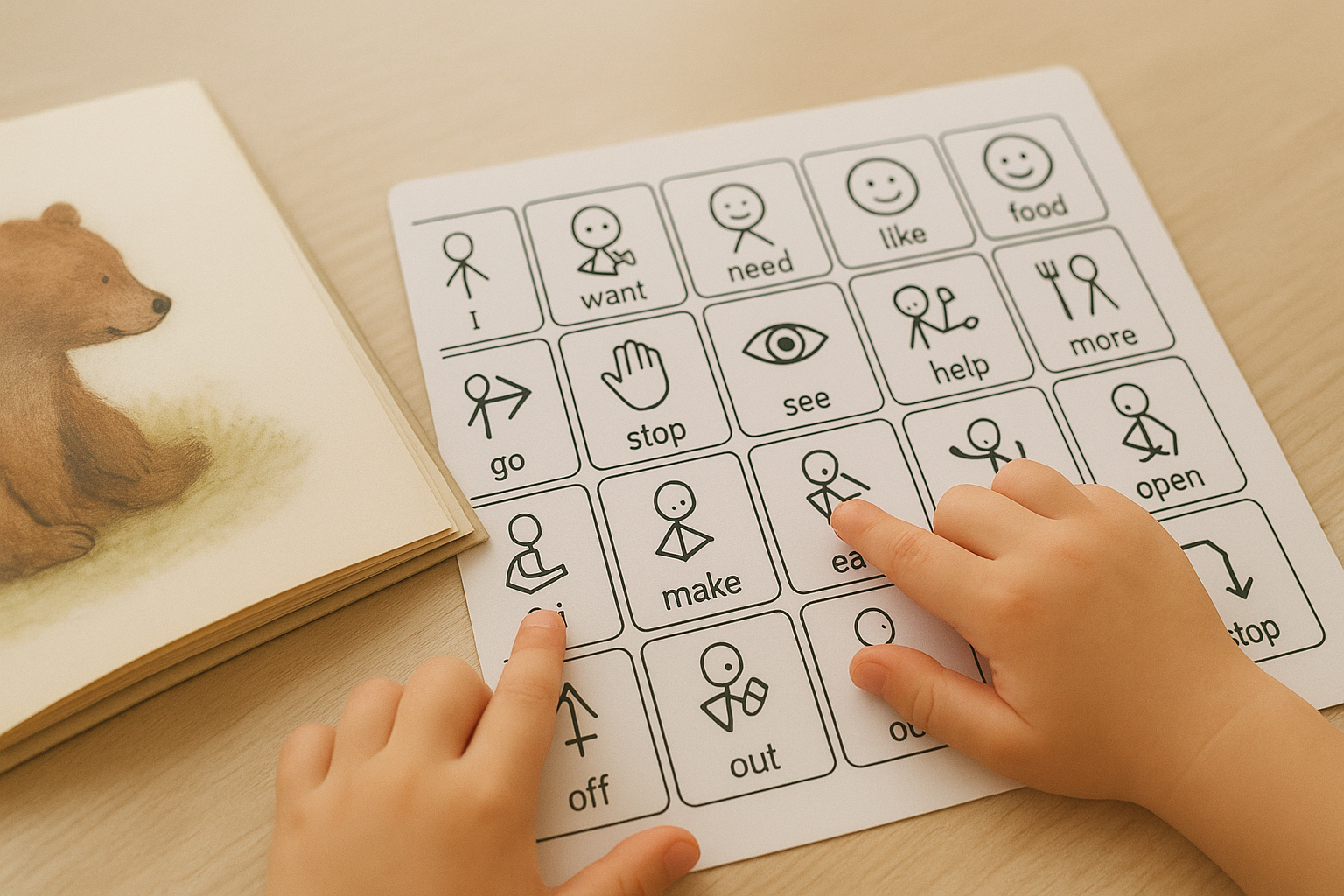
A simple core board next to a favorite storybook is enough to begin AAC shared reading activities.
Building Core Vocabulary Through AAC Storybook Routines
Core vocabulary refers to the small set of high-frequency words — like go, more, help, and stop — that make up the majority of everyday communication across nearly every setting. Because these words appear constantly, they are ideal targets for AAC storybook routines, since a child who masters them can use them far beyond the pages of any single book.
As a result, many SLPs choose a "word of the week" approach, focusing on just one or two core words across several different stories before moving on. This repetition, in particular, helps children generalize a word from one specific story to real-life requests and comments at home or in the classroom. Our detailed SLP guide to teaching core vocabulary through stories breaks this approach down into practical weekly plans, including sample word lists and story pairings that build on each other over time.
Phonological Awareness and Print Concepts During Shared Reading
Many conversations about AAC shared reading activities stop at vocabulary, but print and sound awareness deserve attention too. Phonological awareness — noticing and playing with the sounds inside words, separate from their meaning — is one of the strongest known predictors of later decoding skill. Even brief, playful moments during a shared book can build this skill: pausing to clap the syllables in a character's name, or stretching out the first sound of a repeated word before activating it on the AAC system.
In addition, print concepts matter from the very first reading sessions. Running a finger under the words as you read, pointing out the book's title and cover, and showing that text moves left to right all teach a child how books work before they can read independently. Consequently, a five-minute AAC shared reading session can quietly build four separate skills at once: vocabulary, sentence structure, print awareness, and early phonological awareness — all without turning storytime into a drill.
Supporting Independent Reading and Writing Alongside Shared Reading
Shared reading introduces a book; independent exploration lets a child own it. After several shared readings of the same story, place the book in a reading corner along with the matching core board or AAC page set so the child can "read" it alone, retelling the story from memory and symbol recall. This step matters because it shifts the child from responding to an adult's prompts toward initiating language on their own terms.
Writing belongs in the same rotation. A simple structured writing activity — composing one short sentence about the book using the AAC system, then "writing" it with scribbles, letter approximations, or a keyboard — connects spoken and symbolic language to print in a way that pure reading cannot. Therefore, a complete weekly plan around one storybook might include a shared reading session, a few minutes of independent book exploration, one short writing activity, and a brief word-study moment focused on a single letter or sound from that week's core word.
Tools and Technology That Make AAC Shared Reading Activities Easier
You do not need expensive equipment to begin. A laminated paper core board, a handful of printable visuals, and any favorite picture book are enough for a first session. However, as routines grow, many classrooms and families add light technology to make sessions smoother: a tablet-based AAC app for consistent access to core words, a page set built specifically around a book's vocabulary, or printable overlays that match a specific story.
Digital story resources can also save preparation time by pairing a book's text with ready-made core vocabulary prompts and visuals, so an adult does not need to build an overlay from scratch for every new title. Regardless of the tools chosen, the underlying principle stays the same: the technology exists to support modeling and turn-taking, not to replace them.
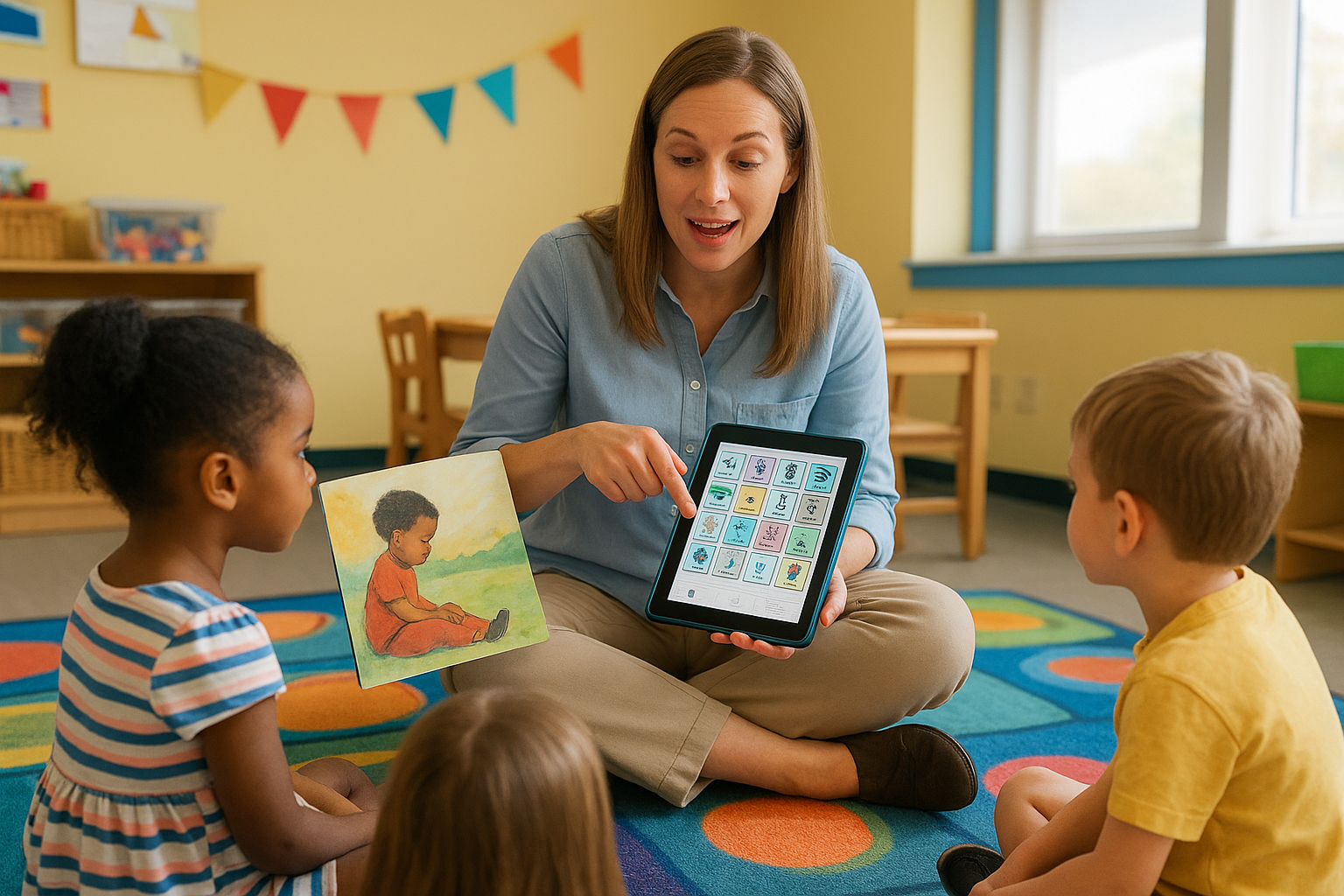
Consistent modeling turns a classroom read-aloud into a genuine AAC shared reading activity.
Common Mistakes to Avoid With AAC and Storytime
Even well-intentioned adults sometimes make a few common mistakes during AAC and storytime sessions. First, talking too much and reading too quickly leaves no real pause for the child to take a turn on the AAC system, which can turn shared reading back into a one-sided read-aloud. Second, introducing too many new core words in a single session can overwhelm a beginning communicator; it is usually better to focus on two or three words per book.
Third, some adults wait for a "perfect" or complete response before acknowledging any attempt, which can discourage a child who is still learning where symbols are located. Instead, honor any attempt — a glance, a reach, or a single button press — as a valid communication turn. Finally, according to guidance from the Centers for Disease Control and Prevention (CDC) on early language milestones, consistency matters more than intensity, so short daily sessions tend to outperform occasional long ones.
Frequently Asked Questions About AAC Shared Reading Activities
What are AAC shared reading activities?
AAC shared reading activities are storytime routines that pair a picture book with an AAC system, such as a speech-generating device or core-word board, so a child can comment, request, and answer questions during the story instead of only listening.
How do you start AAC shared reading with a beginner communicator?
Start by choosing one repetitive, predictable book and modeling just two or three core words on the AAC system as you read, without pressuring the child to respond right away. Over several sessions, gradually add pauses so the child has a chance to take a turn.
Why is shared reading important for AAC users?
Shared reading gives AAC users repeated, natural exposure to core vocabulary in a meaningful context, which supports stronger later language and literacy outcomes. It also builds joint attention and turn-taking skills that transfer to everyday conversation.
What books work best for AAC shared reading activities?
Predictable, repetitive books using simple core vocabulary, such as go, more, stop, and look, tend to work best because they let a child use the same AAC buttons across pages. Board books with clear illustrations also reduce visual clutter.
How is AAC shared reading different from a typical read-aloud?
In a typical read-aloud, the adult usually reads every word start to finish while the child listens. In AAC shared reading, the adult pauses often, models language on the AAC system, and follows the child's lead.
How long should an AAC shared reading session last?
Most sessions work well at five to ten minutes for beginning communicators, since short, frequent sessions hold attention better than one long sitting. As engagement grows, sessions can extend to fifteen minutes or more.
How much does it cost to start AAC shared reading activities?
Getting started can cost very little, since many SLPs and teachers begin with a favorite classroom book and a printable core board. Digital resources, such as Core Stories, add ready-made prompts and visuals for a modest one-time fee.
What is aided language input, and how does it relate to AAC shared reading?
Aided language input is the practice of an adult modeling words on a child's AAC system while speaking, without requiring a response. During AAC shared reading, this modeling shows the child exactly how to talk about the story.
What common mistakes should be avoided during AAC shared reading activities?
A common mistake is talking too much and leaving no pause for the child to take a turn on the AAC system. Another is choosing a book with too much text or too many new core words at once.
How often should AAC shared reading activities happen?
Daily, short sessions tend to build vocabulary and AAC skills faster than occasional long sessions, since repetition helps a child remember where core words are located. Even five minutes at home each day can make a difference.
Can AAC shared reading activities help build core vocabulary skills?
Yes, shared reading is one of the most effective contexts for teaching core vocabulary because the same small set of words can be modeled again and again across different pages and stories. This repeated exposure helps core words become automatic.
What age is appropriate to start AAC shared reading activities?
Children as young as two years old can benefit from AAC shared reading, especially when paired with simple core boards and predictable books. There is no minimum age, since even toddlers can be exposed to aided language input.
Do you need a high-tech AAC device for shared reading activities?
No, a high-tech speech-generating device is not required to start AAC shared reading activities. Many SLPs and teachers begin with printable core boards and introduce more advanced technology later if appropriate.
How does AAC shared reading connect to a full comprehensive literacy plan?
AAC shared reading works best when it is paired with independent book exploration, structured writing, and word study, since each component reinforces the vocabulary and print concepts introduced during the shared book. Treating these as one connected rotation, rather than separate activities, builds stronger long-term literacy skills.
In summary, AAC shared reading activities turn an everyday story into one of the most powerful tools available for building core vocabulary, literacy, connection, and communication confidence. Whether you use a high-tech device or a simple paper core board, the same basic approach works: choose a predictable book, model language generously, weave in independent reading and writing time, and leave plenty of room for the child to take a turn. Consequently, small daily habits — five minutes here, a favorite book there — tend to add up to real, measurable progress over time. For more ready-to-use materials that support this approach, explore Little Speech Corner's library of Core Stories and core-vocabulary resources, built specifically for SLPs, early childhood educators, and families working with children ages 2 to 7.